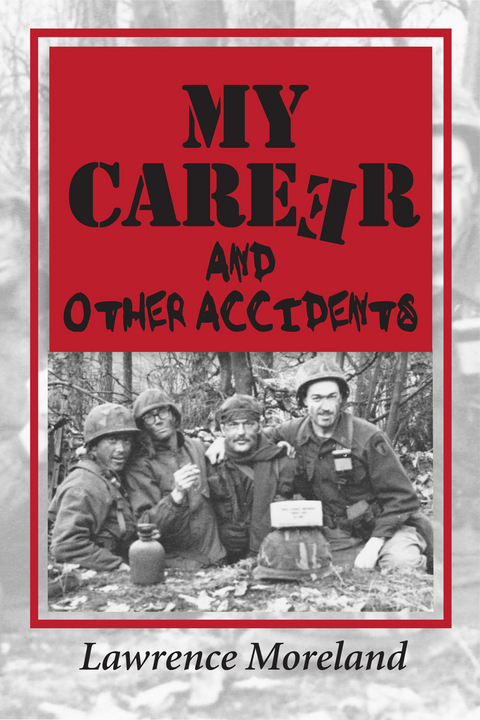
My Career and Other Accidents (eBook)
298 Seiten
Bookbaby (Verlag)
978-1-6678-2380-5 (ISBN)
"e;My Career and Other Accidents"e; is one man's journey as a professional soldier. It was not the path he intended to take, but it would challenge and inspire him for over 30 years. The story starts in his earliest days as his father's coached and prepared him for military service. Over three decades of service are recounted with his successes, follies, and poor decisions laid bare for the reader. Originally written for his grandchildren with a touch of humor, this author's story is worthy of a larger audience. It is a tale from an old Paratrooper' whose boots have seen their fair share of mud and dirt. Proud to have served, but to quote one of his own father's Army Air Corps drinking songs, he is "e;loyal to the outfit, but rotten to the corps."e;For over 12 years the author served in the infantry. The experience shaped his view of the world and forever altered the way he approached problems. He started as a rifleman in an 82nd Airborne Division at Fort Bragg NC, where standards are high and discipline uncompromising. Newlywed, he and his wife traveled to Germany for his first foreign duty assignment. He served as a first-line leader training and leading scouts as a Non-Commission Officer in the Cold Wars' most politically sensitive location, Berlin. Changing career paths, the author left the active Army to pursue an undergraduate degree at Oregon State University. During his years at college, he led a Rifle Platoon in the Oregon National Guard first as an Army ROTC Cadet and then as a Lieutenant. Returning to active duty he completed the Army's Ranger School before serving with the 7th Infantry Division (Light) as a Platoon Leader and junior staff officer. Suffering from a long-term back injury motivated another career change. He transitioned into military logistics as a Transportation Corps junior officer. Serving with numerous active Army and Army Reserve units he refined his skills as a Transporter, Logistician, and Staff Officer. He maintained an infantryman's aggressive disposition for action but employed a logistician's analytics perspective during his five deployments to conflict zones. With the Fort Bragg 1st Corps Support Command, he supported Operations Prime Chance in Bahrain as a staff officer. Within a year he returned to the Middle East as a Company Commander during Operation Desert Storm / Desert Shield in Saudi Arabia. A decade later as an Army Reserve Commander of a Joint Army and Air Force Logistics Task Force, he traveled the dangerous roads of Iraq supporting Operation Iraqi Freedom. Returning to the newly reorganized multi-component 1st Theater Sustainment Command to support Operation Enduring Freedom from Kuwait. In 2010 he returned to Iraq for his last time. Serving with the Army Reserves' 103rd Expeditionary Sustainment Command he managed sustainment operations throughout the troubled country. A graduate of many military courses and schools the author's military education began at Basic Combat Training in 1976. His formal education culminated with his graduation from the Army War College at Carlisle Barracks in 2009. Countless skills were studied, practiced, and refined during his career. However, it was those skills associated with leading soldiers that were constant in his day-to-day life. Who should read this story? For those considering the service or who find themselves in the ranks, there are many lessons and insights into the profession of arms and our Army's culture. History enthusiasts will find a first-person's view of several Middle East conflicts and the logistics operation which sustained them. Finally, for those veterans who once suffered under the weight of a ruck, faced stiff resistance from arbitrary leaders, exhausted soldiers, and dysfunctional systems this story may revive your own long-lost memories.
Chapter 1
Dad’s Little Warrior
Gazing across the flat terrain there was limited cover to be found, only a few patches of brush and trees scattered between the sand dunes. Two warring infantry platoons lay facing one another across the vacant space of “no man’s land”. To the rear of the combatants were tents, supply trucks, and cannons standing ready to support the battle. Dad said the French and Indian would have launched the attack at dawn. Mom said a boy of five had to eat all of his oatmeal and get dressed first. So, the battle would wait, darn!
This is my story, the path I took, the people and events which shaped me along the way. This story is for my Grandkids, so that some distant day they don’t find themselves wondering what Grandpa’s life was like. I was too young when Dad’s father passed and know little of the man’s life. Mom’s dad was a very quiet and rarely talked of his own youth, so Mom would tell his story. My own dad was a great story teller, passed at 57 leaving only a few memories with our oldest daughter and none with our youngest. For those who find this story, I hope you enjoy my tale…a lot of it is even true.
Many mornings Dad and I fought battles on the family’s ping pong table. Dad explained a litany of small unit tactics as we played. On that western South Dakota Strategic Air Command (SAC) base, Dad tutored me. He explained basic infantry and tank movement formations and the different types of attacks and defenses they used. Dad laced my playtime with technical instruction. I would learn types of field obstacles and fortifications. He explained the purpose of the Engineer’s projects. How Combat Engineers either constructed or removed the obstacles and forts. I learned how artillery, naval gun fire, and air attacks could shape a battle’s outcome. From age of five to eight the battle causalities suffered by those 3-inch-tall plastic soldiers were horrendous. The lessons learned in that basement would stay with me for years. This was only one of many classrooms that Dad used to teach his eldest son the military arts.
Hide and seek is a common childhood experience for most of us I suppose. My older sisters, younger brother, and I would hide in the darkened winter basement. Dad crept in silence searching for us in the shadows. We hid under blankets, tucked behind furniture, or wedged between the ever-present cardboard moving boxes. Once Dad found all of the little fugitives the lights flipped on. A wrestling match would often follow, Dad vs Kids complete with tickling and laughter which rattled the house.
What may be different to most kid’s experience was Dad’s tutoring. Dad would coach us on the use of shallows and camouflage; as well as, the importance of avoiding eye contact and remaining motionless. For young children the list of do’s and don’ts seemed endless, but we listened and tried our best to master these techniques in each game. Years later I realized only the children were playing hide and seek. Technical Sergeant Gayle Moreland delivered Escape and Evasion classes. He had added a touch of silliness in every class capturing the attention of his little trainees.
With the warmth of summer and fall, we would spend more time out in the surrounding plains or nearby Black Hills. Often, Dad would take us along for practice shooting or one of his local hunting adventures. Dad stressed the importance of weapons safety and maintenance on each outing. With our 22-caliber bolt action long rifles we practiced correct sight picture, breath control, and smooth trigger pull. Dad never missed the opportunity to teach us to identify superior firing positions along a game trail or edge of woodland clearing. Our hunting positions had to account for the direction of the wind, location of the sun, and available camouflage. Strangely enough Dad’s criteria for a hunting position matched those used at Fort Benning’s Infantry School for selecting an ambush site.
Family camping in the Black Hills occurred during each summer. On those trips the four kids would gather deadfall wood for the camp fire. We would explore the trails, fish or play in the nearby lakes and streams. Mom enjoyed being outdoors. She stayed busy maintaining the camp and the hungry and dirty little rouge band. Through Band-aids, bug spray, hugs and kisses Mom kept us all in good health during our grand adventures.
Dad made the most of his time fishing for trout or teaching the “kids” essential outdoor skills. We learned to identify active game trails by the tracks and droppings of woodland creatures. Dad demonstrated construction of small game snares and traps. At night around the campfire, we roasted marshmallows and we learned to navigate by the stars. Often, he told us how we could survive in the alpine woodlands from our beloved mentor. Dad taught us basic First Aid, construction of tools and weapons; as well as, selection of shelters during each of our outings. Death by repetition was never a concern for Dad.
To say Dad’s SAC flight crew survival, escape, and evasion training shaped our outdoors experience is an understatement. Since 1622, the Moreland clan has lived on or near America’s frontier. Moreland’s had moved westward as our country expanded from the Virginia colony to the Indian territory of Oklahoma. On the frontier, our forefathers collected the practices from both the native American tribes and other settlers. Those practices passed from generation to generation. Dad’s own military training augmented a rich family base of knowledge. Dad continued the family tradition of preparing the young to live in the untamed lands. To this day I can still hear my Dad’s voice lecturing me on this or that when I am alone in the woods.
Like many kids of my day, community youth programs enhanced our Junior High School education. For my brother and I, it was not Boy Scouts or 4H as our friends. Rather Dad entered us into Civil Air Patrol (CAP). During the Second World War Dad had served as a cadet, earning his private pilot’s license before entering the Army Air Corps in 1947. In CAP we wore Army surplus fatigues, black leather boots, and caps all which were almost small enough for us. Though I loved it, my brother was less excited and soon drifted away.
As cadets we marched in a formation, learned map reading, and operated shortwave radios. We received classes on how to detect and calculate radiological fallout (it was still the Cold War years after all). Pilots in our squadron taught us to conduct preflight inspections of their aircraft. We mastered many other tasks of questionable value for an average teenager. As for flying, I went on many flights but never caught the bug. My lack of passion for flight must have frustrated Dad. Though I was only in CAP a couple of years, it was enough to guarantee that military service would be a part of my future.
In my first year of High School Dad laid out the three years ahead of me. I was following my two sisters, both whom had carved out niches for themselves at Corvallis High School. He told me what classes I would need to take, required that I play on at least two varsity sports teams, and be active in either a club or student government. Having worked through much of his own high school years to help his family, there was much of a normal high school life that Dad had missed. His kids were to have the high school experience that he missed. I benefited from his generous guidance, though at the time it seemed a difficult path for a 135-pound introvert. Especially distressing to me was the thought of following my siblings’ many successes.
Before the middle of my Junior year, Dad suffered a severe heart attack and spent many months in recovery. He would survive another 11 years, but he was never the same energic man he had been. In spite of weakened condition Dad ensured I focused on the tasks he had assigned.
America’s high school experience has more in common with becoming a member of a tribe than preparation for work or college. Senior classmates pass down the school’s traditions and songs to the new students. We adopted and identified with our high school’s colors, banners, and symbols the rest of our lives. The battles we wage on sport fields become tales retold amongst our fellow balding and fat middle age warriors at each reunion. I pity the people who find themselves discussing the value of Pythagorean Theorem’s or Shakespeare at their high school reunion.
At Corvallis High School I joined the Spartan tribe. Columbia blue and white dominated our apparel in the school’s hallways and at sporting events. Lettermen’s jackets, scarfs, and watchman caps of the light blue and white were easy tribal identifiers seen around our hometown. Our used cars and well-worn pickup trucks displayed School decals on their rear windows. The CHS block letters or the cartoon symbol of “Sammy the potbelly Spartan” were common sights around town. For three years I trained, conditioned, and practiced with my classmates to represent our tribe in various contest. We proudly wore our school colors off of the sport’s field and our school’s uniforms at each contest. To this day I remain Spartan, that proud old Letterman jacket still hangs in the back of my closet, though it shrinks a bit more each year.
Indulge me a bit longer as I follow this theme. Skilled and disciplined warriors is how history remembers the Spartans. Looking back on my years in the Infantry I realized that my career’s formal preparation did not start at Fort Benning. Rather on the football practice field I started the process of becoming a warrior. Football is a sport which is played in a violent and hazardous environment. The skills, rules, and outcomes of football of course are very different from the Infantry....
| Erscheint lt. Verlag | 1.2.2022 |
|---|---|
| Sprache | englisch |
| Themenwelt | Literatur ► Biografien / Erfahrungsberichte |
| ISBN-10 | 1-6678-2380-9 / 1667823809 |
| ISBN-13 | 978-1-6678-2380-5 / 9781667823805 |
| Informationen gemäß Produktsicherheitsverordnung (GPSR) | |
| Haben Sie eine Frage zum Produkt? |
 EPUB (Adobe DRM)
Größe: 859 KB
Kopierschutz: Adobe-DRM
Adobe-DRM ist ein Kopierschutz, der das eBook vor Mißbrauch schützen soll. Dabei wird das eBook bereits beim Download auf Ihre persönliche Adobe-ID autorisiert. Lesen können Sie das eBook dann nur auf den Geräten, welche ebenfalls auf Ihre Adobe-ID registriert sind.
Details zum Adobe-DRM
Dateiformat: EPUB (Electronic Publication)
EPUB ist ein offener Standard für eBooks und eignet sich besonders zur Darstellung von Belletristik und Sachbüchern. Der Fließtext wird dynamisch an die Display- und Schriftgröße angepasst. Auch für mobile Lesegeräte ist EPUB daher gut geeignet.
Systemvoraussetzungen:
PC/Mac: Mit einem PC oder Mac können Sie dieses eBook lesen. Sie benötigen eine
eReader: Dieses eBook kann mit (fast) allen eBook-Readern gelesen werden. Mit dem amazon-Kindle ist es aber nicht kompatibel.
Smartphone/Tablet: Egal ob Apple oder Android, dieses eBook können Sie lesen. Sie benötigen eine
Geräteliste und zusätzliche Hinweise
Buying eBooks from abroad
For tax law reasons we can sell eBooks just within Germany and Switzerland. Regrettably we cannot fulfill eBook-orders from other countries.
aus dem Bereich