Zum Hauptinhalt springen
Nicht aus der Schweiz? Besuchen Sie lehmanns.de
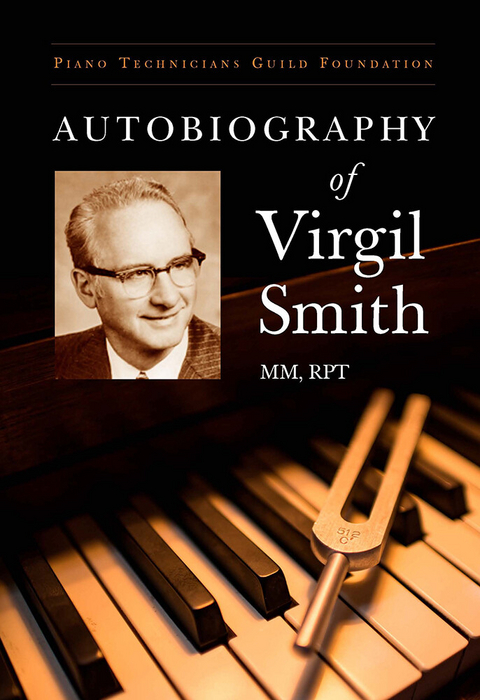
Autobiography - RPT Virgil Smith MM

Autobiography (eBook)

eBook Download: EPUB
2022 | 1. Auflage
234 Seiten
Bookbaby (Verlag)
978-1-6678-2078-1 (ISBN)
Systemvoraussetzungen
29,74 inkl. MwSt
(CHF 28,95)
Der eBook-Verkauf erfolgt durch die Lehmanns Media GmbH (Berlin) zum Preis in Euro inkl. MwSt.
  • Download sofort lieferbar
  • Zahlungsarten anzeigen
During the last decades of his life Virgil Smith became one of the most respected concert piano technicians in the United States, as well as a teacher of tuning whose classes were typically filled to overflowing. In this book, he describes his unlikely path to this second career after an early focus on musical performance in violin and piano, which led to an academic position at Moody Bible College. While at this institution, dissatisfaction with the tuning of the piano in his teaching studio inspired him to tune it himself. Soon after, he was moonlighting as a tuner for radio stations, performance venues and piano teachers. Quickly discovering that he would need skills beyond tuning in order to satisfy his customers, so he set about to learn how to voice, regulate and provide other piano services. His Autobiography is filled with anecdotes about his quest to become a comprehensively trained piano technician, while he sought to refine his tuning skills to the highest possible degree. In writing about his own life, he also documented important aspects of the profession of piano technician in the second half of the twentieth century - how skills were learned, what resources were available - as well as some of the organizational history of the Piano Technicians Guild. The Autobiography itself is supplemented by three major appendices. Two of them are texts by Virgil Smith on the topic of tuning: a short book called New Techniques in Superior Aural Tuning that recently went out of print, and a manuscript intended to replace that book that had not quite reached publication stage when he passed away in 2012. The third appendix is a compilation of an extraordinary discussion concerning Smith's more controversial ideas about tuning that appeared in the pages of the Piano Technicians Journal between Virgil Smith, Journal editor Ed Sutton and Dan Levitan.
In this book, Virgil Smith shares his life story, from his roots as a visually challenged boy from a poor farm family, through his pursuit of a musical career, and culminating in three decades as a music professor. During those years he also became one of the most prominent piano tuner technicians in the United States, in his "e;spare"e; time. Born in rural Iowa, Virgil Smith attended the state boarding school for the blind through high school. While a student there, he was drawn to music, and decided he wanted to pursue a career in music evangelism. He enrolled in Chicago's Moody Bible Institute as a voice major in hopes of becoming a church choir director. Over time his focus shifted to violin, and later piano, with degrees in each from the American Conservatory of Music, and he eventually became a professor of piano and music theory at the Moody Bible Institute, a post he held for 32 years until his retirement in 1984. It was early in his teaching career at Moody that he began moonlighting as a piano tuner. Dissatisfied with the sound of the tuning produced on his studio grand piano by Moody's tuner, he decided to tune it himself, reaching back to earlier training he had received at the Iowa School for the Blind. Over time, he began tuning for others, beginning with a radio station where he performed live on a regular basis, and then progressing to various concert halls in Chicago. He soon became well known as one of the finest tuners in the area. Virgil Smith was, however, strictly a tuner as he started out, without any skills in regulation, voicing and other aspects of piano service, and he writes in detail about his efforts to gain those skills so as to be able to provide for all of his clients' needs. He is very frank about his failures, times when he was trying out procedures for the first time and failed miserably. Over the years, he found a number of teachers and mentors who aided him in gaining proficiency, including such well known figures as Franz Mohr of Steinway. He also interacted with many famous pianists, notably working on voicing in great detail with Alfred Brendel. In many ways, his is a story typical of how most American piano technicians from the 20th century to the present acquired their skills. Full-time training opportunities became increasingly rare, with the number of schools and factories decreasing to the vanishing point. Thus, the development of specialized skills has depended largely on personal initiative, making various contacts over the course of many years, and gradually acquiring proficiency via experimentation. In one particular respect, Virgil Smith's career was unique: throughout his life he worked almost exclusively on large grand pianos in concert and teaching situations, and he rarely worked on more than a few pianos during any given week. Hence, his range of experience was far different from that of the typical piano technician. Once he felt secure in his skills, Virgil Smith began teaching, developing a program in which he taught tuning to classes of eight people over a period of several years. He later abandoned that organized form of training, but continued to mentor and teach individuals, and began teaching classes at Piano Technicians Guild conventions and elsewhere. He also began writing articles for the Piano Technicians Journal on a regular basis, especially following retirement from his teaching job. Virgil Smith attracted a devoted following within the profession, and became one of PTG's most popular teachers. In 2002, he received the Piano Technicians Guild's highest award, the Golden Hammer. In 2004, when Virgil Smith was eighty-six, the PTG Foundation published Virgil Smith's short book (49 pages), New Techniques for Superior Aural Tuning. During the subsequent six years, he worked on what he seems to have intended to be a replacement for that book, with the editorial assistance of Stanley Ryberg. Both are included in this publication of his autobiography.

Chapter 2
School at the Iowa School for the Blind
THE IOWA SCHOOL FOR THE BLIND (ISB), in Vinton, occupied 40 acres at the south end of town. It had several buildings: a large three-story main administration building, a classroom building connected by a tunnel to the main building, a hospital with a full-time nurse in residence, a carpenter shop later converted to a music building, a laundry, a greenhouse, a gym with a basketball court and exercise equipment on the main floor and a swimming pool in the basement, an engine room where they generated their own electricity, an ice house, an underground room for storing fruit, and two barns. The beautiful campus with many trees and a large, lovely flower bed was well maintained. There were two areas for playing baseball and football, and a paved oval for roller skating.
The main building was a large stone building with an east and west wing. The first floor had offices, a reception room, and an auditorium with a balcony that extended to the second floor. The auditorium contained a pipe organ and a grand piano. The west wing contained the boys’ dorms. The first floor was for boys in grades one through four where there were several bedrooms of various sizes, a room where a full-time matron lived, and a large playroom where the boys played with toys and were read to every evening. The second floor was for boys in grades four through eight and was like the first floor only they had a full-time male supervisor rather than a matron. The third floor was for those in high school. It had smaller rooms and an apartment for the supervisor and his wife. The main section of the second floor contained a large apartment for the superintendent and his family. The west wing contained the girls’ dorms and had roughly the same grade division as the boys. A matron lived on each floor. Because the west wing had an extension there was room for high-school classrooms, music studios and the choir room. Each wing had a long porch on the first floor extending the entire length of the wing.
Many of the faculty lived on campus and in various rooms throughout the building. The school served three meals a day, at 7:00 a.m., noon, and 5:30 p.m. Students stood in line outside the doors and at a given signal all marched in and stood at their respective tables until a gong was sounded for them to sing the blessing. A faculty member or older student sat at each table as the head and server. Each student was asked what they wanted and then served it. A favorite phrase was “some of everything please.”
There were usually around 150 students in residence; most of them had some vision, only a few were totally blind. There is a tremendous difference between a little sight and no sight. Those with limited vision willingly helped those who did not see at all. Those with no sight soon became very independent. They learned to get around everywhere by themselves, without using canes. All the students were happy; no one sat around feeling sorry for themselves, especially when they were around people in the same condition. They often joked about their condition —one of their favorite phrases was, “I’m blind in one eye and can’t see out of the other.”
The school had no kindergarten, but they had five years of high school in addition to eight grades of grammar school. That was because they offered classes in industrial work like basket weaving, rug weaving, and piano tuning. It was thought that the students might be able to use these skills to make a living. They offered classes Monday through Friday from 8:00 to 4:00. Each day began with a short chapel service which every student was expected to attend. Monday through Thursday Supt. Palmer gave a short religious message from the Bible. On Fridays visiting ministers from the town churches were invited to lead the service. Everyone attended their assigned classes until four o’clock; there was no thought of ever skipping a class. Students were free to play after school until supper, 7:00 to 9:00 were study hours, and 9:00 was bedtime for the younger students. How good it felt when we got to high school and could stay up later. Saturdays were free for us to play or do whatever else we chose to do. On Sunday everyone was expected to go to church. Those who had no preference were taken to the Methodist church. Teachers would walk the students to and from church in long double-file lines.
We all learned to read and write with Braille, and there was a large library of Braille books available to us. We even had music available to us in Braille, and we could write music in Braille. In the seventh grade those of us who saw well enough were taught to read print and to write script.
My vision problem turned out to be a blessing in disguise for me. By virtue of being at Iowa School for the Blind, I received music and piano tuning training which I never would have been exposed to otherwise. This training turned out to be the source of my lifelong livelihood and enjoyment. I have always thought that this was part of God’s plan to prepare me for my ministry both at and after the Moody Bible Institute. At ISB, we had singing classes right away in first grade. We were classified as A (those who sang on pitch), B (those who sang close to pitch), and C (those who were way off). Because I had no exposure at all to music before I came to ISB I was a C, but I soon became an A. I continued to sing in the chorus and later in the choir and men’s glee club. This was a time when state music contests were receiving a great emphasis, and in various years our choir and men’s glee club took first place. ISB was also pushing music education very strongly.
In third grade I was put into a piano class, but after two weeks I was so far ahead of the class that they decided to give me private lessons. I could not sight-read music so I had to memorize my music right away which led to my becoming a very good memorizer. I learned all my music by Braille one hand at a time; if it wasn’t in print my teacher dictated it to me in Braille. I memorized each hand separately, then put them together. This came in handy later when I used to memorize my music hands alone on the “L” in Chicago on my way to my piano lessons.
I had three teachers at ISB. My first one was Lilly Kingsted. When I was twelve, she took me to a college in Cedar Falls to hear the famous pianist, Paderewski, in concert. My second teacher was Laura Everett. We remained friends and kept in touch for several years after we were both married. My third teacher was Mary Lu Reeder. I liked all my teachers, but I fell in love with Mary Lu. She took me to several concerts and to two of her piano lessons. She would visit me when she came to Chicago on business. She was a wonderful friend and followed my career for many years. She helped me improve a great deal in my piano playing.
When I was in seventh grade, the school decided to enlarge their instrumental program. They hired a full-time violin teacher to give violin lessons and direct an orchestra. I started studying violin and soon was playing in the orchestra, and eventually became the concertmaster. Because not all the orchestra members could see the conductor’s baton well enough, the conductor had to start each piece by saying “ready, play” in the correct tempo. The school bought several new violins, and my teacher gave me the best one. One day I didn’t close my case properly and the violin came out and went bouncing down the iron stairs. The finger board came off and it developed a couple of cracks. The teacher was furious with me. They finally sent it away to be repaired but it never was the same. I played first violin in a string quartet the teachers organized. I played piano and violin solos in several concerts, and even gave a full-length piano recital in my senior year.
I loved all my teachers. Years later when I saw my second grade teacher, she told of coming to the classroom one day and asking, “Virgil, what makes your cheeks so rosy today?” My answer was, “because I wove you.” I also loved to be involved in athletics. I played baseball with the boys whenever weather and time permitted. I played on the basketball team; we played an occasional game with another high school team. My most successful sport was the cross-country two-mile race, and I was captain of our team. Our coach knew that the course in Iowa City involved some hills, so we practiced in the park along the river, which had some big hills. In the state finals I was able to pass several runners on the hills. I came in 44th out of 125 runners. Our reward was to see the University of Iowa football game.
There were several practice rooms in the basement underneath the auditorium; each had two pianos, one for practicing piano and the other for practicing piano tuning. There was also a large room for teaching piano tuning. I was very interested in piano tuning and worked hard at it. I became a good piano tuner and had opportunities to earn some money tuning pianos on Saturdays.
We had a real problem as to where I would spend my summer and Christmas vacations. We were so poor that we often could not afford to get me back to school on time after the Christmas vacation. My dad had not settled anywhere since we left Tillie; he was doing construction odd jobs. The first two years after we left Tillie, I stayed with my mother’s folks in Barnes City. They had no inside...

Erscheint lt. Verlag 15.1.2022
Sprache englisch
Themenwelt Literatur Biografien / Erfahrungsberichte
ISBN-10 1-6678-2078-8 / 1667820788
ISBN-13 978-1-6678-2078-1 / 9781667820781
Informationen gemäß Produktsicherheitsverordnung (GPSR)
Haben Sie eine Frage zum Produkt?
EPUBEPUB (Ohne DRM)
Größe: 1,9 MB

Digital Rights Management: ohne DRM
Dieses eBook enthält kein DRM oder Kopier­schutz. Eine Weiter­gabe an Dritte ist jedoch rechtlich nicht zulässig, weil Sie beim Kauf nur die Rechte an der persön­lichen Nutzung erwerben.

Dateiformat: EPUB (Electronic Publication)
EPUB ist ein offener Standard für eBooks und eignet sich besonders zur Darstellung von Belle­tristik und Sach­büchern. Der Fließ­text wird dynamisch an die Display- und Schrift­größe ange­passt. Auch für mobile Lese­geräte ist EPUB daher gut geeignet.

Systemvoraussetzungen:
PC/Mac: Mit einem PC oder Mac können Sie dieses eBook lesen. Sie benötigen dafür die kostenlose Software Adobe Digital Editions.
eReader: Dieses eBook kann mit (fast) allen eBook-Readern gelesen werden. Mit dem amazon-Kindle ist es aber nicht kompatibel.
Smartphone/Tablet: Egal ob Apple oder Android, dieses eBook können Sie lesen. Sie benötigen dafür eine kostenlose App.
Geräteliste und zusätzliche Hinweise

Buying eBooks from abroad
For tax law reasons we can sell eBooks just within Germany and Switzerland. Regrettably we cannot fulfill eBook-orders from other countries.

Mehr entdecken
aus dem Bereich
Die Autobiografie

von Daniel Böcking; Freddy Quinn

eBook Download (2025)
Edition Koch (Verlag)
CHF 9,75