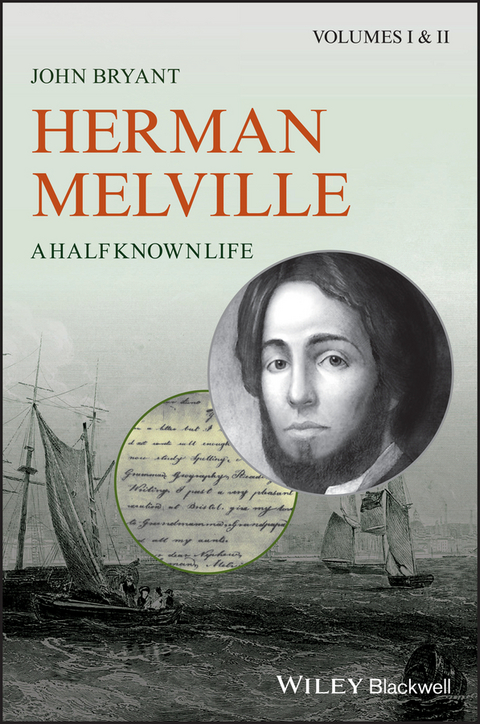
A comprehensive exploration of Melville's formative years, providing a new biographical foundation for today's generations of Melville readers
Herman Melville: A Half Known Life, Volumes 1 and 2, follows Herman Melville's life from early childhood to his astonishing emergence as a bestselling novelist with the publication of Typee in 1846. These volumes comprise the first half of a comprehensive biography on Melville, grounded in archival research, new scholarship, and incisive critical readings. Author John Bryant, a distinguished Melville scholar, editor, critic, and educator, traces the events and experiences that shaped the many-stranded consciousness of one of literature's greatest writers. This in-depth and innovative biography covers Melville's family history and literary friendships, his father-longing, god-hunger, and search for the hidden nature of Being, the genesis of his liberal politics, his empathy for African Americans, Native Americans, Polynesians, South Americans, and immigrants.
Original perspectives on Melville's earliest identities-orphaned son, sibling, farmer, teacher, debater, lover, actor, sailor-provide the context for Melville's evolution as a writer. The biography presents new information regarding Melville's reading, his early orations and acting experience, his life at sea and on the road, and the unsettling death of his older, rival brother from mercury poisoning. It provides insights on experiences such as Melville's trauma at the loss of his father, his learning to write amidst a coterie siblings, his struggles to find work during economic depression, his journey West, his life in whaling and in the navy, and his vagabondage in the South Pacific during the moment of American and European imperial incursions. A significant addition to Melville scholarship, this important biographical work:
- Explores the nature and development of Melville's creative consciousness, through the lens of his revisions in manuscript and print
- Assesses Melville's sexual growth and exploration of the spectrum of his masculinities
- Highlights Melville's relevance in contemporary democratic society
- Discusses Melville's blending of dark humor and tragedy in his unique version of the picturesque
- Examines the 'replaying' of Melville's life traumas throughout his entire works, from Typee, Omoo, Redburn, White-Jacket, Moby-Dick, Pierre, Israel Potter, and The Confidence-Man to his shorter works, including 'Bartleby,' his epic Clarel, his poetry, and his last novella Billy Budd
- Covers such cultural and historical events as the American revolution of his grandparents, the whaling industry, New York slavery, street life and theater in Manhattan, the transatlantic slave trade, the Jacksonian economy, Indian removal, Pacific colonialism, and westward expansion
Written in an engaging style for scholars and general readers alike, Herman Melville: A Half Known Life, Volumes 1 and 2 is an indispensable new source of information and insights for those interested in Melville, 19th-century and modern literature and culture, and readers of general American history and literary culture.
JOHN BRYANT is a leading Melville scholar and Professor Emeritus of English at Hofstra University. He is the author of A Companion to Melville Studies, Melville and Repose, The Fluid Text, Melville Unfolding, and over 70 articles on Melville and related nineteenth-century writers. He is the founder of Leviathan: A Journal of Melville Studies, and of the Melville Electronic Library. He received the Distinguished Editor Award from Council of Editors of Learned Journals in 2015.
A comprehensive exploration of Melville's formative years, providing a new biographical foundation for today's generations of Melville readers Herman Melville: A Half Known Life, Volumes 1 and 2, follows Herman Melville's life from early childhood to his astonishing emergence as a bestselling novelist with the publication of Typee in 1846. These volumes comprise the first half of a comprehensive biography on Melville, grounded in archival research, new scholarship, and incisive critical readings. Author John Bryant, a distinguished Melville scholar, editor, critic, and educator, traces the events and experiences that shaped the many-stranded consciousness of one of literature s greatest writers. This in-depth and innovative biography covers Melville's family history and literary friendships, his father-longing, god-hunger, and search for the hidden nature of Being, the genesis of his liberal politics, his empathy for African Americans, Native Americans, Polynesians, South Americans, and immigrants. Original perspectives on Melville s earliest identities orphaned son, sibling, farmer, teacher, debater, lover, actor, sailor provide the context for Melville s evolution as a writer. The biography presents new information regarding Melville's reading, his early orations and acting experience, his life at sea and on the road, and the unsettling death of his older, rival brother from mercury poisoning. It provides insights on experiences such as Melville's trauma at the loss of his father, his learning to write amidst a coterie siblings, his struggles to find work during economic depression, his journey West, his life in whaling and in the navy, and his vagabondage in the South Pacific during the moment of American and European imperial incursions. A significant addition to Melville scholarship, this important biographical work: Explores the nature and development of Melville's creative consciousness, through the lens of his revisions in manuscript and print Assesses Melville's sexual growth and exploration of the spectrum of his masculinities Highlights Melville's relevance in contemporary democratic society Discusses Melville's blending of dark humor and tragedy in his unique version of the picturesque Examines the 'replaying' of Melville's life traumas throughout his entire works, from Typee, Omoo, Redburn, White-Jacket, Moby-Dick, Pierre, Israel Potter, and The Confidence-Man to his shorter works, including "e;Bartleby,"e; his epic Clarel, his poetry, and his last novella Billy Budd Covers such cultural and historical events as the American revolution of his grandparents, the whaling industry, New York slavery, street life and theater in Manhattan, the transatlantic slave trade, the Jacksonian economy, Indian removal, Pacific colonialism, and westward expansion Written in an engaging style for scholars and general readers alike, Herman Melville: A Half Known Life, Volumes 1 and 2 is an indispensable new source of information and insights for those interested in Melville, 19th-century and modern literature and culture, and readers of general American history and literary culture.
JOHN BRYANT is a leading Melville scholar and Professor Emeritus of English at Hofstra University. He is the author of A Companion to Melville Studies, Melville and Repose, The Fluid Text, Melville Unfolding, and over 70 articles on Melville and related nineteenth-century writers. He is the founder of Leviathan: A Journal of Melville Studies, and of the Melville Electronic Library. He received the Distinguished Editor Award from Council of Editors of Learned Journals in 2015.
Preface
Biography is impossible, it is said. If we cannot fully “know” ourselves or our contemporaries, how can we possibly know the life of someone born 200 years ago? I never sat with Herman Melville, never observed his daily quirks, his manner of speaking, dressing, moving about the house. I've not observed his moods around strangers, shipmates, editors, friends, or family. All I really know of him are his writings, mostly prose fictions, many poems, a couple essays and reviews, and lamentably few letters. Like several worthy predecessors, this biography is a narrative of the known facts of Melville's childhood, adolescence, young manhood, maturity, and old age. But narratives are notoriously subjective and speculative. Biography cannot give you The Life; it can only simulate a life, and what good is a simulation; thus, biography is said to be impossible.
Even so, biography is as inevitable as it is impossible; we desire it. But why? Aren't Typee, Moby‐Dick, “Bartleby,” and Billy Budd all that we need? Yet we want more as we read perhaps because Melville's works – many of them auto‐fictions – have the urgency of self‐exploration. We seek a connection between his writing and his life as if his creative process and his life experiences were linked versions of the same thing. We want to know how this remarkable writer survived the accidents in his life (some tragic) and the traumas of his everyday living (in adolescence and mid‐life); how he absorbed the world around him (white and black; male, female, and other; material and immaterial); how he learned to translate himself into his writings. I cannot claim that my biography – or any biography – can give you a full knowing of a writer's life. We might, however, try different ways of “half knowing” Melville.
The subtitle of this biography– “A Half Known Life” – comes from a passage in Moby‐Dick that equates the human soul with an “insular Tahiti, full of peace and joy” that is surrounded by “all the horrors of the half known life.” We cannot know peace and joy, Melville suggests, without knowing horror, nor horror without peace and joy. It is a world of interdependencies. The “half known” horrors in our lives are public and private. Social structures, whose power strings are pulled by seemingly invisible agents, have given us slavery, Indian removal, species extinction, urban poverty, alienation, and war. But our private horrors seem utterly adventitious and accidental: the loss of a father and of a son, battles with whales, the threat of the cannibal, or the anxieties of variable sexualities. Melville's life also suggests to us that certain quirks of thought and strange emotions, certain shocks of recognition penetrating our very being, and a certain gift for language enabled him to write out and through these public and private horrors. What draws us to Melville, and draws me to the impossible art of biography, is that while we cannot know this writer fully, we can know his writings, and knowing how those writings work, in manuscript and in print, is an opening that exposes the unique imperative in him to write. If we can grasp at this fundamental dynamic in his life, we might in turn be able to read his writings in the context of his evolution as an artist.
One other impossibility. Herman Melville: A Half Known Life is a literary and “critical” biography, and yet, since the 1940s and the rise of the New Criticism the field of literary interpretation has held “biographical criticism” in low regard. In the view of many critics, biography is impossible because knowing the life does not help us read the writings. The assumption is that a novel or poem contains within it all the information we need in order to interpret it, and that Melville's intended meanings, his creative process, and revisions have no bearing on how we interpret the final, published work itself. While these assumptions are reasonable if we take literature to be simply an accumulation of publications, the broader view I adopt is that meaning derives from the sum of all writing, before, during, even after the publication of a writer's novel or poem. Rather than limiting our perspective to single published versions of a literary work, we need to read all versions of a writer's writing, including revisions of novels and poems in manuscript or adaptations created by writers other than Melville. If we want to experience this broader view of writing as the complicated phenomenon that it is, we need to bring the author as a writer back into our thinking about literature. We need reliable ways to think more critically about the interactions of private and social meanings that we might discover hiding out in a single author's creative process.
One constant in a writer's life is revision and replay. In Melville's manuscript revisions such as the erasure of words, characters, and arguments and his invention of new words or in his replaying of images within and throughout published works, we might find lurking the evidence of his discovery of a symbol or the evolution of his picturesque way of seeing and writing. In writing this life of a writer, I focus on the living that unfolds in the writing process itself: what Melville saw in his personal experience of the world around him and how he transformed it into words. The challenge is placing these microscopic moments of creativity in the larger macroscopic context of the writer's world: Melville's siblings who learned to write, too, and in writing alongside him influenced his language; the politics and economy of his life in upstate New York and Manhattan; his exposure to African Americans, who recur throughout his life as a writer; his working life as a farmer, whaler, and naval seaman, as a mutinous beachcomber and a customs inspector; his relation to men and to women; his need to “go off” and be away from home; his conflicting need for domesticity. Though the conclusion of this half known life may still be that we can only half know Melville, a half knowing is enough for us to know more about Melville than we had previously imagined.
One warning about Time, Place, and Name. These two volumes of my projected three‐volume biography cover Melville's early life, adolescence, and young manhood up to his first breakthrough as a writer with the publication of Typee. Since moments from Melville's early life crop up randomly throughout his lifetime of writing, extending from the 1846 of Typee to the 1891 of Billy Budd, this narrative necessarily jumps ahead in time, from the present of Melville's life experience, say as a boy named Herman in 1828, to the future of an artist named Melville writing Moby‐Dick in 1850, and back. To keep track during these moments of biographical time travel, I provide time stamps throughout the narrative to remind readers where they are in the chronology of the life. Similarly, the narrative may hop from place to place. For instance, in steaming up the Ohio River in 1840, Herman took a side trip to Mammoth Cave in Kentucky, which Melville did not record in his journal until 1857 when he was touring the claustrophobic Pyramids of Egypt, and then Rome's Tiber River, which reminded him of the Ohio. The adjacency of place in Melville's mind hints at the half known adjacency of ideas in his thinking. Here, too, I provide place signatures to remind readers where they are on the map of Melville's consciousness. Finally, throughout these two volumes, I use “Herman” when I am speaking about the person as he is experiencing his life, and “Melville” to indicate the writer writing.
I started writing this biography in earnest in 2009, but the idea for the project began decades ago when I began to study, write about, and teach Melville at various venues in the US and abroad. From that earlier beginning, I have benefited from the works of several Melville biographers whom I never met – Charles Roberts Anderson, Newton Arvin, William Gilman, Howard Horsford, Leon Howard, Alice Kenney, Eleanor Melville Metcalf, and Raymond Weaver – and biographers I have met and greatly admired: Andrew Delbanco, Hershel Parker, and Laurie Robertson‐Lorant. Their different approaches and insights have been inspirational. Central to the work of any Melville biographer, researcher, and reader is Jay Leyda's Melville Log, a two‐volume chronology of Melville‐related events. In the mid‐1980s, Jay confided to me that his reason for consolidating the known facts of Melville's life was to provide scholars and critics with a communal foundation upon which they might construct their own biographies and biographical criticism. His assumption was that no single biography will ever be definitive and that each generation will create its own Melville biography – its own narrative of the facts – to reflect our collective and evolving sense of life, culture, and humanity. While I hope my contribution will be comprehensive in scope and accessible in style, I have no illusions that it is the final word on Melville's life but rather hope that it will induce others to write their own half known lives.
Another crucial resource for Melville research can be found in the historical and textual notes in each of the fourteen‐volume Northwestern‐Newberry editions in The Writings of Herman Melville, edited by Harrison Hayford, Hershel Parker, and G. Thomas Tanselle. As he did for so many...
| Erscheint lt. Verlag | 26.10.2020 |
|---|---|
| Sprache | englisch |
| Themenwelt | Literatur ► Biografien / Erfahrungsberichte |
| Literatur ► Romane / Erzählungen | |
| Geisteswissenschaften ► Sprach- / Literaturwissenschaft | |
| Schlagworte | American Literature • Amerikanische Literatur • Literarische Biographien • Literary Biography • Literary Criticism & History • Literature • Literaturkritik • Literaturkritik u. -geschichte • Literaturwissenschaft • Melville • Melville and slavery • Melville biography • Melville creativity • Melville critical analysis • Melville family • Melville fluid text • Melville, Herman • Melville history • Melville insights • Melville novels • Melville perspectives • Melville poetry • Melville politics • Melville research • Melville revision • Melville scholarship • Melville studies |
| ISBN-10 | 1-119-10600-1 / 1119106001 |
| ISBN-13 | 978-1-119-10600-5 / 9781119106005 |
| Informationen gemäß Produktsicherheitsverordnung (GPSR) | |
| Haben Sie eine Frage zum Produkt? |
 EPUB (Adobe DRM)
Kopierschutz: Adobe-DRM
Adobe-DRM ist ein Kopierschutz, der das eBook vor Mißbrauch schützen soll. Dabei wird das eBook bereits beim Download auf Ihre persönliche Adobe-ID autorisiert. Lesen können Sie das eBook dann nur auf den Geräten, welche ebenfalls auf Ihre Adobe-ID registriert sind.
Details zum Adobe-DRM
Dateiformat: EPUB (Electronic Publication)
EPUB ist ein offener Standard für eBooks und eignet sich besonders zur Darstellung von Belletristik und Sachbüchern. Der Fließtext wird dynamisch an die Display- und Schriftgröße angepasst. Auch für mobile Lesegeräte ist EPUB daher gut geeignet.
Systemvoraussetzungen:
PC/Mac: Mit einem PC oder Mac können Sie dieses eBook lesen. Sie benötigen eine
eReader: Dieses eBook kann mit (fast) allen eBook-Readern gelesen werden. Mit dem amazon-Kindle ist es aber nicht kompatibel.
Smartphone/Tablet: Egal ob Apple oder Android, dieses eBook können Sie lesen. Sie benötigen eine
Geräteliste und zusätzliche Hinweise
Buying eBooks from abroad
For tax law reasons we can sell eBooks just within Germany and Switzerland. Regrettably we cannot fulfill eBook-orders from other countries.
aus dem Bereich