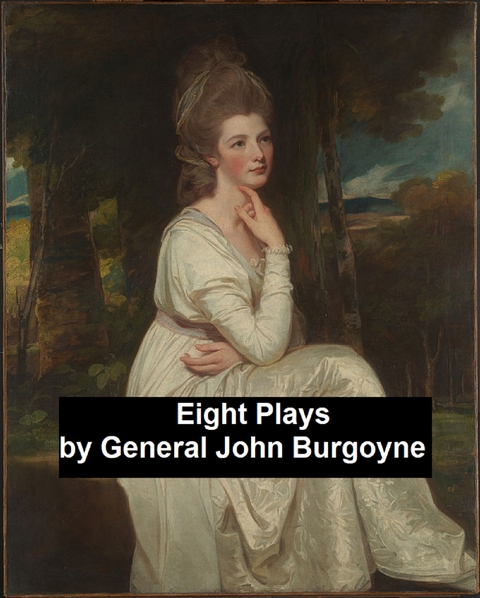
Eight Plays (eBook)
484 Seiten
Seltzer Books (Verlag)
978-1-4554-4822-7 (ISBN)
Eight plays by the British general who lost the Battle of Saratoga (and who appears prominently in Shaw's Devil's Disciple). After the battle, in which he was captured, he returned to England 'on parole', meaning he promised not to come back again and fight the American rebels. Back in England, he wrote plays and musicals for the London stage sometimes in competition with and sometimes in collaboration with Richard Brinsley Sheridan. This collection includes all his extant works: Eudora, The Viceroy, Heroine of Cambria, Maid of the Oaks, The Camp, The Lord of the Manor, and Richard Coeur de Lion. It also includes a biographical sketch of Burgoyne, and 14 illustrations.
Eight plays by the British general who lost the Battle of Saratoga (and who appears prominently in Shaw's Devil's Disciple). After the battle, in which he was captured, he returned to England "e;on parole"e;, meaning he promised not to come back again and fight the American rebels. Back in England, he wrote plays and musicals for the London stage sometimes in competition with and sometimes in collaboration with Richard Brinsley Sheridan. This collection includes all his extant works: Eudora, The Viceroy, Heroine of Cambria, Maid of the Oaks, The Camp, The Lord of the Manor, and Richard Coeur de Lion. It also includes a biographical sketch of Burgoyne, and 14 illustrations.
EIGHT PLAYS BY GENERAL JOHN BURGOYNE
Published by Seltzer Books. seltzerbooks.com/books/catalogue.html
established in 1974, as B&R Samizdat Express
offering over 14,000 books
feedback welcome: seltzer@seltzerbooks.com
A SKETCH OF THE LIFE OF LIEUTENANT-GENERAL BURGOYNE (1722 - 1792) BY ANONYMOUS
THE MAID OF THE OAKS, A DRAMATIC ENTERTAINMENT IN FIVE ACTS
THE HEIRESS, A COMEDY IN FIVE ACTS
THE CAMP: A MUSICAL ENTERTAINMENT BY RICHARD BRINSLEY SHERIDAN WITH THE HELP OF JOHN BURGOYNE
THE LORD OF THE MANOR, A COMIC OPERA BY JOHN BURGOYNE
RICHARD COEUR DE LION, AN HISTORICAL ROMANCE BY JOHN BURGOYNE
A SKETCH OF THE LIFE OF LIEUTENANT-GENERAL BURGOYNE (1722 - 1792) BY ANONYMOUS
from Dramatic and Poetical Works of the Late Lieutenant General J. Burgoyne, 1808
Few circumstances have more frequently, or with more reason, been lamented, by writers of biography, than the deficiency which they have found of materials, for enabling them to trace the progress of celebrated but originally obscure characters, at their first entrance into a state of active existence. The early life of many who steadily worked their way up to distinguished eminence is buried in total darkness. This blank in the history of individuals, though to superficial observers its occurrence may be thought of little moment, is undoubtedly a subject of regret, as it would be not less useful than curious to know throughout what slow gradations, and by what continued struggles, worth and genius eventually surmounted all those obstacles which had been opposed to them by the malignity of fortune. The lesson of patience and perseverance, thus practically taught, would be of more avail than all the volumes of reasoning upon these virtues, which have been, or which ever can be, written by sages and by moralists.
Among those, no memorial of whose youth remains, is to be numbered John Burgoyne, a man who rose to no mean celebrity, as a writer, a senator, and an officer. The time and place of his birth are unknown. Even his parentage is doubtful. He is said, but upon what authority does not appear, to have been the natural son of Lord Bingley, who died, at an advanced age in 1774.
That his education was of the most liberal kind is sufficiently testified by subsequent evidence. It is not improbable, also, that he was either destined for, or resolved upon, the profession of arms, at a very early period. The dates of his subaltern promotions elude discovery, and are not, perhaps, in themselves of much importance; but, on the 10th of May, 1738, he was raised to the rank of lieutenant-colonel. In the August of 1759, he was appointed lieutenant-colonel-commandant of the sixteenth light dragoons. With this regiment he served, in 1761, at Belleisle, where, during the siege of Palais, he was entrusted with a negotiation for an exchange of prisoners.
A more busy service awaited him upon his re- turn home. Spain had now acceded to the family compact, and, after vain endeavours to draw over Portugal from its alliance with England, had resolved to attack that country in the hope of an easy conquest; a hope which arose from her conviction of the weak and undisciplined state of the Portuguese army. In this exigency Great Britain hastened to the succour of an ally, who had preferred the chance of utter ruin to the shame of having violated her faith.
The troops destined for this service arrived in the Tagus on the 6th of May. They were immediately marched to join the Portuguese army, under the command of the Count de la Lippe Buckeburg, and took the field in the course of July. The campaign had been commenced by the Spaniards on the side of Tras os Monies, in which province Miranda, Braganza, and some other towns had fallen into their hands. They next resolved to proceed against Oporto, but this design was frustrated by the bravery of the peasants, who took possession of the defiles, and compelled the Spanish army to a disorderly retreat. Disappointed in this quarter the enemy turned their steps towards the province of Beira, and laid siege to the frontier town of Almeida, which, after a short defence, fell into their hands through the imbecility and cowardice of its governor. Their army now approached the Tagus, the only direction in which an invader can penetrate to the capital, all other access being rendered nearly, if not quite impracticable, by immense chains of mountains, and other natural obstructions.
To second the operations" of this army, by an incursion into Alemtejo, or by advancing on the opposite side of the Tagus, and thus to distract the attention of the Portuguese, already but too feeble in point of numbers, a body of troops was beginning to assemble in Spanish Estramadura, at the town of Valencia de Alcantara. It consisted at present of about 1200 men. Well knowing that it' this force were suffered to increase, it would embarrass him very considerably, the Count de la Lippe, who was encamped at Abrantes, formed the bold design of attacking and dispersing it before it assumed a more formidable aspect.
The execution of this plan was confined to Burgoyne, who then held the rank of brigadier. No inconsiderable difficulties stood in the way of this enterprise ; but the spirit of the commander was not of a nature to be depressed by such considerations. He crossed the Tagus, at midnight on the 23d, with 400 of his own regiment, was joined as he advanced by one or two small detachments, and after a laborious march of more than fifteen leagues, performed through bad roads, and without halting, he arrived on the morning of the 26th at some distance from the town of Alcantara. His intention had been to surprise the place before break of day, but he now found that from the delay, occasioned by the ignorance of the guiles, the dawn was at hand, and his scheme would be frustrated if he waited till his whole division could co-operate in the attack. He, therefore, boldly pushed forward with his dragoons alone. This audacity was favoured by fortune. At the head of his handful of soldiers he entered the town with such determined resolution that the guards in the square were all killed or made prisoners before they could take arms, and the ends of the streets were secured after a trifling resistance. Some parties, having rallied, attempted to return to the charge ; but their lives paid the forfeit of their temerity. A firing was for a short time kept up from the windows. It was, however, put a stop to, by the menace of setting the town in flames, at the four corners, if the doors and windows were not instantly thrown open. Parties were immediately sent out to pursue such of the enemy as had escaped into the country, and in this service their success was very considerable.
In this gallant action the loss of the English was scarcely worthy of notice ; while, on the other hand, that of the Spaniards was remarkably severe. Many prisoners were taken, among whom was the Spanish general, and the regiment of Seville was totally destroyed. Three standards, with a large quantity of arms and ammunition, fell into the hands of the victors. In consequence of the strict discipline observed by the British very little was suffered by the town or the inhabitants. The generosity and gallantry of Burgoyne were indeed subjects of praise among the Spanish officers themselves. From the Count de la Lippe they received, in the public orders of the day, the highest encomiums.
All danger was thus at an end on the side of Alemtejo; but it was not so on the other bank of the Tagus, where their immense superiority of numbers enabled the Spaniards to obtain a footing, though but a trifling one, in Portuguese Estramatlura, and make a somewhat nearer approach to the capital. Early in October they attacked the old Moorish castle of Villa Velha, and the dcfiies of St. Simon. The castle was, for a considerable time, supported across the river by Brigadier Burgoyne, who was posted between Nissa and the Tagus. It was, however, at last compelled to surrender, the enemy having contrived to turn the position.
A body of two thousand Spaniards now encamped in the neighbourhood of Villa Vellia. It was soon perceived by Burgoyne, that this corps, proud of its late successes, was a little more care- less than was proper in the neighbourhood of a vigilant and enterprising adversary. For this unsoldier-like negligence he soon inflicted upon them an exemplary chastisement. Under his orders Lieutenant-Colonel Lee crossed the Tagus, on the night of the 5th of October, with a detachment of 350 British soldiers, and succeeded in completely surprising the Spanish camp. A considerable slaughter took place, with a very trifling loss to the assailants. Some magazines were burned, six cannons spiked, and sixty artillery mules, and a large quantity of baggage taken. After this decisive blow, the detachment recrossed the Tagus, and resumed its original quarters, without interruption.
Here closed the campaign. Harassed, dispirit- ed, and reduced to almost one half of...
| Erscheint lt. Verlag | 24.11.2018 |
|---|---|
| Sprache | englisch |
| Themenwelt | Literatur ► Lyrik / Dramatik ► Dramatik / Theater |
| Schlagworte | American Revolution • Battle of Saratoga • Sheridan |
| ISBN-10 | 1-4554-4822-2 / 1455448222 |
| ISBN-13 | 978-1-4554-4822-7 / 9781455448227 |
| Informationen gemäß Produktsicherheitsverordnung (GPSR) | |
| Haben Sie eine Frage zum Produkt? |
 EPUB (Ohne DRM)
Digital Rights Management: ohne DRM
Dieses eBook enthält kein DRM oder Kopierschutz. Eine Weitergabe an Dritte ist jedoch rechtlich nicht zulässig, weil Sie beim Kauf nur die Rechte an der persönlichen Nutzung erwerben.
Dateiformat: EPUB (Electronic Publication)
EPUB ist ein offener Standard für eBooks und eignet sich besonders zur Darstellung von Belletristik und Sachbüchern. Der Fließtext wird dynamisch an die Display- und Schriftgröße angepasst. Auch für mobile Lesegeräte ist EPUB daher gut geeignet.
Systemvoraussetzungen:
PC/Mac: Mit einem PC oder Mac können Sie dieses eBook lesen. Sie benötigen dafür die kostenlose Software Adobe Digital Editions.
eReader: Dieses eBook kann mit (fast) allen eBook-Readern gelesen werden. Mit dem amazon-Kindle ist es aber nicht kompatibel.
Smartphone/Tablet: Egal ob Apple oder Android, dieses eBook können Sie lesen. Sie benötigen dafür eine kostenlose App.
Geräteliste und zusätzliche Hinweise
Buying eBooks from abroad
For tax law reasons we can sell eBooks just within Germany and Switzerland. Regrettably we cannot fulfill eBook-orders from other countries.
aus dem Bereich