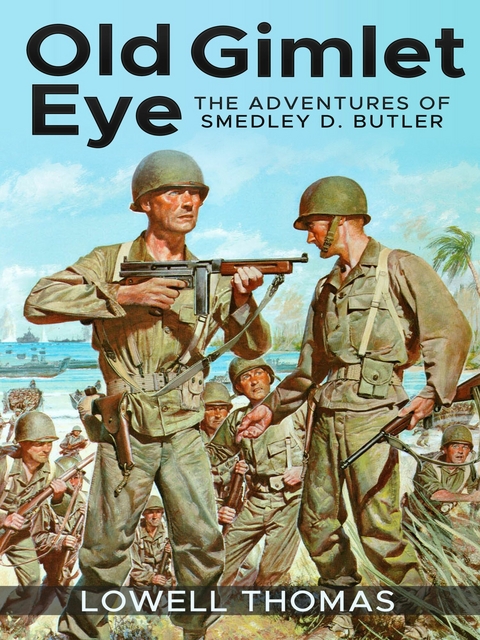
Old Gimlet Eye : The Adventures of Smedley D. Butler (eBook)
184 Seiten
Kismet Publishing (Verlag)
978-0-359-14292-7 (ISBN)
Smedley Butler joined the Marine Corps at age 16 and took part in critical military actions in Cuba, the Philippines, China, Central America, Mexico, and France. He won renown as a battlefield hero and was the most decorated Marine in U.S. history at the time of his death in 1940. Old Gimlet Eye is a boots-on-the-ground account of his many tours of duty, offering invaluable insight into early US military strategy and tactics, weaponry, equipment and many other fascinating field details from the Spanish-American War to World War I and beyond.
This new annotated edition of Old Gimlet Eye includes original footnotes and images.
Smedley Butler joined the Marine Corps at age 16 and took part in critical military actions in Cuba, the Philippines, China, Central America, Mexico, and France. He won renown as a battlefield hero and was the most decorated Marine in U.S. history at the time of his death in 1940. Old Gimlet Eye is a boots-on-the-ground account of his many tours of duty, offering invaluable insight into early US military strategy and tactics, weaponry, equipment and many other fascinating field details from the Spanish-American War to World War I and beyond.This new annotated edition of Old Gimlet Eye includes original footnotes and images.
SOMETIMES I CAN CLOSE my eyes and see a long line of my grey-cloaked forbears pointing reproachful, ghostly fingers at me for throwing in my lot with the fire-eating Marines. But I was in good company. My grandfather Butler was put out of Orthodox meeting for marching off to the Civil War.
Father died four years ago, but I shall always remember him as a man of powerful individuality and vigorous vocabulary. He spoke the plain language of the Quakers in public life just as he did in the bosom of his family, but he garnished the plain language with choice epithets when the occasion demanded high explosives. Father had just made a speech on the floor of Congress advocating a good size navy. Leaving the House, in the corridor of the Capitol he met a pacifist, who said to him: “Thee is a fine Friend.” Father replied by saying: “Thee is a damn fool.”
My mother put me to bed in the middle of a golden summer afternoon for sputtering out a couple of innocent damns. I was five years old and felt outraged and insulted. I didn’t understand why I should be punished for talking like my father. When Father came home, through the half-open door I heard Mother telling him all about my black crime.
“If we don’t take care, he will grow up like a New York newsboy.”
“Thee mustn’t take these little things so to heart,” Father laughed. “I don’t want a son who doesn’t know how to use an honest damn now and then.”
Farming, law and politics have from way back been the principal occupations of my family on both sides. A Butler has sat on the bench in Chester County, Pennsylvania, almost without a break for the past seventy-five years. My father, Thomas S. Butler, was a judge for a time, but he spent most of his later life as a member of Congress, where he represented the same district for thirty-two years. As chairman of the Naval Affairs Committee of the House he occupied a key position of influence.
I was born on July 30, 1881, in West Chester, Pennsylvania, around which so much of my family history has been woven. I had a strenuous, but not particularly eventful childhood. Brought up as a Hicksite Quaker, I am still one in good standing, so far as I know. I was vigorously brushed and combed and soaped to acquire the cleanliness next to godliness before going to the Friends’ Meeting twice a week. Dozing off on a hard bench to the drone of words that meant nothing to me and being “The fighting Quaker” is what my friends and enemies call me, and I’m proud of both titles—fighter and Quaker. But I’m ashamed to confess that in my first recorded fight I took unfair advantage. I was a small boy packed off to spend a vacation with my grandfather. He was sixty years older than I and not much fun as a playmate, so I searched the neighborhood for a friend my own age. I found him standing on the edge of a muddy little pond. He had yellow curls, a lace collar and a black velvet suit.
“Hello,” I sang out, “What’s your name?”
“I’m not allowed to speak to strange boys,” he answered.
That was more than I could bear. I gave Lord Fauntleroy a hearty shove into the shallow, reed-choked water. Red-faced, mud-streaked and dripping, he ran home, howling at the top of his voice. I felt that my grandfather secretly approved of my action. Nevertheless, I was sent home in semi-disgrace a week before the proposed end of my visit.
My first school was the Friends’ Graded High School in West Chester. Later I was sent to the Haverford School near Philadelphia, which was then, as it is now, an outstanding school and accepted like the Ten Commandments as a matter of course by the old Quaker families of the city for the education of their sons. Studying was not my specialty. I have always preferred action to books. I’m probably the only general officer in the United States who has never attended a war or naval college.
Our elocution teacher taught me the pump-handle gestures and dramatic flourishes of the nineties, and then said to me: “My boy, I’m going to make a first-class orator out of you.” Whereupon he made me learn an oration by William Cullen Bryant* and entered me in the yearly competition. But I secretly memorized Mark Twain’s “Storm on the Erie Canal.” I’ve always liked a good storm.
*Victorian man of letters, William Cullen Bryant (1794-1878).
The annual oratory contest was a gala night at the school. Squirmingly self-conscious in my first long trousers, I mounted the platform before all the boys and their parents. The teacher was in the front row and nodded at me approvingly. Beforehand, he had taken me aside to assure me that I would win the cup. I thought I would, too, but I didn’t tell him about the surprise I had for him. I drew myself up and tried to feel like Patrick Henry and Daniel Webster rolled into one. As I launched out into the Erie storm, the dignified old gentleman leaned forward, his jaw dropped and his eyes almost popped out of his head in horror. The boys clapped and pounded on the floor, but the judges didn’t give me even honorable mention.
That was my first experience at speaking out of turn in public. But not my last, I’m told.
When the Maine was blown up in Havana Harbor, in February 1898, I was just sixteen. The excitement was intense. Headlines blazed across the papers. Crowds pushed and shoved around the bulletin boards. School seemed stupid and unnecessary.
War was declared two months later and we boys thought our government exceedingly slow in avenging the death of our gallant American sailors. But here was the war at last, and we built bonfires and stamped around shouting “Remember the Maine, to Hell with Spain” and singing “We’ll Hang General Weyler to a Sour Apple Tree.”
Enviously I watched volunteer companies marching gaily off to war to the tunes of “There’ll Be a Hot Time in the Old Town Tonight” and “The Girl I Left Behind Me.” I clenched my fists when I thought of those poor Cuban devils being starved and murdered by the beastly Spanish tyrants.* I was determined to shoulder a rifle and help free little Cuba. It made no difference to me that Cuba had been a vague dot on the map until the Maine was blown up. Cuba now seemed more important than all the Latin and history in the world.
*Rumors pumped out by the sensationalist press at the time greatly exaggerated the Spanish treatment of Cubans. Some of it was government propaganda to help frame the US intervention as a humanitarian crusade.
The 6th Pennsylvania Volunteers was recruiting a company in West Chester. I tried to join up but was good-naturedly told to run along home. I couldn’t even break into the navy as an apprentice boy. Father refused to give his consent.
One night as I was getting into bed, I heard him say to Mother in the next room: “Today Congress increased the Marine Corps by twenty-four second lieutenants and two thousand men for the period of the war. The Marine Corps is a finely trained body of men. Too bad Smedley is so young. He seems determined to go.”
The Marine Corps was little more than a name to me then, except that once I had seen a Marine officer flashing down the street in sky-blue trousers with scarlet stripes. I had been much impressed with the handsome uniform. I knew I’d like to wear it. I tossed all night. In half-waking dreams I was charging up a hill at the head of my company, with sword drawn, bullets dropping around me.
Father’s seal of approval on the Marine Corps settled it. The next morning, I took Mother aside and told her I was going to be a Marine. “If thee doesn’t come with me and give me thy permission, I’ll hire a man to say he is my father. And I’ll run away and enlist in some far-away regiment where I’m not known.”
Mother sighed. “Let me think it over quietly today.” That evening she agreed to go with me on the first train leaving Philadelphia for Washington next day. Father knew nothing of our conspiracy. We started out at five o’clock. In the train Mother reached over and took my hand. I drew away. I was a man now and didn’t want to be fondled in public. I’ve always hoped that my mother in her wisdom understood my lack of affection that morning.
In Washington, we went to the headquarters of the Marine Corps. Mother waited outside when I went into the office to introduce myself to Colonel Commandant Heywood. That fine old soldier looked at me quizzically. “When I met your father the other day, he told me you were only sixteen.”
“No, sir,” I lied promptly, “that’s my brother.”
“How old are you, then?”
“I’m eighteen, sir.”
His keen eyes twinkled. “Well, you’re big enough, anyway. We’ll take you.”
The Colonel directed me across the parade ground to Sergeant Hector McDonald, a tall, sway-backed, weather-beaten old timer, who was in charge of recruits.
While I was answering his questions, I looked out of the window, and to my horror saw my father. His coat-tails were flying out behind him as he rushed wildly across the parade ground to the Commandant’s office. Goodbye, war, now I’m in for a scene.
An orderly appeared at the door and said the Commandant wished to see me. I was quaking in my boots as I went to the...
| Erscheint lt. Verlag | 8.10.2018 |
|---|---|
| Sprache | englisch |
| Themenwelt | Literatur ► Biografien / Erfahrungsberichte |
| ISBN-10 | 0-359-14292-3 / 0359142923 |
| ISBN-13 | 978-0-359-14292-7 / 9780359142927 |
| Informationen gemäß Produktsicherheitsverordnung (GPSR) | |
| Haben Sie eine Frage zum Produkt? |
 EPUB (Adobe DRM)
Kopierschutz: Adobe-DRM
Adobe-DRM ist ein Kopierschutz, der das eBook vor Mißbrauch schützen soll. Dabei wird das eBook bereits beim Download auf Ihre persönliche Adobe-ID autorisiert. Lesen können Sie das eBook dann nur auf den Geräten, welche ebenfalls auf Ihre Adobe-ID registriert sind.
Details zum Adobe-DRM
Dateiformat: EPUB (Electronic Publication)
EPUB ist ein offener Standard für eBooks und eignet sich besonders zur Darstellung von Belletristik und Sachbüchern. Der Fließtext wird dynamisch an die Display- und Schriftgröße angepasst. Auch für mobile Lesegeräte ist EPUB daher gut geeignet.
Systemvoraussetzungen:
PC/Mac: Mit einem PC oder Mac können Sie dieses eBook lesen. Sie benötigen eine
eReader: Dieses eBook kann mit (fast) allen eBook-Readern gelesen werden. Mit dem amazon-Kindle ist es aber nicht kompatibel.
Smartphone/Tablet: Egal ob Apple oder Android, dieses eBook können Sie lesen. Sie benötigen eine
Geräteliste und zusätzliche Hinweise
Buying eBooks from abroad
For tax law reasons we can sell eBooks just within Germany and Switzerland. Regrettably we cannot fulfill eBook-orders from other countries.
aus dem Bereich