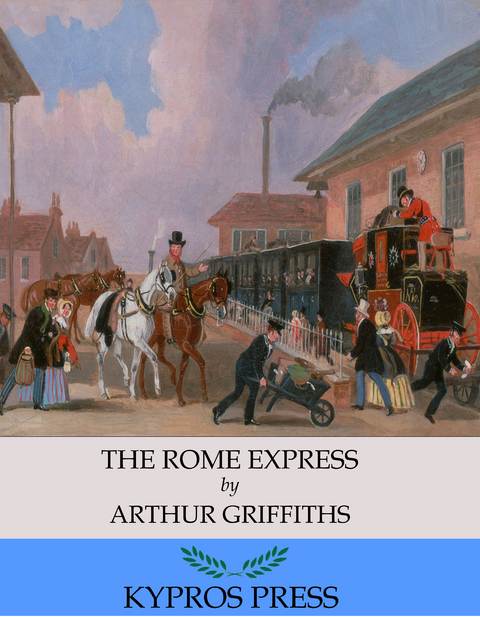
Rome Express (eBook)
142 Seiten
Charles River Editors (Verlag)
9781508019527 (ISBN)
"e;A mysterious murder on a flying express train, a wily Italian, a charming woman caught in the meshes of circumstantial evidence, a chivalrous Englishman, and a police force with a keen nose for the wrong clue, are the ingredients from which Major Griffiths has concocted a clever, up-to-date detective story. The book is bright and spirited, with rapid action, and consistent development which brings the story to a logical and dramatic ending."e;
CHAPTER II
M. FLOÇON, THE CHIEF, was an early man, and he paid a first visit to his office about 7 A.M.
He lived just round the corner in the Rue des Arcs, and had not far to go to the Prefecture. But even now, soon after daylight, he was correctly dressed, as became a responsible ministerial officer. He wore a tight frock coat and an immaculate white tie; under his arm he carried the regulation portfolio, or lawyer’s bag, stuffed full of reports, dispositions, and documents dealing with cases in hand. He was altogether a very precise and natty little personage, quiet and unpretending in demeanour, with a mild, thoughtful face in which two small ferrety eyes blinked and twinkled behind gold-rimmed glasses. But when things went wrong, when he had to deal with fools, or when scent was keen, or the enemy near, he would become as fierce and eager as any terrier.
He had just taken his place at his table and begun to arrange his papers, which, being a man of method, he kept carefully sorted by lots each in an old copy of the Figaro, when he was called to the telephone. His services were greatly needed, as we know, at the Lyons station and the summons was to the following effect:
“Crime on train No. 45. A man murdered in the sleeper. All the passengers held. Please come at once. Most important.”
A fiacre was called instantly, and M. Floçon, accompanied by Galipaud and Block, the two first inspectors for duty, was driven with all possible speed across Paris.
He was met outside the station, just under the wide verandah, by the officials, who gave him a brief outline of the facts, so far as they were known, and as they have already been put before the reader.
“The passengers have been detained?” asked M. Floçon at once.
“Those in the sleeping-car only—”
“Tut, tut! they should have been all kept—at least until you had taken their names and addresses. Who knows what they might not have been able to tell?”
It was suggested that as the crime was committed presumably while the train was in motion, only those in the one car could be implicated.
“We should never jump to conclusions,” said the Chief snappishly. “Well, show me the train card—the list of the travellers in the sleeper.”
“It cannot be found, sir.”
“Impossible! Why, it is the porter’s business to deliver it at the end of the journey to his superiors, and under the law—to us. Where is the porter? In custody?”
“Surely, sir, but there is something wrong with him.”
“So I should think! Nothing of this kind could well occur without his knowledge. If he was doing his duty—unless, of course, he—but let us avoid hasty conjectures.”
“He has also lost the passengers’ tickets, which you know he retains till the end of the journey. After the catastrophe, however, he was unable to lay his hand upon his pocket-book. It contained all his papers.”
“Worse and worse. There is something behind all this. Take me to him. Stay, can I have a private room close to the other—where the prisoners, those held on suspicion, are? It will be necessary to hold investigations, take their depositions. M. le Juge will be here directly.”
M. Floçon was soon installed in a room actually communicating with the waiting-room, and as a preliminary of the first importance, taking precedence even of the examination of the sleeping-car, he ordered the porter to be brought in to answer certain questions.
The man, Ludwig Groote, as he presently gave his name, thirty-two years of age, born at Amsterdam, looked such a sluggish, slouching, blear-eyed creature that M. Floçon began by a sharp rebuke.
“Now. Sharp! Are you always like this?” cried the Chief.
The porter still stared straight before him with lack-lustre eyes, and made no immediate reply.
“Are you drunk? are you—Can it be possible?” he said, and in vague reply to a sudden strong suspicion, he went on:
“What were you doing between Laroche and Paris? Sleeping?”
The man roused himself a little. “I think I slept. I must have slept. I was very drowsy. I had been up two nights; but so it is always, and I am not like this generally. I do not understand.”
“Hah!” The Chief thought he understood. “Did you feel this drowsiness before leaving Laroche?”
“No, monsieur, I did not. Certainly not. I was fresh till then—quite fresh.”
“Hum; exactly; I see;” and the little Chief jumped to his feet and ran round to where the porter stood sheepishly, and sniffed and smelt at him.
“Yes, yes.” Sniff, sniff, sniff, the little man danced round and round him, then took hold of the porter’s head with one hand, and with the other turned down his lower eyelid so as to expose the eyeball, sniffed a little more, and then resumed his seat.
“Exactly. And now, where is your train card?”
“Pardon, monsieur, I cannot find it.”
“That is absurd. Where do you keep it? Look again—search—I must have it.”
The porter shook his head hopelessly.
“It is gone, monsieur, and my pocket-book.”
“But your papers, the tickets—”
“Everything was in it, monsieur. I must have dropped it.”
Strange, very strange. However—the fact was to be recorded, for the moment. He could of course return to it.
“You can give me the names of the passengers?”
“No, monsieur. Not exactly. I cannot remember, not enough to distinguish between them.”
“Fichtre! But this is most devilishly irritating. To think that I have to do with a man so stupid—such an idiot, such an ass!”
“At least you know how the berths were occupied, how many in each, and which persons? Yes? You can tell me that? Well, go on. By and by we will have the passengers in, and you can fix their places, after I have ascertained their names. Now, please! For how many was the car?”
“Sixteen. There were two compartments of four berths each, and four of two berths each.”
“Stay, let us make a plan. I will draw it. Here, now, is that right?” and the Chief held up the rough diagram, here shown—
[Illustration: Diagram of railroad car.]
“Here we have the six compartments. Now take a, with berths 1, 2, 3, and 4. Were they all occupied?”
“No; only two, by Englishmen. I know that they talked English, which I understand a little. One was a soldier; the other, I think, a clergyman, or priest.”
“Good! we can verify that directly. Now, b, with berths 5 and 6. Who was there?”
“One gentleman. I don’t remember his name. But I shall know him by appearance.”
“Go on. In c, two berths, 7 and 8?”
“Also one gentleman. It was he who—I mean, that is where the crime occurred.”
“Ah, indeed, in 7 and 8? Very well. And the next, 9 and 10?”
“A lady. Our only lady. She came from Rome.”
“One moment. Where did the rest come from? Did any embark on the road?”
“No, monsieur; all the passengers travelled through from Rome.”
“The dead man included? Was he Roman?”
“That I cannot say, but he came on board at Rome.”
“Very well. This lady—she was alone?”
“In the compartment, yes. But not altogether.”
“I do not understand!”
“She had her servant with her.”
“In the car?”
“No, not in the car. As a passenger by second class. But she came to her mistress sometimes, in the car.”
“For her service, I presume?”
“Well, yes, monsieur, when I would permit it. But she came a little too often, and I was compelled to protest, to speak to Madame la Comtesse—”
“She was a countess, then?”
“The maid addressed her by that title. That is all I know. I heard her.”
“When did you see the lady’s maid last?”
“Last night. I think at Amberieux. about 8 p.m.”
“Not this morning?”
“No, sir, I am quite sure of that.”
“Not at Laroche? She did not come on board to stay, for the last stage, when her mistress would be getting up, dressing, and likely to require her?”
“No; I should not have permitted it.”
“And where is the maid now, d’you suppose?”
The porter looked at him with an air of complete imbecility.
“She is surely somewhere near, in or about the station. She would hardly desert her mistress now,” he said, stupidly, at last.
“At any rate we can soon settle that.” The Chief turned to one of his assistants, both of whom had been standing behind him all the time, and said:
“Step out, Galipaud, and see. No, wait. I am nearly as stupid as this simpleton. Describe this maid.”
“Tall and slight, dark-eyed, very black hair. Dressed all in black, plain black bonnet. I cannot remember...
| Erscheint lt. Verlag | 22.3.2018 |
|---|---|
| Sprache | englisch |
| Themenwelt | Literatur ► Historische Romane |
| Literatur ► Krimi / Thriller / Horror ► Historische Kriminalromane | |
| Schlagworte | Christie • detective • Doyle • Mystery • Poe • Poirot • Sherlock |
| ISBN-13 | 9781508019527 / 9781508019527 |
| Informationen gemäß Produktsicherheitsverordnung (GPSR) | |
| Haben Sie eine Frage zum Produkt? |
 EPUB (Adobe DRM)
Größe: 496 KB
Kopierschutz: Adobe-DRM
Adobe-DRM ist ein Kopierschutz, der das eBook vor Mißbrauch schützen soll. Dabei wird das eBook bereits beim Download auf Ihre persönliche Adobe-ID autorisiert. Lesen können Sie das eBook dann nur auf den Geräten, welche ebenfalls auf Ihre Adobe-ID registriert sind.
Details zum Adobe-DRM
Dateiformat: EPUB (Electronic Publication)
EPUB ist ein offener Standard für eBooks und eignet sich besonders zur Darstellung von Belletristik und Sachbüchern. Der Fließtext wird dynamisch an die Display- und Schriftgröße angepasst. Auch für mobile Lesegeräte ist EPUB daher gut geeignet.
Systemvoraussetzungen:
PC/Mac: Mit einem PC oder Mac können Sie dieses eBook lesen. Sie benötigen eine
eReader: Dieses eBook kann mit (fast) allen eBook-Readern gelesen werden. Mit dem amazon-Kindle ist es aber nicht kompatibel.
Smartphone/Tablet: Egal ob Apple oder Android, dieses eBook können Sie lesen. Sie benötigen eine
Geräteliste und zusätzliche Hinweise
Buying eBooks from abroad
For tax law reasons we can sell eBooks just within Germany and Switzerland. Regrettably we cannot fulfill eBook-orders from other countries.
EPUB (Ohne DRM)Digital Rights Management: ohne DRM
Dieses eBook enthält kein DRM oder Kopierschutz. Eine Weitergabe an Dritte ist jedoch rechtlich nicht zulässig, weil Sie beim Kauf nur die Rechte an der persönlichen Nutzung erwerben.
Dateiformat: EPUB (Electronic Publication)
EPUB ist ein offener Standard für eBooks und eignet sich besonders zur Darstellung von Belletristik und Sachbüchern. Der Fließtext wird dynamisch an die Display- und Schriftgröße angepasst. Auch für mobile Lesegeräte ist EPUB daher gut geeignet.
Systemvoraussetzungen:
PC/Mac: Mit einem PC oder Mac können Sie dieses eBook lesen. Sie benötigen dafür die kostenlose Software Adobe Digital Editions.
eReader: Dieses eBook kann mit (fast) allen eBook-Readern gelesen werden. Mit dem amazon-Kindle ist es aber nicht kompatibel.
Smartphone/Tablet: Egal ob Apple oder Android, dieses eBook können Sie lesen. Sie benötigen dafür eine kostenlose App.
Geräteliste und zusätzliche Hinweise
Buying eBooks from abroad
For tax law reasons we can sell eBooks just within Germany and Switzerland. Regrettably we cannot fulfill eBook-orders from other countries.
aus dem Bereich