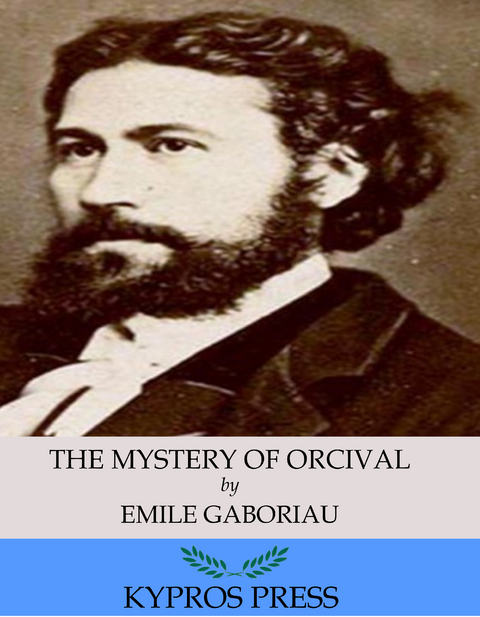
Mystery of Orcival (eBook)
415 Seiten
Charles River Editors (Verlag)
9781508019008 (ISBN)
Emile Gaboriau was a renowned 19th century French writer who wrote a number of mystery classics that helped revolutionize the genre. This is one of his most famous works.
“Good,” said M. Lecoq.
“Observe that I am not positive,” returned the doctor quickly. “I merely state a probability. The phenomena on which I base my own conviction are too fugitive, too capricious in their nature, to enable me to be absolutely certain.”
This seemed to disturb M. Lecoq.
“But, from the moment when—”
“What I can affirm,” interrupted Dr. Gendron, “what I would affirm under oath, is, that all the wounds on the head, excepting one, were inflicted after death. No doubt of that whatever—none whatever. Here, above the eye, is the blow given while the countess was alive.”
“It seems to me, Doctor,” observed M. Lecoq, “that we may conclude from the proved fact that the countess, after death, was struck by a flat implement, that she had also ceased to live when she was mutilated by the knife.”
M. Gendron reflected a moment.
“It is possible that you are right; as for me, I am persuaded of it. Still the conclusions in my report will not be yours. The physician consulted by the law, should only pronounce upon patent, demonstrated facts. If he has a doubt, even the slightest, he should hold his tongue. I will say more; if there is any uncertainty, my opinion is that the accused, and not the prosecution, should have the benefit of it.”
This was certainly not the detective’s opinion, but he was cautious not to say so. He had followed Dr. Gendron with anxious attention, and the contraction of his face showed the travail of his mind.
“It seems to me now possible,” said he, “to determine how and where the countess was struck.”
The doctor had covered the body, and Plantat had replaced the lamp on the little table. Both asked M. Lecoq to explain himself.
“Very well,” resumed the detective. “The direction of the wound proves to me that the countess was in her chamber taking tea, seated, her body inclined a little forward, when she was murdered. The assassin came up behind her with his arm raised; he chose his position coolly, and struck her with terrific force. The violence of the blow was such that the victim fell forward, and in the fall, her forehead struck the end of the table; she thus gave herself the only fatal blow which we have discovered on the head.”
M. Gendron looked from one to the other of his companions, who exchanged significant glances. Perhaps he suspected the game they were playing.
“The crime must evidently have been committed as you say,” said he.
There was another embarrassing silence. M. Lecoq’s obstinate muteness annoyed Plantat, who finally asked him:
“Have you seen all you want to see?”
“All for to-day; I shall need daylight for what remains. I am confident, indeed, that with the exception of one detail that worries me, I have the key to the mystery.”
“We must be here, then, early to-morrow morning.”
“I will be here at any hour you will name.”
“Your search finished, we will go together to Monsieur Domini, at
Corbeil.”
“I am quite at your orders.”
There was another pause.
M. Plantat perceived that M. Lecoq guessed his thoughts; and did not understand the detective’s capriciousness; a little while before, he had been very loquacious, but now held his tongue. M. Lecoq, on the other hand, was delighted to puzzle the old man a little, and formed the intention to astonish him the next morning, by giving him a report which should faithfully reflect all his ideas. Meanwhile he had taken out his lozenge-box, and was intrusting a hundred secrets to the portrait.
“Well,” said the doctor, “there remains nothing more to be done except to retire.”
“I was just going to ask permission to do so,” said M. Lecoq. “I have been fasting ever since morning.”
M. Plantat now took a bold step.
“Shall you return to Paris to-night, Monsieur Lecoq?” asked he, abruptly.
“No; I came prepared to remain over-night; I’ve brought my night-gown, which I left, before coming up here, at the little roadside inn below. I shall sup and sleep there.”
“You will be poorly off at the Faithful Grenadier,” said the old justice of the peace. “You will do better to come and dine with me.”
“You are really too good, Monsieur—”
“Besides, we have a good deal to say, and so you must remain the night with me; we will get your night-clothes as we pass along.”
M. Lecoq bowed, flattered and grateful for the invitation.
“And I shall carry you off, too, Doctor,” continued M. Plantat, “whether you will or not. Now, don’t say no. If you insist on going to Corbeil to-night, we will carry you over after supper.”
The operation of fixing the seals was speedily concluded; narrow strips of parchment, held by large waxen seals, were affixed to all the doors, as well as to the bureau in which the articles gathered for the purposes of the investigation had been deposited.
IX
Despite the haste they made, it was nearly ten o’clock when M. Plantat and his guests quitted the chateau of Valfeuillu. Instead of taking the high road, they cut across a pathway which ran along beside Mme. de Lanascol’s park, and led diagonally to the wire bridge; this was the shortest way to the inn where M. Lecoq had left his slight baggage. As they went along, M. Plantat grew anxious about his good friend, M. Courtois.
“What misfortune can have happened to him?” said he to Dr. Gendron.
“Thanks to the stupidity of that rascal of a servant, we learned nothing at all. This letter from Mademoiselle Laurence has caused the trouble, somehow.”
They had now reached the Faithful Grenadier.
A big red-faced fellow was smoking a long pipe at the door, his back against the house. He was talking with a railway employee. It was the landlord.
“Well, Monsieur Plantat,” he cried, “what a horrible affair this is! Come in, come in; there are several folks in the hall who saw the assassins. What a villain old Bertaud is! And that Guespin; ah, I would willingly trudge to Corbeil to see them put up the scaffold!”
“A little charity, Master Lenfant; you forget that both these men were among your best customers.”
Master Lenfant was confused by this reply; but his native impudence soon regained the mastery.
“Fine customers, parbleu!” he answered, “this thief of a Guespin has got thirty francs of mine which I’ll never see again.”
“Who knows?” said Plantat, ironically. “Besides, you are going to make more than that to-night, there’s so much company at the Orcival festival.”
During this brief conversation, M. Lecoq entered the inn for his night-gown. His office being no longer a secret, he was not now welcomed as when he was taken for a simple retired haberdasher. Mme. Lenfant, a lady who had no need of her husband’s aid to show penniless sots the door, scarcely deigned to answer him. When he asked how much he owed, she responded, with a contemptuous gesture, “Nothing.” When he returned to the door, his night-gown in hand, M. Plantat said:
“Let’s hurry, for I want to get news of our poor mayor.”
The three hastened their steps, and the old justice of the peace, oppressed with sad presentiments, and trying to combat them, continued:
“If anything had happened at the mayor’s, I should certainly have been informed of it by this time. Perhaps Laurence has written that she is ill, or a little indisposed. Madame Courtois, who is the best woman in the world, gets excited about nothing; she probably wanted to send her husband for Laurence at once. You’ll see that it’s some false alarm.”
No; some catastrophe had happened. A number of the village women were standing before the mayor’s gate. Baptiste, in the midst of the group, was ranting and gesticulating. But at M. Plantat’s approach, the women fled like a troop of frightened gulls. The old man’s unexpected appearance annoyed the placid Baptiste not a little, for he was interrupted, by the sudden departure of his audience, in the midst of a superb oratorical flight. As he had a great fear of M. Plantat, however, he dissimulated his chagrin with his habitual smile.
“Ah, sir,” cried he, when M. Plantat was three steps off, “ah, what an affair! I was going for you—”
“Does your master wish me?”
“More than you can think. He ran so fast from Valfeuillu here, that I could scarcely keep up with him. He’s not usually fast, you know; but you ought to have seen him this time, fat as he is!”
M. Plantat stamped impatiently.
“Well, we got here at last,” resumed the man, “and monsieur rushed into the drawing-room, where he found madame sobbing like a Magdalene. He was so out of breath he could scarcely speak. His eyes stuck out of his head, and he stuttered like this—’What’s-the-matter? What’s the-matter?’ Madame, who couldn’t speak either, held out mademoiselle’s letter, which she had in her hand.”
The three auditors were on coals of fire; the rogue...
| Erscheint lt. Verlag | 22.3.2018 |
|---|---|
| Sprache | englisch |
| Themenwelt | Literatur ► Historische Romane |
| Literatur ► Krimi / Thriller / Horror ► Historische Kriminalromane | |
| Schlagworte | Christie • detective • Doyle • Mystery • Poe • Poirot • Sherlock |
| ISBN-13 | 9781508019008 / 9781508019008 |
| Informationen gemäß Produktsicherheitsverordnung (GPSR) | |
| Haben Sie eine Frage zum Produkt? |
 EPUB (Adobe DRM)
Größe: 564 KB
Kopierschutz: Adobe-DRM
Adobe-DRM ist ein Kopierschutz, der das eBook vor Mißbrauch schützen soll. Dabei wird das eBook bereits beim Download auf Ihre persönliche Adobe-ID autorisiert. Lesen können Sie das eBook dann nur auf den Geräten, welche ebenfalls auf Ihre Adobe-ID registriert sind.
Details zum Adobe-DRM
Dateiformat: EPUB (Electronic Publication)
EPUB ist ein offener Standard für eBooks und eignet sich besonders zur Darstellung von Belletristik und Sachbüchern. Der Fließtext wird dynamisch an die Display- und Schriftgröße angepasst. Auch für mobile Lesegeräte ist EPUB daher gut geeignet.
Systemvoraussetzungen:
PC/Mac: Mit einem PC oder Mac können Sie dieses eBook lesen. Sie benötigen eine
eReader: Dieses eBook kann mit (fast) allen eBook-Readern gelesen werden. Mit dem amazon-Kindle ist es aber nicht kompatibel.
Smartphone/Tablet: Egal ob Apple oder Android, dieses eBook können Sie lesen. Sie benötigen eine
Geräteliste und zusätzliche Hinweise
Buying eBooks from abroad
For tax law reasons we can sell eBooks just within Germany and Switzerland. Regrettably we cannot fulfill eBook-orders from other countries.
EPUB (Ohne DRM)Digital Rights Management: ohne DRM
Dieses eBook enthält kein DRM oder Kopierschutz. Eine Weitergabe an Dritte ist jedoch rechtlich nicht zulässig, weil Sie beim Kauf nur die Rechte an der persönlichen Nutzung erwerben.
Dateiformat: EPUB (Electronic Publication)
EPUB ist ein offener Standard für eBooks und eignet sich besonders zur Darstellung von Belletristik und Sachbüchern. Der Fließtext wird dynamisch an die Display- und Schriftgröße angepasst. Auch für mobile Lesegeräte ist EPUB daher gut geeignet.
Systemvoraussetzungen:
PC/Mac: Mit einem PC oder Mac können Sie dieses eBook lesen. Sie benötigen dafür die kostenlose Software Adobe Digital Editions.
eReader: Dieses eBook kann mit (fast) allen eBook-Readern gelesen werden. Mit dem amazon-Kindle ist es aber nicht kompatibel.
Smartphone/Tablet: Egal ob Apple oder Android, dieses eBook können Sie lesen. Sie benötigen dafür eine kostenlose App.
Geräteliste und zusätzliche Hinweise
Buying eBooks from abroad
For tax law reasons we can sell eBooks just within Germany and Switzerland. Regrettably we cannot fulfill eBook-orders from other countries.
aus dem Bereich