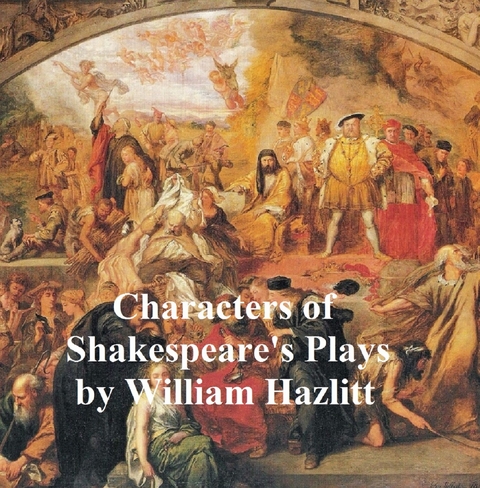
Characters of Shakespeare's Plays (eBook)
907 Seiten
Seltzer Books (Verlag)
978-1-4553-0363-2 (ISBN)
According to the Preface: "e;It is observed by Mr. Pope, that 'If ever any author deserved the name of an ORIGINAL, it was Shakespeare. Homer himself drew not his art so immediately from the fountains of nature; it proceeded through AEgyptian strainers and channels, and came to him not without some tincture of the learning, or some cast of the models, of those before him. The poetry of Shakespeare was inspiration: indeed, he is not so much an imitator, as an instrument of nature; and it is not so just to say that he speaks from her, as that she speaks through him."e;
PREFACE
It is observed by Mr. Pope, that 'If ever any author deserved the name of an ORIGINAL, it was Shakespeare. Homer himself drew not his art so immediately from the fountains of nature; it proceeded through AEgyptian strainers and channels, and came to him not without some tincture of the learning, or some cast of the models, of those before him. The poetry of Shakespeare was inspiration: indeed, he is not so much an imitator, as an instrument of nature; and it is not so just to say that he speaks from her, as that she speaks through him.
His CHARACTERS are so much nature herself, that it is a sort of injury to call them by so distant a name as copies of her. Those of other poets have a constant resemblance, which shows that they received them from one another, and were but multipliers of the same image: each picture, like a mock-rainbow, is but the reflection of a reflection. But every single character in Shakespeare, is as much an individual, as those in life itself; it is as impossible to find any two alike; and such, as from their relation or affinity in any respect appear most to be twins, will, upon comparison, be found remarkably distinct. To this life and variety of character, we must add the wonderful preservation of it; which is such throughout his plays, that had all the speeches been printed without the very names of the persons, I believe one might have applied them with certainty to every speaker.'
The object of the volume here offered to the public, is to illustrate these remarks in a more particular manner by a reference to each play. A gentleman of the name of Mason, [Footnote: Hazlitt is here mistaken. The work to which he alludes, 'Remarks on some of the Characters of Shakespeare, by the Author of Observations on Modern Gardening', was by Thomas Whately, Under-Secretary of State under Lord North. Whately died in 1772, and the Essay was published posthumously in 1785 [2nd edition, 1808; 3rd edition, with a preface by Archbishop Whately, the author's nephew, 1839]. Hazlitt confused T. Whately's Observations on Modern Gardening with George Mason's Essay on Design in Gardening, and the one error led to the other.] the author of a Treatise on Ornamental Gardening (not Mason the poet), began a work of a similar kind about forty years ago, but he only lived to finish a parallel between the characters of Macbeth and Richard III which is an exceedingly ingenious piece of analytical criticism. Richardson's Essays include but a few of Shakespeare's principal characters. The only work which seemed to supersede the necessity of an attempt like the present was Schlegel's very admirable Lectures on the Drama, which give by far the best account of the plays of Shakespeare that has hitherto appeared. The only circumstances in which it was thought not impossible to improve on the manner in which the German critic has executed this part of his design, were in avoiding an appearance of mysticism in his style, not very attractive to the English reader, and in bringing illustrations from particular passages of the plays themselves, of which Schlegel's work, from the extensiveness of his plan, did not admit. We will at the same time confess, that some little jealousy of the character of the national understanding was not without its share in producing the following undertaking, for 'we were piqued' that it should be reserved for a foreign critic to give 'reasons for the faith which we English have in Shakespeare'. Certainly, no writer among ourselves has shown either the same enthusiastic admiration of his genius, or the same philosophical acuteness in pointing out his characteristic excellences. As we have pretty well exhausted all we had to say upon this subject in the body of the work, we shall here transcribe Schlegel's general account of Shakespeare, which is in the following words:
'Never, perhaps, was there so comprehensive a talent for the delineation of character as Shakespeare's. It not only grasps the diversities of rank, sex, and age, down to the dawnings of infancy; not only do the king and the beggar, the hero and the pickpocket, the sage and the idiot, speak and act with equal truth; not only does he transport himself to distant ages and foreign nations, and pourtray in the most accurate manner, with only a few apparent violations of costume, the spirit of the ancient Romans, of the French in their wars with the English, of the English themselves during a great part of their history, of the Southern Europeans (in the serious part of many comedies) the cultivated society of that time, and the former rude and barbarous state of the North; his human characters have not only such depth and precision that they cannot be arranged under classes, and are inexhaustible, even in conception:--no--this Prometheus not merely forms men, he opens the gates of the magical world of spirits; calls up the midnight ghost; exhibits before us his witches amidst their unhallowed mysteries; peoples the air with sportive fairies and sylphs:--and these beings, existing only in imagination, possess such truth and consistency, that even when deformed monsters like Caliban, he extorts the conviction, that if there should be such beings, they would so conduct themselves. In a word, as he carries with him the most fruitful and daring fancy into the kingdom of nature,--on the other hand, he carries nature into the regions of fancy, lying beyond the confines of reality. We are lost in astonishment at seeing the extraordinary, the wonderful, and the unheard of, in such intimate nearness.
'If Shakespeare deserves our admiration for his characters, he is equally deserving of it for his exhibition of passion, taking this word in its widest signification, as including every mental condition, every tone from indifference or familiar mirth to the wildest rage and despair. He gives us the history of minds; he lays open to us, in a single word, a whole series of preceding conditions. His passions do not at first stand displayed to us in all their height, as is the case with so many tragic poets, who, in the language of Lessing, are thorough masters of the legal style of love. He paints, in a most inimitable manner, the gradual progress from the first origin. "He gives", as Lessing says, "a living picture of all the most minute and secret artifices by which a feeling steals into our souls; of all the imperceptible advantages which it there gains; of all the stratagems by which every other passion is made subservient to it, till it becomes the sole tyrant of our desires and our aversions." Of all poets, perhaps, he alone has pourtrayed the mental diseases,--melancholy, delirium, lunacy,-- with such inexpressible, and, in every respect, definite truth, that the physician may enrich his observations from them in the same manner as from real cases.
'And yet Johnson has objected to Shakespeare, that his pathos is not always natural and free from affectation. There are, it is true, passages, though, comparatively speaking, very few, where his poetry exceeds the bounds of true dialogue, where a too soaring imagination, a too luxuriant wit, rendered the complete dramatic forgetfulness of himself impossible. With this exception, the censure originates only in a fanciless way of thinking, to which everything appears unnatural that does not suit its own tame insipidity. Hence, an idea has been formed of simple and natural pathos, which consists in exclamations destitute of imagery, and nowise elevated above every-day life. But energetical passions electrify the whole of the mental powers, and will, consequently, in highly favoured natures, express themselves in an ingenious and figurative manner. It has been often remarked, that indignation gives wit; and, as despair occasionally breaks out into laughter, it may sometimes also give vent to itself in antithetical comparisons.
'Besides, the rights of the poetical form have not been duly weighed. Shakespeare, who was always sure of his object, to move in a sufficiently powerful manner when he wished to do so, has occasionally, by indulging in a freer play, purposely moderated the impressions when too painful, and immediately introduced a musical alleviation of our sympathy. He had not those rude ideas of his art which many moderns seem to have, as if the poet, like the clown in the proverb, must strike twice on the same place. An ancient rhetorician delivered a caution against dwelling too long on the excitation of pity; for nothing, he said, dries so soon as tears; and Shakespeare acted conformably to this ingenious maxim, without knowing it.
"The objection, that Shakespeare wounds our feelings by the open display of the most disgusting moral odiousness, harrows up the mind unmercifully, and tortures even our senses by the exhibition of the most insupportable and hateful spectacles, is one of much greater importance. He has never, in fact, varnished over wild and blood- thirsty passions with a pleasing exterior,--never clothed crime and want of principle with a false show of greatness of soul; and in that respect he is every way deserving of praise. Twice he has pourtrayed downright villains; and the masterly way in which he has contrived to elude impressions of too painful a nature, may be seen in Iago and Richard the Third. The constant reference to a petty and puny race must cripple the boldness of the poet. Fortunately for his art, Shakespeare lived in an age extremely susceptible of noble and tender impressions, but which had still enough of the firmness inherited from a vigorous olden time not to shrink back with dismay from every strong and violent picture. We have lived to see tragedies of which the catastrophe consists in the swoon of an enamoured princess. If Shakespeare falls...
| Erscheint lt. Verlag | 1.3.2018 |
|---|---|
| Sprache | englisch |
| Themenwelt | Literatur ► Lyrik / Dramatik ► Dramatik / Theater |
| ISBN-10 | 1-4553-0363-1 / 1455303631 |
| ISBN-13 | 978-1-4553-0363-2 / 9781455303632 |
| Informationen gemäß Produktsicherheitsverordnung (GPSR) | |
| Haben Sie eine Frage zum Produkt? |
 EPUB (Adobe DRM)
Größe: 906 KB
Kopierschutz: Adobe-DRM
Adobe-DRM ist ein Kopierschutz, der das eBook vor Mißbrauch schützen soll. Dabei wird das eBook bereits beim Download auf Ihre persönliche Adobe-ID autorisiert. Lesen können Sie das eBook dann nur auf den Geräten, welche ebenfalls auf Ihre Adobe-ID registriert sind.
Details zum Adobe-DRM
Dateiformat: EPUB (Electronic Publication)
EPUB ist ein offener Standard für eBooks und eignet sich besonders zur Darstellung von Belletristik und Sachbüchern. Der Fließtext wird dynamisch an die Display- und Schriftgröße angepasst. Auch für mobile Lesegeräte ist EPUB daher gut geeignet.
Systemvoraussetzungen:
PC/Mac: Mit einem PC oder Mac können Sie dieses eBook lesen. Sie benötigen eine
eReader: Dieses eBook kann mit (fast) allen eBook-Readern gelesen werden. Mit dem amazon-Kindle ist es aber nicht kompatibel.
Smartphone/Tablet: Egal ob Apple oder Android, dieses eBook können Sie lesen. Sie benötigen eine
Geräteliste und zusätzliche Hinweise
Buying eBooks from abroad
For tax law reasons we can sell eBooks just within Germany and Switzerland. Regrettably we cannot fulfill eBook-orders from other countries.
EPUB (Ohne DRM)Digital Rights Management: ohne DRM
Dieses eBook enthält kein DRM oder Kopierschutz. Eine Weitergabe an Dritte ist jedoch rechtlich nicht zulässig, weil Sie beim Kauf nur die Rechte an der persönlichen Nutzung erwerben.
Dateiformat: EPUB (Electronic Publication)
EPUB ist ein offener Standard für eBooks und eignet sich besonders zur Darstellung von Belletristik und Sachbüchern. Der Fließtext wird dynamisch an die Display- und Schriftgröße angepasst. Auch für mobile Lesegeräte ist EPUB daher gut geeignet.
Systemvoraussetzungen:
PC/Mac: Mit einem PC oder Mac können Sie dieses eBook lesen. Sie benötigen dafür die kostenlose Software Adobe Digital Editions.
eReader: Dieses eBook kann mit (fast) allen eBook-Readern gelesen werden. Mit dem amazon-Kindle ist es aber nicht kompatibel.
Smartphone/Tablet: Egal ob Apple oder Android, dieses eBook können Sie lesen. Sie benötigen dafür eine kostenlose App.
Geräteliste und zusätzliche Hinweise
Buying eBooks from abroad
For tax law reasons we can sell eBooks just within Germany and Switzerland. Regrettably we cannot fulfill eBook-orders from other countries.
aus dem Bereich