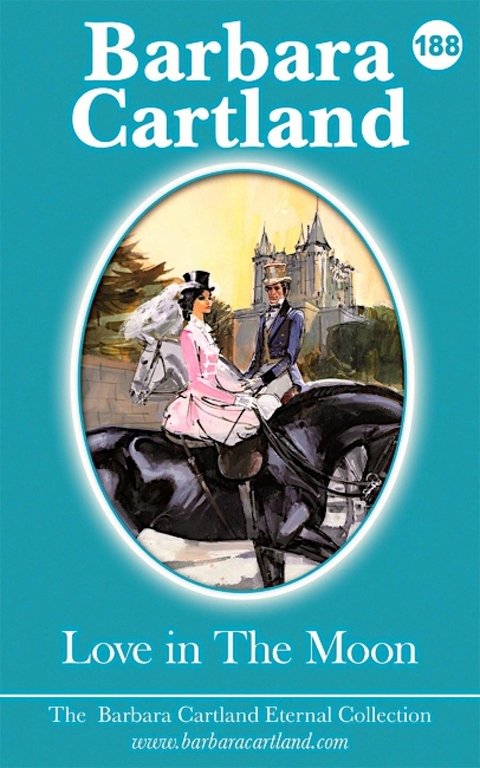
Love in the Moon (eBook)
298 Seiten
Barbara Cartland eBooks Ltd (Verlag)
978-1-78867-034-0 (ISBN)
Barbara Cartland was the world's most prolific novelist who wrote an amazing 723 books in her lifetime, of which no less than 644 were romantic novels with worldwide sales of over 1 billion copies and her books were translated into 36 different languages. As well as romantic novels, she wrote historical biographies, 6 autobiographies, theatrical plays and books of advice on life, love, vitamins and cookery. She wrote her first book at the age of 21 and it was called Jigsaw. It became an immediate bestseller and sold 100,000 copies in hardback in England and all over Europe in translation. Between the ages of 77 and 97 she increased her output and wrote an incredible 400 romances as the demand for her romances was so strong all over the world. She wrote her last book at the age of 97 and it was entitled perhaps prophetically The Way to Heaven. Her books have always been immensely popular in the United States where in 1976 her current books were at numbers 1 & 2 in the B. Dalton bestsellers list, a feat never achieved before or since by any author. Barbara Cartland became a legend in her own lifetime and will be best remembered for her wonderful romantic novels so loved by her millions of readers throughout the world, who have always collected her books to read again and again, especially when they feel miserable or depressed. Her books will always be treasured for their moral message, her pure and innocent heroines, her handsome and dashing heroes, her blissful happy endings and above all for her belief that the power of love is more important than anything else in everyone's life.
Times have been tough for young Lady Caneda Lang and her brother Harry and they neither seek not expect help from the aristocratic French family that ostracised their mother Clementine de Bantome in their outrage at her running away to marry their father, Gerald Lang, whom they considered beneath her.Worse still, the couple incurred the wrath of the much older and powerful Duc de Saumac, to whom Clementine was betrothed and so a bitter vendetta began.Then, overnight, Harry discovers that he is now an Earl! He has unexpectedly inherited the Earldom of Langstone with an ancestral Castle and a large and prosperous estate.Hearing the news, their French grandmother invites them to stay evidently the de Bantomes have fallen on hard times themselves and now have the nerve to ask for help.Apparently their vines have contracted the deadly phylloxera disease that is ravaging vineyards all over Europe and has badly damaged the family s finances.Harry is determined to refuse the invitation, but Caneda is set on journeying to the Dordogne to meet the family and the Duc de Saumac and to wreak her revenge on them for all the years of misery they have caused..But on arrival it is not hatred but love that she finds in beautiful Perigord!
Chapter 2
With its white sails billowing out in the wind, The Seagull nosed its way slowly into the port of St. Nazaire.
Canèda had been on deck since dawn as they sailed past Belle Île and entered the harbour.
She was so excited that she had found it almost impossible to sleep since she had left Folkestone. It was there that the late Earl’s yacht had been moored in order always to be ready to carry its owner across the Channel anytime that he wished to go.
She was certain that Harry would soon avail himself of this new toy, but there were so many other distractions among his possessions that he had been quite content for Canèda to see and use The Seagull first.
The Seagull had been commissioned by their uncle only three years before he died and therefore it was of the most up to date design. To Canèda’s delight, there was plenty of room to carry quite a number of horses besides a travelling chariot.
She had been a little apprehensive lest the sea should be rough and the horses upset, especially Ariel, but Ben, who was in charge, had been very reassuring.
“Now you leave it to me. Miss Canèda, I means my Lady,” he said. “The horses’ll be all right, I’ll see to that.”
Canèda knew he meant what he said, and there was no doubt that Ben was a wizard not only in training the horses but in looking after them.
When Canèda was fourteen, she had rushed into her father’s study to tell him that there was news of a circus coming to the small market town that was only two miles from where they lived.
“We must see it, Papa. You must take me to the circus!” Canèda had cried.
“I hate to see wild animals in captivity,” Gerald Lang had replied.
“It is not the wild animals I want to see,” Canèda answered, “but a poster hanging up in the village says that there is a performing horse that will obey every command she is given, which makes her the cleverest animal in the world.”
Gerald Lang had looked sceptical, but because Canèda was so insistent that in the end he promised to take her to the circus.
He knew exactly the tumbledown show it would be, consisting of a few mangy old horses, some clowns who were not very funny, a Ringmaster who doubtless owned the circus and drank away his financial troubles and if they were fortunate a couple of acrobats.
But he was well aware that for Canèda, living very quietly in the country and especially with Harry away at school, it would be a delight that would rival Ashley’s Circus in London.
Clémentine Lang had said she was too busy in the house to accompany them and father and daughter had set off.
They travelled in the old-fashioned gig, which Gerald Lang drove with an expertise and a flourish that made Canèda aware that he should have had an up to date chaise with two or even four superlative horses.
The gig had been the only form of transport they could afford, but as far as she was concerned she was so happy to be with her father that nothing else mattered.
They reached the small town and Gerald Lang saw that there was the usual collection of farmers’ wives selling their wares in the marketplace with the townsfolk taking a long time to make up their minds whether they should buy an old hen suitable for boiling or a more expensive fat chicken to roast.
There were turnips, beets and cabbages brought in from the countryside, pats of golden butter, honeycomb and inevitably rabbits and hares that had been trapped or snared, regardless of what time of year it was.
Canèda was not interested in the market that stood in the middle of the town.
She was waiting breathlessly for her father to drive to where, in the field that sloped down to the river, the circus had been erected.
There was a big tent that let in the rain in bad weather and there was a sawdust ring with rows of rickety seats round it They had gone for too many months without repair and at any unexpected moment were likely to precipitate to the ground those who sat on them.
There was a band playing and to Canèda the Ringmaster in his red coat, top hat and cracking his long whip, was very impressive as he introduced his performers to an audience that consisted mostly of gaping children, a few farmhands and some giggling girls.
The first turn was quite ordinary, at least to Gerald Lang, and consisted of four grey horses with feathers on their bridles and ballerinas perched precariously on their backs.
He thought that the horses looked as old as their riders and there was certainly not much skill in raising a leg above a frilly ballet skirt while holding on tightly to the front of the saddle.
But Canèda’s small face was rapt with enjoyment and Gerald Lang said nothing but watched his daughter rather than the performers.
The clowns made her laugh and there was an acrobatic turn that made her hold her breath.
Then the Ringmaster announced,
“Now, ladies and gentlemen, you’ll see the most sensational, the most intelligent, the most unusual horse in the world. Her name is ‘Juno’ and she understands every word that is said to her. She also can dance in a manner that no other horse has been able to do in all my long experience of them.”
There was applause from the crowd as Juno came into the ring.
She was black with a white star on her nose and Gerald Lang saw that she had once undoubtedly been a very fine mare but was now getting old.
Riding her was a small jockey with an ugly impudent face, a disarming grin and twinkling eyes. He made her perform as if she was a musical instrument in the hands of a Master of the art.
Juno waltzed in time to the band and then she danced the polka, which had just become fashionable. She walked on her hind legs and answered questions by shaking or nodding her head.
Finally when jumps had been erected round the ring, Juno sailed over them in a style that made Canèda clap her hands wildly at such a brilliant performance.
The enthusiastic applause of everyone in the big tent made her rider decide that she should take the jumps once again and now with a roll of the drums she started off, taking each fence in a way that made her seem almost to fly through the air.
Quite suddenly when she reached the last fence of all, she rose off the ground, seemed to stagger and the next moment, almost before anyone could realise what was happening, she crashed down on the other side of the fence in a crumpled heap.
There was a scream from the women in the audience, a groan from the men and Canèda clutched at her father’s hand.
“What is happening, Papa?”
“Her heart, I should imagine,” Gerald Lang replied.
“Oh, she cannot die!” Canèda cried. “Please, Papa, see if there is anything you can do. I could not bear that beautiful horse to die in such a manner.”
Because Gerald Lang knew only too well what his daughter was feeling, they went round to the back of the tent as Juno was dragged out of the ring and the clowns went on to take the audience’s mind off the tragedy.
There were a few grooms with the small man who had been riding her when Gerald Lang and Canèda reached them, but it was obvious at first glance that there was nothing anyone could do for the mare.
Juno was dead, because her heart, as Gerald Lang had rightly suspected, had given out.
Canèda crouched down beside the mare and as she did so she saw that the small jockey who had been riding her in his gaudy theatrical costume was now kneeling on the other side.
He was crying unashamedly, tears running down his ugly lined face and his despair was in itself very moving.
“I am so sorry,” Canèda said softly.
“She were a wonderful ’orse.”
“Have you been with her long? Canèda enquired.
“For ten years, miss,” he replied. “I started to train ’er with ’er first Master and when ’e dies ’e gives ’er to me. She were mine, me very own.”
“I know what you must be feeling,” Canèda said softly, “and there is nothing I can say, except that I am so very sorry for you.”
She could understand that he was desolate over losing such a magnificent horse and one who was so clever.
“I’ve got someat to show you, miss, if you’d come with me,” the jockey said.
“Yes, of course,” Canèda agreed.
He rose to his feet and, as she rose too, she found her father standing beside her.
“He has something to show us, Papa,” she said, slipping her hand into his.
Gerald Lang nodded but did not speak. With his daughter he followed the jockey with his red-and-gold-braided coat until they came to a battered tent where all the horses that worked for the circus were housed.
The greys were already back tethered to posts, but still wearing their feathers on the fronts of their bridles as they would be wanted in the finale. But there was one end of the tent shut off from the rest, which appeared at first to be empty until, as the jockey walked into it, Canèda saw something moving.
It was then that she was aware of what he had brought her to see. It was a foal of about six or seven weeks old and already it showed the good breeding of its mother.
As Canèda stroked its neck, it nuzzled its black nose against her and she heard her father say,
“What are you going to do now?”
“I don’t know, sir, and that be the truth,” the little man answered. “Juno were me livin’, so to speak, and it’ll be a year or two afore I can do anythin’ with Ariel and that’ll be too soon for most circuses to be interested in ’im.”
There was something both helpless and hopeless in the way he spoke and Canèda suddenly knew...
| Erscheint lt. Verlag | 1.2.2018 |
|---|---|
| Sprache | englisch |
| Themenwelt | Literatur ► Biografien / Erfahrungsberichte |
| Literatur ► Historische Romane | |
| ISBN-10 | 1-78867-034-5 / 1788670345 |
| ISBN-13 | 978-1-78867-034-0 / 9781788670340 |
| Informationen gemäß Produktsicherheitsverordnung (GPSR) | |
| Haben Sie eine Frage zum Produkt? |
 EPUB (Adobe DRM)
Kopierschutz: Adobe-DRM
Adobe-DRM ist ein Kopierschutz, der das eBook vor Mißbrauch schützen soll. Dabei wird das eBook bereits beim Download auf Ihre persönliche Adobe-ID autorisiert. Lesen können Sie das eBook dann nur auf den Geräten, welche ebenfalls auf Ihre Adobe-ID registriert sind.
Details zum Adobe-DRM
Dateiformat: EPUB (Electronic Publication)
EPUB ist ein offener Standard für eBooks und eignet sich besonders zur Darstellung von Belletristik und Sachbüchern. Der Fließtext wird dynamisch an die Display- und Schriftgröße angepasst. Auch für mobile Lesegeräte ist EPUB daher gut geeignet.
Systemvoraussetzungen:
PC/Mac: Mit einem PC oder Mac können Sie dieses eBook lesen. Sie benötigen eine
eReader: Dieses eBook kann mit (fast) allen eBook-Readern gelesen werden. Mit dem amazon-Kindle ist es aber nicht kompatibel.
Smartphone/Tablet: Egal ob Apple oder Android, dieses eBook können Sie lesen. Sie benötigen eine
Geräteliste und zusätzliche Hinweise
Buying eBooks from abroad
For tax law reasons we can sell eBooks just within Germany and Switzerland. Regrettably we cannot fulfill eBook-orders from other countries.
aus dem Bereich