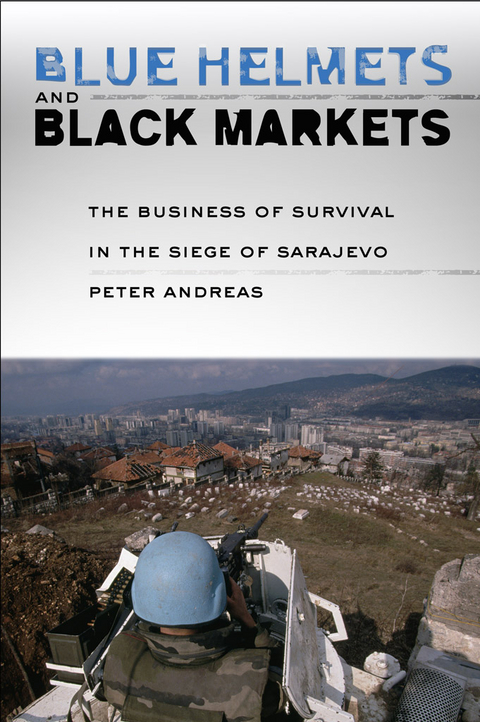
Blue Helmets and Black Markets (eBook)
224 Seiten
Cornell University Press (Verlag)
978-0-8014-5704-3 (ISBN)
A major contribution to our understanding of contemporary urban warfare, war economies, and the political repercussions of humanitarian action.
The 1992–1995 battle for Sarajevo was the longest siege in modern history. It was also the most internationalized, attracting a vast contingent of aid workers, UN soldiers, journalists, smugglers, and embargo-busters. The city took center stage under an intense global media spotlight, becoming the most visible face of post-Cold War conflict and humanitarian intervention. However, some critical activities took place backstage, away from the cameras, including extensive clandestine trading across the siege lines, theft and diversion of aid, and complicity in the black market by peacekeeping forces.
In Blue Helmets and Black Markets, Peter Andreas traces the interaction between these formal front-stage and informal backstage activities, arguing that this created and sustained a criminalized war economy and prolonged the conflict in a manner that served various interests on all sides. Although the vast majority of Sarajevans struggled for daily survival and lived in a state of terror, the siege was highly rewarding for some key local and international players. This situation also left a powerful legacy for postwar reconstruction: new elites emerged via war profiteering and an illicit economy flourished partly based on the smuggling networks built up during wartime. Andreas shows how and why the internationalization of the siege changed the repertoires of siege-craft and siege defenses and altered the strategic calculations of both the besiegers and the besieged. The Sarajevo experience dramatically illustrates that just as changes in weapons technologies transformed siege warfare through the ages, so too has the arrival of CNN, NGOs, satellite phones, UN peacekeepers, and aid convoys.
Drawing on interviews, reportage, diaries, memoirs, and other sources, Andreas documents the business of survival in wartime Sarajevo and the limits, contradictions, and unintended consequences of international intervention. Concluding with a comparison of the battle for Sarajevo with the sieges of Leningrad, Grozny, and Srebrenica, and, more recently, Falluja, Blue Helmets and Black Markets is a major contribution to our understanding of contemporary urban warfare, war economies, and the political repercussions of humanitarian action.
The 1992–1995 battle for Sarajevo was the longest siege in modern history. It was also the most internationalized, attracting a vast contingent of aid workers, UN soldiers, journalists, smugglers, and embargo-busters. The city took center stage under an intense global media spotlight, becoming the most visible face of post-Cold War conflict and humanitarian intervention. However, some critical activities took place backstage, away from the cameras, including extensive clandestine trading across the siege lines, theft and diversion of aid, and complicity in the black market by peacekeeping forces.
In Blue Helmets and Black Markets, Peter Andreas traces the interaction between these formal front-stage and informal backstage activities, arguing that this created and sustained a criminalized war economy and prolonged the conflict in a manner that served various interests on all sides. Although the vast majority of Sarajevans struggled for daily survival and lived in a state of terror, the siege was highly rewarding for some key local and international players. This situation also left a powerful legacy for postwar reconstruction: new elites emerged via war profiteering and an illicit economy flourished partly based on the smuggling networks built up during wartime.
Andreas shows how and why the internationalization of the siege changed the repertoires of siege-craft and siege defenses and altered the strategic calculations of both the besiegers and the besieged. The Sarajevo experience dramatically illustrates that just as changes in weapons technologies transformed siege warfare through the ages, so too has the arrival of CNN, NGOs, satellite phones, UN peacekeepers, and aid convoys. Drawing on interviews, reportage, diaries, memoirs, and other sources, Andreas documents the business of survival in wartime Sarajevo and the limits, contradictions, and unintended consequences of international intervention.
Concluding with a comparison of the battle for Sarajevo with the sieges of Leningrad, Grozny, and Srebrenica, and, more recently, Falluja, Blue Helmets and Black Markets is a major contribution to our understanding of contemporary urban warfare, war economies, and the political repercussions of humanitarian action.
Peter Andreas is John Hay Professor of International Studies at Brown University. He is the author of Border Games and coeditor of Sex, Drugs, and Body Counts, both from Cornell. He is also the author of Smuggler Nation and coauthor of Policing the Globe and Drug War Politics.
Preface1. The Longest Siege
Sarajevo on Center Stage
The Cast of Characters
Front Stage and Backstage: Formal and Informal Roles
Conflict Narratives
Criminalized Conflict Narratives
Preview2. Imposing the Siege
The Road to Siege Warfare
The Start of the Siege and the Criminally Aided Defense
The International Response3. Sustaining the Siege
Diverting and Manipulating Humanitarian Aid
Exploiting the Privileges of Mobility and Access
The UN-Controlled Airport as Smuggling Hub
Tunneling under the Siege: Lifeline and Profit Center
Trading with the Enemy
The Media and Its Dependence on the Black Market
The Money Letter Smuggling System
The Smugglers' Markets and Cigarettes as Currency4. The Siege Within
Criminal Defenders as Predators
Political Corruption, Abuse, and Opportunism
Obstructing Access to Water5. Lifting the Siege
Front Stage:Triggering NATO Air Strikes
Backstage: Shifting the Military Balance by Evading the UN Arms Embargo6. Aftermath
The Criminalized Aftermath of War
The Criminalized New Elite
Sarajevo as Transit Point for Migrant Smuggling
Sex Trafficking and Peacekeeping
The Arizona Market: Peace through Illicit Trade?7. Extensions
Srebrenica
Leningrad
Grozny
FallujaConclusions
Revisiting Sarajevo
Lessons from SarajevoNotes
Index
| Erscheint lt. Verlag | 15.8.2011 |
|---|---|
| Zusatzinfo | 1 map, 7 halftones |
| Verlagsort | Ithaca |
| Sprache | englisch |
| Maße | 150 x 150 mm |
| Gewicht | 28 g |
| Themenwelt | Literatur ► Biografien / Erfahrungsberichte |
| Geisteswissenschaften ► Geschichte ► Regional- / Ländergeschichte | |
| Recht / Steuern ► Strafrecht ► Kriminologie | |
| Sozialwissenschaften ► Politik / Verwaltung ► Europäische / Internationale Politik | |
| Sozialwissenschaften ► Soziologie | |
| Schlagworte | Sarajevo, siege, war economy, humanitarian intervention, black market • Sarajevo, siege, war economy, humanitarian intervention, black market, criminalized war economy, war profiteering, international intervention |
| ISBN-10 | 0-8014-5704-1 / 0801457041 |
| ISBN-13 | 978-0-8014-5704-3 / 9780801457043 |
| Informationen gemäß Produktsicherheitsverordnung (GPSR) | |
| Haben Sie eine Frage zum Produkt? |
 EPUB (Adobe DRM)
Kopierschutz: Adobe-DRM
Adobe-DRM ist ein Kopierschutz, der das eBook vor Mißbrauch schützen soll. Dabei wird das eBook bereits beim Download auf Ihre persönliche Adobe-ID autorisiert. Lesen können Sie das eBook dann nur auf den Geräten, welche ebenfalls auf Ihre Adobe-ID registriert sind.
Details zum Adobe-DRM
Dateiformat: EPUB (Electronic Publication)
EPUB ist ein offener Standard für eBooks und eignet sich besonders zur Darstellung von Belletristik und Sachbüchern. Der Fließtext wird dynamisch an die Display- und Schriftgröße angepasst. Auch für mobile Lesegeräte ist EPUB daher gut geeignet.
Systemvoraussetzungen:
PC/Mac: Mit einem PC oder Mac können Sie dieses eBook lesen. Sie benötigen eine
eReader: Dieses eBook kann mit (fast) allen eBook-Readern gelesen werden. Mit dem amazon-Kindle ist es aber nicht kompatibel.
Smartphone/Tablet: Egal ob Apple oder Android, dieses eBook können Sie lesen. Sie benötigen eine
Geräteliste und zusätzliche Hinweise
Buying eBooks from abroad
For tax law reasons we can sell eBooks just within Germany and Switzerland. Regrettably we cannot fulfill eBook-orders from other countries.
aus dem Bereich