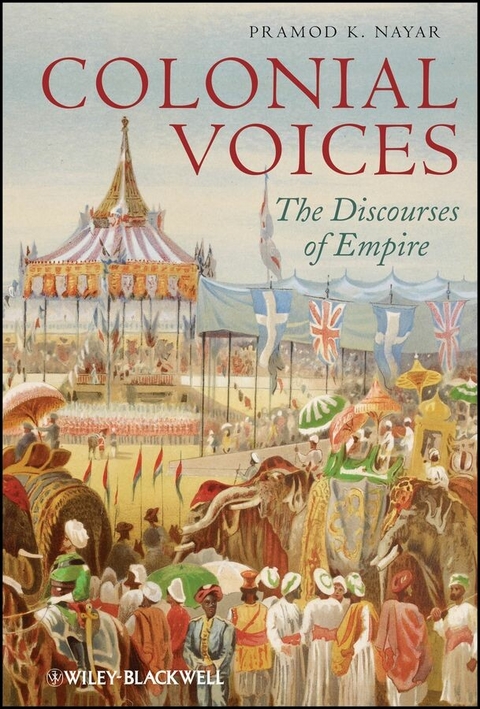
Colonial Voices (eBook)
John Wiley & Sons (Verlag)
978-1-118-27899-4 (ISBN)
- An engaging examination of European colonizers’ representations of native populations
- Analyzes colonial discourse through an impressive range of primary sources, including memoirs, letters, exhibition catalogues, administrative reports, and travelogues
- Surveys 400 years of India’s history, from the 16th century to the end of the British Empire
- Demonstrates how colonial discourses naturalized the racial and cultural differences between the English and the Indians, and controlled anxieties over these differences
This accessible cultural history explores 400 years of British imperial adventure in India, developing a coherent narrative through a wide range of colonial documents, from exhibition catalogues to memoirs and travelogues. It shows how these texts helped legitimize the moral ambiguities of colonial rule even as they helped the English fashion themselves. An engaging examination of European colonizers representations of native populations Analyzes colonial discourse through an impressive range of primary sources, including memoirs, letters, exhibition catalogues, administrative reports, and travelogues Surveys 400 years of India s history, from the 16th century to the end of the British Empire Demonstrates how colonial discourses naturalized the racial and cultural differences between the English and the Indians, and controlled anxieties over these differences
Pramod K. Nayar is a member of the English Faculty at the University of Hyderabad, India. He has been Smuts Visiting Fellow in Commonwealth Studies at the University of Cambridge, the Charles Wallace India Trust-British Council Fellow at the University of Kent at Canterbury and Fulbright Senior Fellow at Cornell University. His many publications include States of Sentiment: Exploring the Cultures of Emotion (2011), An Introduction to New Media and Cybercultures (2010), Postcolonialism: A Guide for the Perplexed (2010), English Writing and India, 1600-1920: Colonizing Aesthetics (2008), and Writing Wrongs: The Cultural Construction of Human Rights in India (2012). Forthcoming is a book on new media.
Acknowledgments vii
1 Introducing Colonial Discourse 1
2 Travel, Exploration, and
''Discovery'': From Imagination to Inquiry
12
Imagining Multiple Worlds: The Fantasy of
''Discovery'' 18
The Narrative Organization of Discovery 29
''Inquiry'' and the Documentation of
the Others 41
Conclusion: ''Discovery'' and Wonder,
''Contracted and Epitomized'' 49
3 The Discourse of Difference: Constructing the Colonial
Exotic 55
The Colony and Imperial Wealth 57
The Exotic in English Culture 59
The Colonial Exotic: Aesthetics, Science, and Difference
60
The Sentimental Exotic 62
The Scientific Exotic 79
Conclusion: From the Indian to the Colonial Exotic 95
4 Empire Management: From Domestication to Spectacle
104
The Domestication of Colonial Spaces 106
Administering Colonial Spaces 121
''Raising the General Credit of the
Empire'': The Spectacle of Empire 140
Conclusion: Imperial Improvisation and the Spectacle
145
5 Civilizing the Empire: The Ideology of Moral and Material
Progress 161
England's Age of Improvement 164
Discipline and Improve 170
Imperial Lessons 174
The Salvific Colonial 178
Rescue, Reform, and Race 183
Conclusion: From Improvement to Self-Legitimization
194
6 Aesthetic Understanding: From Colonial English to Imperial
Cosmopolitans 201
The Self-Fashioning of the Scholar-Colonial 204
Antiquarian Aesthetics and Colonial Authority 213
''Consumption, Ingestion, and
Decoration'': Colonial Commodities 219
The ''Empire City'': Pageantry and
Empire 226
Conclusion: From Colonial English to Imperial
Cosmopolitan 229
References 235
Index 260
"Nayar makes the field of 'colonial discourse studies' irresistible
to anyone seeking to explore the complex relationship between
textual production, (South) Asian Orientalism, and the politics of
empire building."
- Walter S. H. Lim, National University of Singapore
"Drawing on an enormous range of writing, Dr. Nayar provides a
lucid and nuanced analysis of British representations of India as a
continent to be discovered, controlled, 'civilized',
and incorporated. This important book by one of India's
leading scholars gives students and scholars a significantly new
understanding of the complex nature and history of colonial
discourse regarding India."
- C.L.Innes, University of Kent
"A theoretical and historical perspective on colonial
discourse...an impressive demonstration of the nature and power
of discourse using an array of texts from the archive of British
India."
- Nandana Dutta, Gauahati University
| Erscheint lt. Verlag | 28.2.2012 |
|---|---|
| Sprache | englisch |
| Themenwelt | Literatur |
| Geisteswissenschaften ► Geschichte ► Regional- / Ländergeschichte | |
| Geschichte ► Teilgebiete der Geschichte ► Wirtschaftsgeschichte | |
| Geisteswissenschaften ► Sprach- / Literaturwissenschaft ► Anglistik / Amerikanistik | |
| Geisteswissenschaften ► Sprach- / Literaturwissenschaft ► Literaturwissenschaft | |
| Schlagworte | Asian & Australasian History • Colonialism & Imperialism • Geschichte • Geschichte / Asien u. Australasien • History • Kolonialismus u. Imperialismus • Literatur • Literature • Literaturwissenschaft • Political Science • Politikwissenschaft • postcolonial theory • Postcolonial Theory, Studies, Southern Asia History, British Empire, India, Imperial, dominance • Theorie der Postkolonialzeit |
| ISBN-10 | 1-118-27899-2 / 1118278992 |
| ISBN-13 | 978-1-118-27899-4 / 9781118278994 |
| Informationen gemäß Produktsicherheitsverordnung (GPSR) | |
| Haben Sie eine Frage zum Produkt? |
 PDF (Adobe DRM)
Kopierschutz: Adobe-DRM
Adobe-DRM ist ein Kopierschutz, der das eBook vor Mißbrauch schützen soll. Dabei wird das eBook bereits beim Download auf Ihre persönliche Adobe-ID autorisiert. Lesen können Sie das eBook dann nur auf den Geräten, welche ebenfalls auf Ihre Adobe-ID registriert sind.
Details zum Adobe-DRM
Dateiformat: PDF (Portable Document Format)
Mit einem festen Seitenlayout eignet sich die PDF besonders für Fachbücher mit Spalten, Tabellen und Abbildungen. Eine PDF kann auf fast allen Geräten angezeigt werden, ist aber für kleine Displays (Smartphone, eReader) nur eingeschränkt geeignet.
Systemvoraussetzungen:
PC/Mac: Mit einem PC oder Mac können Sie dieses eBook lesen. Sie benötigen eine
eReader: Dieses eBook kann mit (fast) allen eBook-Readern gelesen werden. Mit dem amazon-Kindle ist es aber nicht kompatibel.
Smartphone/Tablet: Egal ob Apple oder Android, dieses eBook können Sie lesen. Sie benötigen eine
Geräteliste und zusätzliche Hinweise
Buying eBooks from abroad
For tax law reasons we can sell eBooks just within Germany and Switzerland. Regrettably we cannot fulfill eBook-orders from other countries.
aus dem Bereich