Education and Role-Playing Games
CRC Press (Verlag)
978-1-041-07616-2 (ISBN)
- Noch nicht erschienen (ca. Februar 2026)
- Versandkostenfrei
- Auch auf Rechnung
- Artikel merken
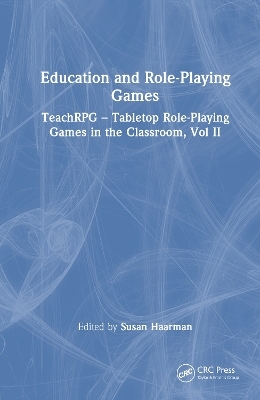
This volume fills a critical gap by centering the voices of practitioner-scholar educators who adapt RPGs to fit their unique disciplines, institutions, and student needs. Contributors share how these games enhance cognitive and affective learning, support marginalized students, and offer meaningful pedagogical opportunities for both instructors and learners. Striking a balance between practical strategies, empirical insight, and personal narrative, Teach RPG provides adaptable models for integrating analog RPGs into a wide range of classrooms. It moves beyond theory or anecdote to show how role-playing can be a rigorous, relational, and inclusive educational practice.
Susan Haarman Ph.D., is Associate Director at Loyola University Chicago’s Center for Engaged Learning, Teaching, and Scholarship. She facilitates the university’s service-learning program and publishes on community-based learning. Her real love is her research on the capacity of tabletop role-playing games as formative tools for civic identity and imagination. She serves on the editorial board of the International Journal of Role-Playing and is also a professional improviser and a licensed therapist.
Introduction, Part I - Roll a Knowledge Check: How Tabletop RPGs Help Us Learn, Chapter 1 - Educational RPGs: A Practitioner’s Guide to Bringing the Gaming Table into the Classroom, Chapter 2 - Tabletop Role-Playing Games in the Classroom: A Systems Thinking Approach for Quick Implementation and Meaningful Learning Outcomes, Chapter 3 - The Impact of Role-playing Game Mechanics on the Classroom Experience, Part II - Playing Together: Creating Inclusive Community in the Classroom Through RPGs, Chapter 4 - Everybody Wins: Role-Playing Games with Students with Disabilities, Chapter 5 - Cripping Tabletop Role-Playing Games: A Critical Analysis of Disability and Inclusion in Inspirisles and Beyond, Part III - Class Features: Discipline Specific Practices, Chapter 6 - At the Crossroads of Composition, Creative Writing, and Technical Writing: A Proposal for Teaching Tabletop Role-Playing Game Design in Higher Education, Chapter 7 - Role-Playing Games and Narrative Identity as Pedagogical Tools in Teaching Fiction: A Reflection from Inside the Classroom, Part IV - Critical Encounters: Games that Challenge and Change, Chapter 8 - Distributed Role-play: A Proposed Game Mechanic for Mitigating Player Harm, Chapter 9 - Teaching Masculinities: The Transformative Potential of Blood Feud
| Erscheint lt. Verlag | 26.2.2026 |
|---|---|
| Zusatzinfo | 4 Tables, black and white; 7 Halftones, black and white; 7 Illustrations, black and white |
| Verlagsort | London |
| Sprache | englisch |
| Maße | 152 x 229 mm |
| Themenwelt | Kunst / Musik / Theater |
| Informatik ► Software Entwicklung ► Spieleprogrammierung | |
| Sozialwissenschaften ► Pädagogik ► Allgemeines / Lexika | |
| Sozialwissenschaften ► Pädagogik ► Bildungstheorie | |
| ISBN-10 | 1-041-07616-9 / 1041076169 |
| ISBN-13 | 978-1-041-07616-2 / 9781041076162 |
| Zustand | Neuware |
| Informationen gemäß Produktsicherheitsverordnung (GPSR) | |
| Haben Sie eine Frage zum Produkt? |
aus dem Bereich