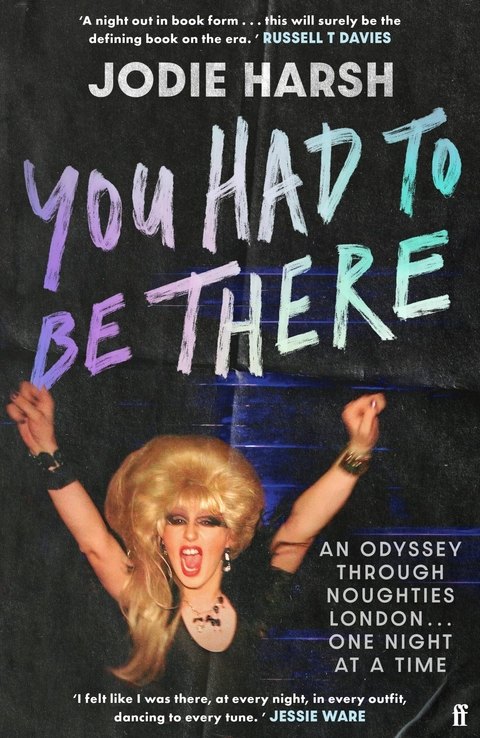
You Had to Be There (eBook)
288 Seiten
Faber & Faber (Verlag)
978-0-571-39243-8 (ISBN)
Jodie Harsh is nothing short of a dance floor icon. Her blonde beehive and thumping DJ sets have taken her from London's underground to the global stage. Whilst studying for a degree in writing, Harsh created the now instantly recognisable silhouette. As a party starter, she remains at the centre of London night life. As a DJ, she headlines festivals and raves. As a producer and songwriter, Harsh's releases have racked-up over 40 million streams to date. As a remixer, Harsh she has worked her magic on everyone from Beyoncé to Charli XCX. You Had to Be There is her first book.
'Gallops through the pre-mobile phone era with wit and chaotic energy.'Sunday Times'A joyous rags-to-riches tale.'Financial Times'Nostalgic, salacious and bitingly witty.' Joe Lycett'A delicious, neon-soaked fever dream.' Munroe Bergdorf'I couldn't put it down.' Annie MacmanusThe defining book on the iconic noughties-era of pop culture in London as told by DJ Jodie Harsh, who saw, did and survived it all. Jodie Harsh arrived in London aged fifteen in 2001, heading straight off the train from Canterbury to her first club night at the Astoria. Intoxicated by this initial taste of city nightlife, she didn't leave the party for years, falling in with the right wrong people and exploring the sides of London best experienced under cover of darkness. Throughout the noughties, from Camden and Soho to Mayfair, from Notting Hill and Primrose Hill to Hackney Road, the city was a messy, beating, slick and sordid melting pot. New music, new fashion, new art, all came together in a mad, dizzying rush before - and during - the financial crash of 2008. Different scenes collided, exploded, were reborn and shaped across the city, at rapid speed. Harsh grabs us by the hand and leads us back to those decadent times: from the Astoria to The Cross, the Soho Revue Bar to Mahiki, Boombox to The End and her famous friends' houses; to a time before social media and cameraphones were ubiquitous and a life without their perpetual scrutiny allowed for a more liberated, hedonistic and creative existence. You had to be there, and Jodie Harsh was. Every single night.
There’s always a first night. The moment you drop into a mess of lights, movement and bodies, while all around you the world sleeps. You fall in love, connect, disappear into pure feeling. Immediately, I became intoxicated by the dance floor, never to look back. At times it was something of a solace, all those flashing beams cutting through the blackness. At others it was a darker place, one that sucked me in as the strobes and smoke blinded me.
So, let’s start from the beginning. They say you always remember your first, and mine was at the Astoria in 2001.
On Saturday, I arrived in London and armed myself with an excellent fake ID forged by the artisans of Oxford Street. For five pounds, this piece of laminated card became my access to possibilities, a photoshopped pass to the promised land.
From there I headed a few streets down into Soho, trundling around bars with rainbow flags strung outside, entering any that would let me in. I wore a pair of sunglasses big enough to conceal my youth, a crop top spelling out the word BITCH in diamanté, and enough pimple-concealing foundation to tarmac a road. I wandered the streets nomadically. I soaked it all in forensically. I discovered a discarded whistle on the toilet floor at the Village. It glowed in the dark, and I claimed it as my own.
This is pre-Jodie Harsh, pre-DJ, pre-anything. It’s just J, a little gay boy from Canterbury stepping into the big city alone for the first time. Anticipation churned in my tummy; I was nervous at the unknown. A lump formed in my throat, dreading interactions I’d have to navigate if I made it on to a dance floor at all.
By the evening, I was clamped to a new ensemble. We’d bonded on some shallow level outside a nearby Soho bar called Manto’s, connected for life by a cigarette lighter and the hopeful promise of getting into a club with our fake ID. I cannot for the life of me recall anyone’s names now; they were so fair-weather I can barely remember their faces. But I can remember feeling they connected me to something I’d been lacking – a sense of community, a clear message of ‘you belong here’. London drew kids like me from the towns and villages of isolation that lay beyond it, like some great migration, enticing us with the thought that we might not be alone.
Promises kept, we marched up Charing Cross Road to the London Astoria, the venue that hosted a world-famous weekly party. My new comrades had breathlessly told me about it within minutes of meeting. The club night, G-A-Y, was full of people like us. The Astoria was about to become the Eden that housed everything, and everyone, that mattered to me.
I didn’t know any of that at the time, of course. I was just pulled along on a whisper and a prayer. We were waifs and strays, looking for a place to feel seen and express our sexuality, a place to be free and dance. Our dads were miles away at home, tutting when adverts for Queer as Folk came on the telly, passing unfriendly comment at Stephen Gately being dragged out of the closet on to the front pages, telling us to man up and ‘stop acting like a poof’. Homophobia, transphobia and the fear of AIDS rippled through so many homes in the country.
The West End streets offered a refuge. They were literally paved with rainbows – colourful printed flyers advertising the evening’s celebrations were handed out by twinks and discarded en route.
THIS SATURDAY: G-A-Y … GOOD AS YOU. The club blasted its siren call and, oh, was I ready to respond …
And there it was: the Astoria. It stood four storeys tall, an imposing white facade like some American temple. Silver barricades separated the passer-by from the entrance – and me from my dreams. Behind that door was the unknown. Behind that door was adulthood.
I clutched the fake ID tight, repeating my newly invented date of birth in my head as if writing lines in detention. A false backstory memorised, a new life within reach. And then …
We got in. Relief. I was a tenner lighter, my pocket half-empty but my hopes filled. As we climbed the foyer’s sweeping staircase, I stared at the stamp on my wrist – G-A-Y was branded on to my skin. I smiled, knowing I’d been recognised and accepted, if only by Dolly Rocket, the voluptuous woman in drag whose job it was to welcome me and the 1,999 other people attending that night. The mission of scrubbing this ink off my wrist before I arrived home in Kent was still a whole twelve-hour problem away.
At the top of the stairs a set of double doors opened, and a thick, cloying scent hit me like a backhander. Marlboro Lights, poppers, body odour, stale beer, toilet bleach and Jean Paul Gaultier Le Male mixed together like some kind of celebratory birthday cake, one that tasted so buttery, so appealing and so … moreish. If you could bottle this up and sell it as a scented candle, you could transport tired millennials right back there. You’d make a fortune.
I took in the panorama. It was a room of colossal height, like Canterbury Cathedral, where I was forced to endure long Christmas carol concerts and fables of Jesus. But this place was different – it was filled with people like me. There was dancing, and there was kissing. It was airless, furnace-hot; a baptism of fire. Everyone’s skin glistened with a film of shimmery sweat. Serotonin flushed into my brain, and my eyes widened. The room felt limitless.
There was an energy in the building that was fresh to my palate. It tasted like unadulterated freedom, a spirit of adventure, and sex … dangerous sex.
There were bars along the circumference that sold cheap drinks, and the theatre-like space in the middle was packed, moving as if a single organism. I stood soaking it up from the Outer Hebrides of the room, self-conscious but ready to join the throng and be absorbed into the cavernous, sexy pit of joy. Like a jolt of electric charge, the trance banger ‘Who Do You Love Now?’ by Dannii Minogue blasted from the giant wall-mounted speakers. I knew the routine – I’d videoed her performance of it on CD:UK – and I had just about enough Smirnoff Ice inside me to hit the floor and show it off. Fresh meat, baby – all eyes on me.
My new group of friends loved drugs. Couldn’t get enough. I’d never tried anything more than a couple of tokes on a spliff at the park behind school. But, on a night of change and newness, I was easily persuaded, and accepted an offer of a pill. It wasn’t quite white, and it was slightly bigger than an aspirin. I took half.
This being the first time I’d enhanced my brain with high levels of mind-altering chemicals, I was beyond nervous. I carried my father’s adventurous streak, which often curdled with my mother’s neurotic worry. A constant battle.
Instantly, as I swallowed the tablet, a vision of being buried by my grieving family in my BITCH top after a tragic death on the dance floor filled me with pre-emptive regret. I washed the pill down with a glug of tepid Bacardi Breezer and puffed furiously on a cigarette.
The chemicals were in me, working their way through my system.
I blinked and I was stuck in the tar of the packed dance floor: I submitted to its grip. My little spot felt private and intimate, despite it being among thousands of bodies. My motions were restricted, but I felt free.
The club would book all sorts of live music to entertain the crowd at exactly 1.30 a.m. every Saturday night – it was the thing they were famous for. Sometimes it would be a pop star creating a viral moment ready to have splattered over the Monday-morning press, like Geri Halliwell writhing around on stage in a sea of naked dancers, or a boy band like A1 making their all-important gay-club stop on a promotional tour. Sometimes it would be an eighties act singing their Stock Aitken Waterman classics – a Rick Astley or a Bananarama. Back in the nineties, when the club night first began, the Spice Girls and Take That had made their live debuts here. Occasionally there’d be a global music icon – Kylie in the flesh, for example. As she lit my cigarette, a nameless new friend gushed through a story where Mariah Carey wafted through the dance floor, carried on a chaise longue by shirtless men, and pointed out the exact place she had emerged. G-A-Y had mastered the passion and promo balance of live shows, launching some careers into the stratosphere and giving others a late-stage flourish.
The main focus, though, was on the wild gratification of the audience, who blew their shrieking whistles in the direction of the stage. Because of its unrepentant pop pleasure, G-A-Y became a gateway club for so many queer people, the starting line for a nocturnal journey. It was also a cheap night out in every sense – a spirit-and-mixer combo would only set you back a couple of quid. It was seeing the pop stars that soundtracked our lives that turned this place into sticky flypaper for people like me. And there I was, on my first ever proper night out – bar the school disco – ecstatically and apprehensively awaiting the arrival of both my E high and kitsch pop band Vengaboys.
I felt … nothing. The pill hadn’t really had any effect. I was a little woozy perhaps, but that was...
| Erscheint lt. Verlag | 23.9.2025 |
|---|---|
| Sprache | englisch |
| Themenwelt | Literatur ► Biografien / Erfahrungsberichte |
| Kunst / Musik / Theater | |
| Sozialwissenschaften | |
| ISBN-10 | 0-571-39243-1 / 0571392431 |
| ISBN-13 | 978-0-571-39243-8 / 9780571392438 |
| Informationen gemäß Produktsicherheitsverordnung (GPSR) | |
| Haben Sie eine Frage zum Produkt? |
 EPUB (Adobe DRM)
Kopierschutz: Adobe-DRM
Adobe-DRM ist ein Kopierschutz, der das eBook vor Mißbrauch schützen soll. Dabei wird das eBook bereits beim Download auf Ihre persönliche Adobe-ID autorisiert. Lesen können Sie das eBook dann nur auf den Geräten, welche ebenfalls auf Ihre Adobe-ID registriert sind.
Details zum Adobe-DRM
Dateiformat: EPUB (Electronic Publication)
EPUB ist ein offener Standard für eBooks und eignet sich besonders zur Darstellung von Belletristik und Sachbüchern. Der Fließtext wird dynamisch an die Display- und Schriftgröße angepasst. Auch für mobile Lesegeräte ist EPUB daher gut geeignet.
Systemvoraussetzungen:
PC/Mac: Mit einem PC oder Mac können Sie dieses eBook lesen. Sie benötigen eine
eReader: Dieses eBook kann mit (fast) allen eBook-Readern gelesen werden. Mit dem amazon-Kindle ist es aber nicht kompatibel.
Smartphone/Tablet: Egal ob Apple oder Android, dieses eBook können Sie lesen. Sie benötigen eine
Geräteliste und zusätzliche Hinweise
Buying eBooks from abroad
For tax law reasons we can sell eBooks just within Germany and Switzerland. Regrettably we cannot fulfill eBook-orders from other countries.
aus dem Bereich