Sounding Brass (eBook)
258 Seiten
Springer (Verlag)
978-3-031-86735-4 (ISBN)
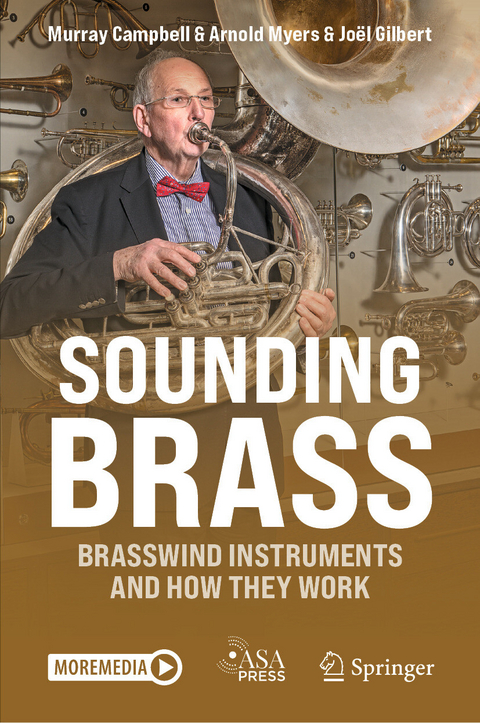
A lone bugler sounds the Last Post at a Festival of Remembrance. Overlapping horn arpeggios conjure up the flowing waters of the Rhine in Wagner’s opera “Das Rheingold”. Seventy-six trombones lead the big parade; trumpets sound ceremonial fanfares, and power the horn sections in jazz and funk bands. The sounds of brass instruments enrich many of our most inspiring musical experiences. But what defines a “brass instrument”? How is a stream of air blown through a small gap in the player’s lips transformed into a sound which fills a concert hall? When did brass instruments originate, and how did they evolve into the instruments of the modern orchestra? These are some of the questions addressed in this book. The authors, professional scientists but also experienced brass players, explain how recent research has illuminated our understanding of brass instruments. The presentation is aimed at a general readership, including players, teachers, and lovers of all types of music. No mathematical background is assumed. Descriptions of many experiments on brass instruments carried out by the authors and others bring out the musical significance of the results. A novel approach to the systematic classification of brass instruments is outlined and graphically illustrated. Separate chapters are devoted to trumpets and related instruments, horns, trombones, tubas, brass instruments with toneholes, and instruments from antiquity including the Celtic carnyx. The final chapter reviews the application of electronic enhancement techniques to brass instruments. The book is generously illustrated with colour photographs, musical examples, and explanatory figures.
| Erscheint lt. Verlag | 20.6.2025 |
|---|---|
| Zusatzinfo | XXXVIII, 258 p. 218 illus., 189 illus. in color. |
| Sprache | englisch |
| Themenwelt | Kunst / Musik / Theater ► Musik |
| Naturwissenschaften ► Physik / Astronomie | |
| Schlagworte | acoustics of brass instruments • how do trombones work • how do trumpets work • how do tubas work • Organology • Physics of brass instruments • science of brass instruments • science of musical instruments |
| ISBN-10 | 3-031-86735-1 / 3031867351 |
| ISBN-13 | 978-3-031-86735-4 / 9783031867354 |
| Informationen gemäß Produktsicherheitsverordnung (GPSR) | |
| Haben Sie eine Frage zum Produkt? |
 PDF (Wasserzeichen)
DRM: Digitales Wasserzeichen
Dieses eBook enthält ein digitales Wasserzeichen und ist damit für Sie personalisiert. Bei einer missbräuchlichen Weitergabe des eBooks an Dritte ist eine Rückverfolgung an die Quelle möglich.
Dateiformat: PDF (Portable Document Format)
Mit einem festen Seitenlayout eignet sich die PDF besonders für Fachbücher mit Spalten, Tabellen und Abbildungen. Eine PDF kann auf fast allen Geräten angezeigt werden, ist aber für kleine Displays (Smartphone, eReader) nur eingeschränkt geeignet.
Systemvoraussetzungen:
PC/Mac: Mit einem PC oder Mac können Sie dieses eBook lesen. Sie benötigen dafür einen PDF-Viewer - z.B. den Adobe Reader oder Adobe Digital Editions.
eReader: Dieses eBook kann mit (fast) allen eBook-Readern gelesen werden. Mit dem amazon-Kindle ist es aber nicht kompatibel.
Smartphone/Tablet: Egal ob Apple oder Android, dieses eBook können Sie lesen. Sie benötigen dafür einen PDF-Viewer - z.B. die kostenlose Adobe Digital Editions-App.
Buying eBooks from abroad
For tax law reasons we can sell eBooks just within Germany and Switzerland. Regrettably we cannot fulfill eBook-orders from other countries.
aus dem Bereich