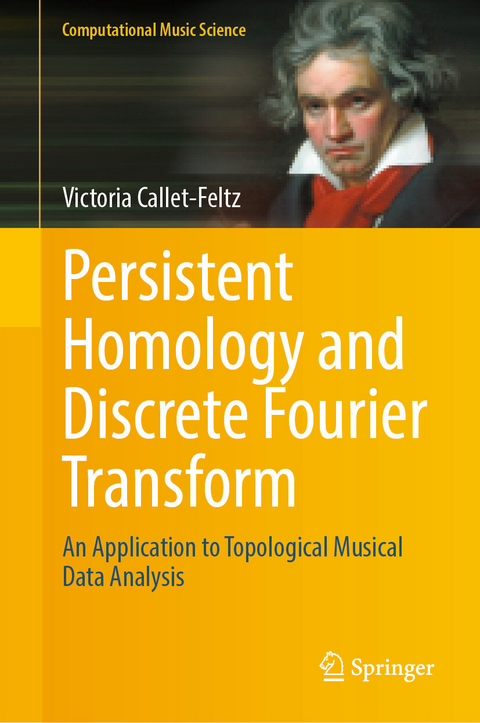
Persistent Homology and Discrete Fourier Transform (eBook)
XV, 230 Seiten
Springer-Verlag
978-3-031-82236-0 (ISBN)
This book proposes contributions to various problems in the field of topological analysis of musical data: the objects studied are scores represented symbolically by MIDI files, and the tools used are the discrete Fourier transform and persistent homology. The manuscript is divided into three parts: the first two are devoted to the study of the aforementioned mathematical objects and the implementation of the model. More precisely, the notion of DFT introduced by Lewin is generalized to the case of dimension two, by making explicit the passage of a musical bar from a piece to a subset of Z/tZ×Z/pZ, which leads naturally to a notion of metric on the set of musical bars by their Fourier coefficients. This construction gives rise to a point cloud, to which the filtered Vietoris-Rips complex is associated, and consequently a family of barcodes given by persistent homology. This approach also makes it possible to generalize classical results such as Lewin's lemma and Babitt's Hexachord theorem. The last part of this book is devoted to musical applications of the model: the first experiment consists in extracting barcodes from artificially constructed scores, such as scales or chords. This study leads naturally to song harmonization process, which reduces a song to its melody and chord grid, thus defining the notions of graph and complexity of a piece. Persistent homology also lends itself to the problem of automatic classification of musical style, which will be treated here under the prism of symbolic descriptors given by statistics calculated directly on barcodes. Finally, the last application proposes a encoding of musical bars based on the Hausdorff distance, which leads to the study of musical textures.
The book is addressed to graduate students and researchers in mathematical music theory and music information research, but also at researchers in other fields, such as applied mathematicians and topologists, who want to learn more about mathematical music theory or music information research.
| Erscheint lt. Verlag | 31.5.2025 |
|---|---|
| Reihe/Serie | Computational Music Science |
| Zusatzinfo | XV, 230 p. 279 illus., 225 illus. in color. |
| Sprache | englisch |
| Themenwelt | Kunst / Musik / Theater ► Musik |
| Mathematik / Informatik ► Mathematik | |
| Schlagworte | Automatic musical style classification • Barcodes • discrete Fourier transform • hausdorff distance • Hexachordal Theorem • Lewin's Lemma • musical analysis • musical textures • Persistent Homology • Simplicial theory • tonnetz • topological data analysis |
| ISBN-10 | 3-031-82236-6 / 3031822366 |
| ISBN-13 | 978-3-031-82236-0 / 9783031822360 |
| Informationen gemäß Produktsicherheitsverordnung (GPSR) | |
| Haben Sie eine Frage zum Produkt? |
 PDF (Wasserzeichen)
DRM: Digitales Wasserzeichen
Dieses eBook enthält ein digitales Wasserzeichen und ist damit für Sie personalisiert. Bei einer missbräuchlichen Weitergabe des eBooks an Dritte ist eine Rückverfolgung an die Quelle möglich.
Dateiformat: PDF (Portable Document Format)
Mit einem festen Seitenlayout eignet sich die PDF besonders für Fachbücher mit Spalten, Tabellen und Abbildungen. Eine PDF kann auf fast allen Geräten angezeigt werden, ist aber für kleine Displays (Smartphone, eReader) nur eingeschränkt geeignet.
Systemvoraussetzungen:
PC/Mac: Mit einem PC oder Mac können Sie dieses eBook lesen. Sie benötigen dafür einen PDF-Viewer - z.B. den Adobe Reader oder Adobe Digital Editions.
eReader: Dieses eBook kann mit (fast) allen eBook-Readern gelesen werden. Mit dem amazon-Kindle ist es aber nicht kompatibel.
Smartphone/Tablet: Egal ob Apple oder Android, dieses eBook können Sie lesen. Sie benötigen dafür einen PDF-Viewer - z.B. die kostenlose Adobe Digital Editions-App.
Buying eBooks from abroad
For tax law reasons we can sell eBooks just within Germany and Switzerland. Regrettably we cannot fulfill eBook-orders from other countries.
aus dem Bereich