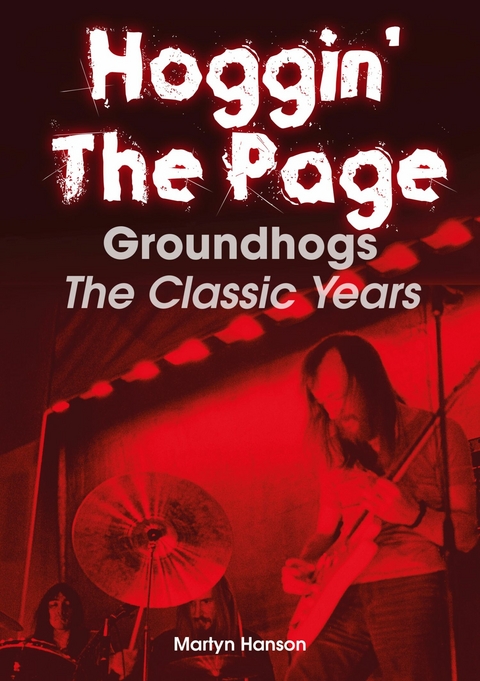
Hoggin’ the page (eBook)
192 Seiten
Sonicbond Publishing (Verlag)
978-1-78952-384-3 (ISBN)
The story of the Groundhogs spans the most exciting years British rock will ever enjoy. Springing from the same early roots as the Animals, Pretty Things and Rolling Stones, they soon garnered a reputation as a blues band backing the likes of John Lee Hooker and many other giants of the genre. From this solid base, they graduated to writing some of the most challenging progressive music of the 1960s and 1970s, even though the next generation of musicians like Captain Sensible and others were fans.
They were led by visionary guitarist, singer and songwriter Tony McPhee (who sadly passed away in 2023, age 79), abetted by the powerhouse rhythm section of Ken Pustelnik and Pete Cruickshank. Legendary DJ John Peel was a big fan and helped to send their Split album into the UK top five.
Other albums such as Thank Christ For The Bomb, Who Will Save The World, Hogwash and Solid cemented their reputation and their thirteen studio albums span four decades. Tony's adventures as a pioneer of the synthesizer, taking it on the road on a solo tour and building one of the first home studios to record with it, shows another side to the complex McPhee that is far less widely known, understood and, as a result, appreciated.
This is the story of those classic years.
The author
Martyn Hanson was born in 1956 and married Carole in 1978. They have two grown-up children and are grandparents. Martyn ran many marathons in the 1980s and 1990s, also completing the famous London to Brighton road race twice. He co-authored ELP - The Show That Never Ends in 2000 followed by four solo projects. Hang on to a Dream - The Story of The Nice was published in 2002. Hoggin' The Page was originally published in 2005. He has also written two books on Jon Hiseman - Colosseum's founder: Playing The Band - A Musical Biography and Jon Hiseman's Journey in the Time Machine - Album by Album. He has also written many CD/vinyl liner notes. He lives in Solihull, UK.
The House Of Blues
He had a dramatic impact on the band.
Pete Cruickshank’s verdict on Tony joining The Dollarbills
It is rock history’s duty to attempt to make amends for all these lives of injustice and misery; while white rock musicians strutted in the hallways of five-star hotels earning money from music that was not
really of their own making, the true composers were neither recognised nor recompensed.
Chambers Rock Music Guide
Apart from John Cruickshank on vocals, later on harmonica, there was also his brother, Pete, on bass guitar. John Lockyear made up the rest of The Dollarbills – he played lead guitar. It was no exaggeration to say that John Cruikshank was the acknowledged leader of the band. In joining the band, Tony teamed up for the first time with John’s younger brother. It was the beginning of a lifelong association. Pete Cruickshank was born in India on 2 July 1945. His grandfather had gone to India to take over a mill. His father was born on the steamship on the way over. Things didn’t go well and his father ended up in an orphanage at the age of four. When he was older, his father joined the RAF, where he met Pete’s mother, who was a teacher. They got married in India. In 1955, the family left India and came to England in order to give their children a better education.
Pete’s mother was a classically trained musician who was trained at the Royal Academy in London. There was always some sort of music going on in the household. He remembers hearing classical music, and although he didn’t like it, he believed it subconsciously made an impression on him. As was expected, his elder brother, John, was very interested in becoming a musician and he acquired a drum kit. All his other friends had acquired guitars and the young Pete also got one.
However, being the youngest in the group had distinct disadvantages: ‘All the others were a lot more advanced than me. I was always making up ground. We needed a bass player, so I decided that it would be something that would give me a unique identity. I paid £20 for a Tuxedo bass guitar.’
The young Pete Cruickshank liked Gene Vincent, Elvis Presley and The Everley Brothers; one of his favourite tracks was ‘Cathy’s Clown’(April 1960). The brothers rehearsed in their front room in Wallbutton Road, Brockley, South London. But even this produced problems, as Pete revealed: ‘My parents were incredibly tolerant. They did have people knocking on the door about the noise. They told us to turn it down, but we would carry on playing. In fact, we had a ‘nasty’ put through the letterbox.’ It was clear that the parents were giving the children as much artistic encouragement as they could.
The brothers didn’t have a name for their band. However, one thing was for certain: John Cruickshank was a useless drummer, so he decided to concentrate on singing. They drafted in Dave Boorman on drums.
They decided to call themselves The Dollarbills in deference to the concept of ‘all things American had to be good’. It seemed logical as all the artists they liked were from there. They played their first gig at the famous 2I’s coffee bar in London. They journeyed there on the train and taxi. As Pete Cruickshank remembered with a big grin on his face: ‘We thought we were going to be stars. We carried our gear around London without any covers! We didn’t even have covers for the drums.’ By this time, John Lockyear was struggling as lead guitarist.
Pete Cruickshank, meanwhile, had his own personal problems. In 1961, Pete started work as an apprentice fitter. He didn’t really have his heart in it: ‘My dad forced me to sign the papers. He said, ‘We are not going to leave this room until you do.’ However, when I’d served two years and I was 18, I packed it in. I was old enough to make my own decisions.’ It was obvious that, by then, when push came to shove, music was going to win the day.
The Dollarbills played the pop songs of the day by the likes of The Coasters, Elvis and The Shadows. They were having some success just as Tony McPhee came in. It was ironic that Tony had just been offered the promotion at the Post Office, which he had already turned down previously. It may seem obvious now that he would choose music, but he loved his day job. He loved working in electrics and problem-solving, but in the end, there was no serious debate about it. The chance to be a full-time musician was too great. He left the Post Office and turned professional.
The new addition immediately made an impression on his new bandmates. Pete Cruickshank takes up the story: ‘We were doing The Shadows stuff quite badly. Tony was an accomplished musician. He was unusual in that he never copied songs note for note like everybody else. Even without an echo unit and Fender, he still emulated the sound. Hehad a dramatic impact on the band.’ Despite Pete’s reservations about the band making it before John Lockyear’s departure, Tony’s arrival opened up new horizons.
Whereas The Seneschals had played only local gigs, The Dollarbills travelled around a lot more. They played places like The Top Hat in Worthing and the famous Sophia Gardens in Cardiff. Tony knew there was a lot of competition: ‘Sophia Gardens was huge and there would be many bands playing their 30-minute slot. In a way, it was like a conveyor belt.’ They appeared with Vince Hill on Saturday 31 August 1963. On another occasion, they appeared with Chris Andrews; he had a big hit with ‘Yesterday Man’. They also played the RAF Air Force Base at Brize Norton, where they were asked if they could play a waltz – they could! They were getting around the country courtesy of John Lockyear’s Dad’s Thames Van. He was convinced they were going to make it and even started to arrange gigs for them. They approached the Cana Variety agency to get them more gigs. They were told confidently, ‘If we can’t get you gigs in England, we can get them in Germany.’ They had more than enough work at home, so there was no need to go abroad.
Tony McPhee didn’t just bring his guitar to The Dollarbills, but he also brought every blues album he had ever heard. From this point, the rest of the band would hear a lot about the blues movement that Tony loved so much. As Pete Cruickshank revealed: ‘We only knew of pop; we didn’t know where pop actually came from. Tony knew the background and, as it turned out, we soon came to love it, too.’ In the early months after Tony joined, their repertoire started to change. One of the early additions was ‘My Babe’, which was influenced by Little Walter’s version. Jimmy Reed’s ‘Big Boss Man’ was another. And, of course, John Lee Hooker and Muddy Waters songs were well represented in the set. There was a short period of inactivity as they honed their act to suit the new direction. Even though John Cruickshank was acknowledged as the leader of the band, Tony had other plans: ‘I led from the back. I was happy to manipulate things from there.’ It must be said that everyone, apart from Tony, looked at John as the leader.
In an interview with Record Collector in 1993, Tony McPhee outlined that he wasn’t attracted to all of the blues, only certain aspects of it: ‘I loved the primitiveness of the blues. I’ve never been into B.B. King that much; it’s too sickly, too sweet. I prefer the rough, primitive stuff; country players from the ‘20s and ‘30s like Leadbelly and Robert Johnson – he’s just a total genius. In the ‘60s, you mistrusted whiteartists playing the blues … I only wanted to listen to black artists. There wasn’t anybody white who was any good back then.’ These black artists generally came from the Mississippi Delta, but they gravitated north to Chicago to play the clubs. Leonard and Phil Chess initially owned only one of the clubs before snapping most of them up. In 1947, they founded Chess Records – the vehicle that would bring these artists to the attention of the world.
It wasn’t long before a name change was on the cards in order to reflect the way the band had evolved and their future direction. Tony suggested they change their name to the Groundhogs. This was in homage to ‘Groundhog Blues’ from the 1960 John Lee Hooker album House Of The Blues. Tony had perused all his Hooker albums to find the right name. But the decision process wasn’t as straightforward as it seemed, as Pete elucidated: ‘Yes, it was Tony’s idea for the name, but my brother would have been involved in all of this as he was the leader of the band. John is a very forceful character. By that time, we were all blues fans anyway, so that obviously helped.’ Tony wasn’t the only one who disliked The Dollarbills as a name; it was also hated by Pete, who found it a tad embarrassing. At the same time, John decided to call himself John Lee and this was added on to the Groundhogs, making the full name of the band John Lee Groundhogs. This happened because John was fascinated by the name Lee. The Dollarbills had also sometimes been known as Lee Grant (a mixture of the US Civil War generals) and The Dollarbills. But contrary to what many people believed, the name of John Lee Hooker did not influence his new stage name.
By late 1963, they decided that they needed a piano player. Not knowing any, they put an advert in Melody Maker. Only two people applied for the job and only one turned...
| Erscheint lt. Verlag | 19.5.2025 |
|---|---|
| Sprache | englisch |
| Themenwelt | Kunst / Musik / Theater ► Musik |
| Schlagworte | Tony McFee • Tony McPhee |
| ISBN-10 | 1-78952-384-2 / 1789523842 |
| ISBN-13 | 978-1-78952-384-3 / 9781789523843 |
| Informationen gemäß Produktsicherheitsverordnung (GPSR) | |
| Haben Sie eine Frage zum Produkt? |
 EPUB (Ohne DRM)
Digital Rights Management: ohne DRM
Dieses eBook enthält kein DRM oder Kopierschutz. Eine Weitergabe an Dritte ist jedoch rechtlich nicht zulässig, weil Sie beim Kauf nur die Rechte an der persönlichen Nutzung erwerben.
Dateiformat: EPUB (Electronic Publication)
EPUB ist ein offener Standard für eBooks und eignet sich besonders zur Darstellung von Belletristik und Sachbüchern. Der Fließtext wird dynamisch an die Display- und Schriftgröße angepasst. Auch für mobile Lesegeräte ist EPUB daher gut geeignet.
Systemvoraussetzungen:
PC/Mac: Mit einem PC oder Mac können Sie dieses eBook lesen. Sie benötigen dafür die kostenlose Software Adobe Digital Editions.
eReader: Dieses eBook kann mit (fast) allen eBook-Readern gelesen werden. Mit dem amazon-Kindle ist es aber nicht kompatibel.
Smartphone/Tablet: Egal ob Apple oder Android, dieses eBook können Sie lesen. Sie benötigen dafür eine kostenlose App.
Geräteliste und zusätzliche Hinweise
Buying eBooks from abroad
For tax law reasons we can sell eBooks just within Germany and Switzerland. Regrettably we cannot fulfill eBook-orders from other countries.
aus dem Bereich