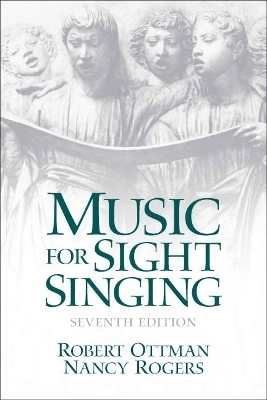
Music for Sight Singing
Pearson (Verlag)
978-0-13-187234-9 (ISBN)
- Titel erscheint in neuer Auflage
- Artikel merken
Using an abundance of meticulously organized melodies drawn from the literature of composed music and a wide range of the world’s folk music, Ottman provides the most engaging and comprehensive Sight Singing text on the market.
Over fifty years ago, Robert W. Ottman set out to write a book that draws examples from the literature as opposed to being composed by the author. He proposed that students should work with "real" music as they study musical forms. The result was Music for Sight Singing. Not only is real music more enjoyable and interesting to sing than dry examples, but genuine repertoire naturally introduces a host of important musical considerations beyond pitch and rhythm (including dynamics, accents, articulations, slurs, repeat signs, and tempo markings). Several generations of teachers have also agreed that Ottman's ability to order his examples from the simple to the complex is another key to the book's long term success.
Robert W. Ottman, deceased, an internationally renowned music theorist, was an important contributor to Music Theory education. He wrote eight textbooks and co-authored four others, all which are used to educate English-speaking students worldwide. Dr. Ottman also was a professor and chair of the Music Theory Department at the University of North Texas and a conductor of the Madrigal Singers. He earned both his BA and MM from Eastman School of Music, University of Rochester, NY, and his Ph.D. from what is now the University of North Texas in 1956. He was honored with the University of North Texas President's Citation for outstanding service to the university in April 2004. Nancy Rogers is an Assistant Professor of Music Theory at Florida State University and the current Secretary of the Society for Music Theory; she is also a Faculty Reader and Consultant for the Advanced Placement Test in Music Theory. She received her Ph.D. from the Eastman School of Music, where she won both school-wide and university-wide teaching awards. Dr. Rogers' primary research interest is music cognition and its pedagogical implications, and she has presented papers at national, international, and regional conferences. Her recent publications may be found inMusic Theory Online, theJournal of Music Theory Pedagogy, andIndiana Theory Review.
(R) indicates Rhythmic Reading exercises
PREFACE
In Memorium
ACKNOWLEDGMENTS
PART I
MELODY: DIATONIC INTERVALS
RHYTHM: DIVISION OF THE BEAT
1 RHYTHM: Simple meter; the Beat and Its Division into Two Parts
RHYTHMIC READING
Section 1 (R). The quarter note as the beat unit. Beat-note values and larger only
Section 2 (R). The quarter note as the beat unit and its division. Dotted notes and tied notes
Section 3 (R). Two-part drills
Section 4 (R). Note values other than the quarter note as beat values
Section 5 (R). Two-part drills
2 MELODY: Stepwise Melodies, Major Keys
RHYTHM: Simple Time (Meter); the Beat and its Division into Two Parts
Section 1. Major keys, treble clef, the quarter note as the beat unit. Key signatures with no more than three sharps or three flats
Section 2. Bass clef
Section 3. Other meter signatures
Section 4. Duets
Section 5. Structured Improvisation
3 MELODY: Intervals from the Tonic Triad, Major Keys
RHYTHM: Simple Meters
Section 1. Major keys, treble clef, intervals of the third, fourth, fifth, and octave from the tonic triad. The quarter note as the beat unit
Section 2. Bass clef
Section 3. Interval of the sixth; minor sixth, up to , and major sixth, up to , or descending
Section 4. The half note and the eighth note as beat units
Section 5. Duets
Section 6. Key signatures with five, six, and seven sharps or flats
Section 7. Structured Improvisation
4 MELODY: Intervals from the Tonic Triad, Major Keys
RHYTHM: Compound Meters; the Beat and Its Division into Three Parts
Section 1 (R). Rhythmic reading: The dotted quarter note as the beat unit. Single lines and two-part drills
Section 2. Sight singing: Major keys, treble clef; the dotted quarter note as the beat unit
Section 3. Sight singing: Bass clef
Section 4 (R). Rhythmic reading: The dotted half note and the dotted eighth note as beat units, including two-part drills
Section 5. Sight singing: The dotted half note and dotted eighth note as beat units
Section 6. Duets
Section 7. Structured Improvisation
5 MELODY: Minor Keys; Intervals from the Tonic Triad
RHYTHM: Simple and Compound Meters
Section 1. Simple meters
Section 2. Compound meters
Section 3. Duets
Section 4. Structured Improvisation
6 MELODY: Intervals from the Dominant (V) Triad; Major and Minor Keys
RHYTHM: Simple and Compound Meters
Section 1. Intervals of the third from the V triad; major keys; simple meters
Section 2. Intervals of the third from the V triad; minor keys; simple meters
Section 3. Intervals of the fourth and fifth from the V triad; major and minor keys; simple meters
Section 4. Interval of the sixth from the V triad; simple meters
Section 5. Compound meters; various intervals from the V triad
Section 6. Numerators of three, compound meters
Section 7. Duets
Section 8. Structured Improvisation
7 THE C CLEFS: Alto and Tenor Clefs
Section 1. The alto clef
Section 2. The tenor clef
Section 3. Additional practice in the C clefs
8 MELODY: Further Use of Diatonic Intervals
RHYTHM: Simple and Compound Meters
Section 1. Single-line melodies
Section 2. Duets
Section 3. Structured Improvisation
9 MELODY: Intervals from the Dominant Seventh Chord (V7); Other Diatonic Intervals of the Seventh
RHYTHM: Simple and Compound Meters
Section 1. The complete dominant seventh chord
Section 2. The interval of the minor seventh; up to or reverse
Section 3. The interval of the tritone
Section 4. Other uses of diatonic intervals of the seventh
Section 5. Structured Improvisation
PART II
MELODY: DIATONIC INTERVALS
RHYTHM: SUBDIVISION OF THE BEAT
10 RHYTHM: The Subdivision of the Beat; the Simple Beat into Four Parts; the Compound Beat into Six Parts
RHYTHMIC READING, SIMPLE meters
Section 1 (R). Preliminary exercises, simple meters
Section 2 (R). Rhythmic reading exercises in simple meters
Section 3 (R). Two-part drills, simple meters
RHYTHMIC READING, COMPOUND meters
Section 4 (R). Preliminary exercises, compound meters
Section 5 (R). Rhythmic reading exercises in compound meters
Section 6 (R). Two-part drills, compound meters
11 MELODY: Intervals from the Tonic and Dominant Triads
RHYTHM: Subdivision in Simple and Compound Meters
Section 1. Major keys
Section 2. Minor keys
Section 3. Structured Improvisation
12 MELODY: Further Use of Diatonic Intervals
RHYTHM: Subdivision in Simple and Compound Meters
Section 1. Diatonic intervals except the seventh and the tritone
Section 2. The dominant seventh (V7) chord; intervals of the seventh and the tritone
Section 3. Other uses of the interval of the seventh
Section 4. Structured Improvisation
PART III
MELODY: CHROMATICISM
RHYTHM: FURTHER RHYTHMIC PRACTICES
13 MELODY: Chromaticism (I): Chromatic Nonharmonic Tones; the Dominant of the Dominant (V/V) Harmony; Modulation to the Key of the Dominant
Section 1. Chromatic nonharmonic tones. Augmented and diminished intervals created by their use
Section 2. The secondary dominant chord, V/V or V7/V. Modulation from a major key to its dominant key
Section 3. Duets
Section 4. Structured Improvisation
14 MELODY: Chromaticism (II): Modulation to Closely Related Keys; Additional Secondary Dominant Harmonies
Section 1. Single-line melodies
Section 2. Duets
Section 3. Structured Improvisation
15 RHYTHM: Syncopation
RHYTHMIC READING
Section 1 (R). Divided beat patterns in simple meters
Section 2 (R). Divided beat patterns in compound meters
Section 3 (R). Two-part drills
Section 4 (R). Subdivided beat patterns in simple meters
Section 5 (R). Subdivided beat patterns in compound meters
Section 6 (R). Two-part drills
SIGHT SINGING
Section 7. Divided beat patterns in simple meters
Section 8. Divided beat patterns in compound meters
Section 9. Duets
Section 10. Subdivided beat patterns in simple and compound meters
Section 11. Structured Improvisation
16 RHYTHM and MELODY: Triplet Division of Undotted Note Values; Duplet Division of Dotted Note Values
RHYTHMIC READING
Section 1 (R). Triplet division of undotted note values
Section 2 (R). Duplet division of dotted note values
Section 3 (R). Two-part drills
SIGHT SINGING
Section 4. Triplet division of undotted note values
Section 5. Duplet division of dotted note values
Section 6. Duets
Section 7. Structured Improvisation
17 RHYTHM and MELODY: Changing Meter Signatures; the Hemiola; Less Common Meter Signatures
RHYTHMIC READING
Section 1 (R). Definitions and rhythmic reading exercises
SIGHT SINGING
Section 2. Changing meter signatures
Section 3. The hemiola
Section 4. Meters of 5 and 7, and other meters
Section 5. Structured Improvisation
18 RHYTHM and MELODY: Further Subdivision of the Beat; Notation in Slow Tempi
Section 1 (R). Rhythmic reading
Section 2. Sight singing
19 MELODY: Chromaticism (III): Additional Uses of Chromatic Tones; Remote Modulation
Section 1. Chromatic tones
Section 2. The Neapolitan Sixth
Section 3. Remote modulation
Section 4. Structured Improvisation
PART IV
THE MEDIEVAL MODES AND TWENTIETH-CENTURY MUSIC
20 MELODY: The Medieval Modes
Section 1. Folk music
Section 2. Composed music
Section 3. Structured Improvisation
21 MELODY: Twentieth-Century Melody
RHYTHM: Twentieth-Century Rhythm
Section 1 (R). Meter and rhythm. Rhythmic reading
Section 2. Extensions of the traditional tonal system
Section 3. Symmetrical collections; the octatonic and whole-tone scales
Section 4. Freely post-tonal melodies
Section 5. Twelve-tone melodies
Section 6. Duets
Section 7. Structured Improvisation
APPENDIX: MUSICAL TERMS
| Erscheint lt. Verlag | 6.11.2006 |
|---|---|
| Sprache | englisch |
| Maße | 152 x 229 mm |
| Gewicht | 596 g |
| Themenwelt | Kunst / Musik / Theater ► Musik |
| ISBN-10 | 0-13-187234-6 / 0131872346 |
| ISBN-13 | 978-0-13-187234-9 / 9780131872349 |
| Zustand | Neuware |
| Informationen gemäß Produktsicherheitsverordnung (GPSR) | |
| Haben Sie eine Frage zum Produkt? |
aus dem Bereich