In the Scene (eBook)
176 Seiten
Supernova Books (Verlag)
978-1-913641-18-4 (ISBN)
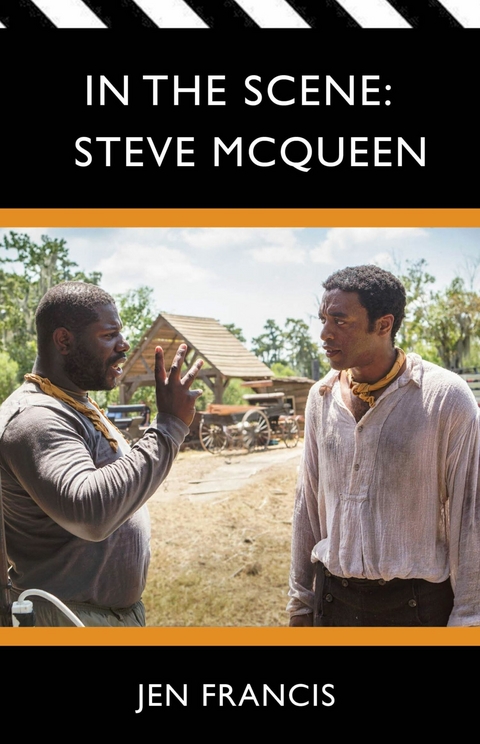
This guide is a must for film fans and students of contemporary cinema alike. An introductory chapter highlights thematic and visual devices, followed by an exploration of British director Steve McQueen's work, from his short films and video art through his critically acclaimed feature films, including his masterpiece, the Academy Award-winning 12 Years A Slave, to his BBC TV series Small Axe and the new war film, Blitz.
Londoner Steve McQueen shot to fame in 1999 when he won the prestigious Turner Prize for innovative art. In 2020, the Tate Gallery in London held an exhibition of over a dozen works spanning film, photography and sculpture, including his homage to the African American actor and civil rights activist Paul Robeson. Ranging across the visual arts, to advertising, documentary and drama, McQueen often tackles hard-hitting topics such as discrimination and injustice in powerful, cinematic ways.
Includes interviews with historian, David Olusoga and director of film programming at the Lincoln Center, Dennis Lim.
Reviews
'... provides useful insight into the director's background and motivations and offers easy-to-read reviews of his numerous films, documentaries and exhibitions. An invaluable guide to the incredible work Steve McQueen has produced since his time as an art student until today.'
- Tony Warner, co-founder, chair of African Odysseys programme
'A highly readable and wide-ranging consideration of McQueen's work.' - Kirkus reviews
'...an accessible and comprehensive guide to McQueen's work that covers its breadth of ambition alongside the depth of its core themes.'
- Paul Sutton, Head of Film Studies, CityLit
'A resource for budding film writers and directors. Definitely need a copy. This outline of every Steve McQueen project is for true fans of film or will make a fan out of you. This presents a researcher's insight into the director and his works. Arranging and discussing the films by timeline and type, really helped to show the evolution of McQueen's creative perspective and output. Fun fact that I didn't realize before this book: He and Michael Fassbender have a longstanding and fruitful work relationship.' ****
- Adrienne Adrimano, netgalley
Introduction
If you search the internet quite simply for ‘Black British Director’ Steve McQueen’s Wikipedia page is the top result. To the newer class of film enthusiasts and critics, Sir Steve Rodney McQueen cbe is a British film director most notably known for his Oscar-winning film about a free African American man being sold into slavery, 12 Years A Slave (2013). In 2020, he exploded onto the small screen with a series of immersive, biographical, and explorative films that made up the Small Axe anthology. These five movies which varied in length and tone were connected in their unstripped truth of the West Indian experience of living in the uk between the late 1960s and early 1980s.
McQueen’s varied decades-long career through the arts, makes it impossible to put him into a box. A man who is led by his own creative muse, the unpredictable choices he makes both of his subjects and the media he employs, demonstrate the depth and skill that have made him a celebrated artist and filmmaker internationally.
Through his documentaries and films, McQueen has brought historical incidents and movements to the forefront. He’s highlighted the political through Northern Irish prisoners taking on the Conservative Government in 1981 and the injustice towards nine activists wrongly accused of inciting a riot in Notting Hill, West London.
McQueen’s characters express the power and resilience of women, how they show strength in grief, for example in his feature film Widows. All the while McQueen employs the recurring themes of endurance, truth, brutality and beauty in his work.
McQueen has described himself as ‘not very friendly’, an honest analysis which sits self-deprecatingly alongside the high praise which both the man and the creative artist has received from those who have worked with him.
Viola Davis, who worked with McQueen on the movie Widows, praised his directorial style which allowed all parts of you to be seen.2 As a Black woman, as a Black actress, she is rarely looked at beyond face value: a dark-skinned woman with a deep voice and the aura of authority. However, McQueen’s observation of all aspects of her imbued her character with a degree of adoration. He saw her femininity, her shyness, and her fragility.
In 2020, McQueen received a knighthood for services to film, and cemented his place as a world-class filmmaker capable of making original films true to his own unique vision.
Before the accreditations and accolades as a feature film-maker, McQueen had refined his keen artistic eye as a visual artist which saw him produce at least ten short films and several art installations. One of these led to his winning the prestigious Turner Prize, an award reserved for the most innovative and forward-thinking artists of our time. Other notable names to have received the award include Damien Hirst and Sir Anish Kapoor.
Currently residing in Amsterdam, where he has lived for many years with his wife and children, McQueen did not envision filmmaking as a career in his youth.
Early Years
Born in London in 1969, the child of immigrants, McQueen’s mother immigrated to England from Grenada, while his father came from Trinidad.
Growing up in the suburbs of Ealing in the 1980s, McQueen recounts racial prejudice as a common occurrence. However, the discriminatory treatment that he endured during his formative years while attending Drayton Manor High School in Acton seems to have fuelled his determination to champion outsiders and underdogs.
McQueen was diagnosed with dyslexia while he was at school, but it is something he hid from the public as he became more prolific as an artist. It is only in recent years that he has felt comfortable discussing its impact on his life and those early feelings of shame which accompanied the diagnosis.
Returning to Drayton Manor High School in 2000, by then a Turner Prize-winner but not yet a feature filmmaker – a truth that may not have been clear to the teenage McQueen was glaringly obvious to the man in his thirties; institutional racism within the British education system was deeply ingrained. Despite attempts to label him as unintelligent, lazy and subnormal, McQueen had defied their expectations.
Feeling ashamed and ignored, McQueen struggled against a system that wasn’t built to grant him any favours. He remains thankful that he didn’t end up in a subnormal school thanks to the work put in by the Black Parents Association. They pushed for change contributing to the abolition of the term ‘educationally subnormal’, and its marginalisation through the 1981 Education Act. McQueen goes on to explore this topic in the 2021 documentary Subnormal: A British Scandal which he executive produced with his production company Lammas Park.
His personal experience at school was reflected through the character of Kingsley in his television drama, Education (2020), which forms one fifth of the Small Axe anthology.
McQueen’s time in secondary education has provided a well of anger that he draws on for his dramatic works. What kept him on track on an otherwise darkened path was his love of football and art.
Despite his treatment by the wider education system of the 1980s, McQueen was considered one of the ‘cool kids’ which was predominantly due to his larger size and his skills on the football pitch. Out in the open air over patchy grass with bag and blazer piled goalposts, football gave him freedom and endless possibilities.
His love of the game was entwined with his lifelong support for Tottenham Hotspur. On weekends, McQueen would be glued to the screen, watching the footwork of Glen Hoddle and Steve Archibald.
Persevering through school, McQueen, who had always been good at drawing, took A Level Art. This allowed him to mix with his peers in the higher houses and opened up new creative opportunities.
Despite not having the grades, McQueen took a leap of faith and applied to Chelsea College of Art and Design. Gaining a place at the college, once there as a student, his talent ensured his success.
Education
For the first time in an educational environment, McQueen felt truly happy. During the year he spent at Chelsea, he received encouragement from tutors who recognised the talent and originality in his drawings. The environment was more inclusive, and he drew inspiration from the like-minded buzzing creativity of his peers.
Continuing his education, McQueen went on to spend three years studying Fine Art at Goldsmiths, University of London. Whilst there, he met others who sought to challenge the art world and who became known collectively as Young British Artists (yba).
The yba scene referred to a group of visual artists in the late 1980s and early 1990s who exhibited together in London. They mostly hailed from the Fine Art course at Goldsmiths and at the Royal College of Art and were known not only for the shock of their art but also the uninhibited nature of their lifestyles. This combination aided in reinforcing the stereotypical trope of an ‘artist’.
Notable ybas such as Damien Hirst, Tracey Emin and Sarah Lucas went on to form a loose-knit community. A few years behind them but on a different trajectory, McQueen never really formed a personal or artistic connection with the ybas.
He recalls being invited for a drink with some of those names but finding the experience isolating. As a fledgling artist, making those connections could have taken McQueen in a different direction with his art and bonded him to a host of artists who were fast becoming household names. However, McQueen was developing his own ideas and exploring new creative mediums with a singular focus.
It was during McQueen’s time at Goldsmiths that he became interested in film. In 1993, the same year he graduated, McQueen released his black and white short film Bear. The 10 minute and 35 second movie depicted themes of violence and homosexuality within the Black community – though he claims there are no direct racial themes. It was presented at the Royal College of Art and went on to show in several international film exhibitions.
To continue his filmic journey, McQueen applied to, and subsequently attended Tisch School of the Arts – part of New York University. He was inspired by the school’s notable alumni which included famous directors such as Martin Scorsese, Spike Lee and Jim Jarmusch.
McQueen’s experience at nyu wasn’t what he had anticipated and he dropped out after only three months. Expecting to have the same creative freedom as he had enjoyed during his time at both Chelsea College of Art and Design and Goldsmiths, McQueen found his time at nyu disillusioning. The famed film school didn’t align with his ideas about filmmaking and rather than feeling inspired, he found the course stifling. His issue wasn’t only with the institution and its structures but also with those he was surrounded by: “a lot of rich kids with no talent.”3
The decision to walk away from New York University is a key indication that McQueen was coming into his own both as an individual and as an artist.
McQueen’s decision to study film was in part due to his parents. As a second-generation immigrant there was a level of disconnect, particularly from his father, when it came to McQueen...
| Erscheint lt. Verlag | 18.6.2025 |
|---|---|
| Reihe/Serie | In the Scene |
| Sprache | englisch |
| Themenwelt | Kunst / Musik / Theater ► Film / TV |
| Kunst / Musik / Theater ► Theater / Ballett | |
| Schlagworte | African American History • anti-racist cinema • Black British filmmakers • documentary directors • Independent Film • movie directors • television directors |
| ISBN-10 | 1-913641-18-X / 191364118X |
| ISBN-13 | 978-1-913641-18-4 / 9781913641184 |
| Informationen gemäß Produktsicherheitsverordnung (GPSR) | |
| Haben Sie eine Frage zum Produkt? |
 EPUB (Ohne DRM)
Digital Rights Management: ohne DRM
Dieses eBook enthält kein DRM oder Kopierschutz. Eine Weitergabe an Dritte ist jedoch rechtlich nicht zulässig, weil Sie beim Kauf nur die Rechte an der persönlichen Nutzung erwerben.
Dateiformat: EPUB (Electronic Publication)
EPUB ist ein offener Standard für eBooks und eignet sich besonders zur Darstellung von Belletristik und Sachbüchern. Der Fließtext wird dynamisch an die Display- und Schriftgröße angepasst. Auch für mobile Lesegeräte ist EPUB daher gut geeignet.
Systemvoraussetzungen:
PC/Mac: Mit einem PC oder Mac können Sie dieses eBook lesen. Sie benötigen dafür die kostenlose Software Adobe Digital Editions.
eReader: Dieses eBook kann mit (fast) allen eBook-Readern gelesen werden. Mit dem amazon-Kindle ist es aber nicht kompatibel.
Smartphone/Tablet: Egal ob Apple oder Android, dieses eBook können Sie lesen. Sie benötigen dafür eine kostenlose App.
Geräteliste und zusätzliche Hinweise
Buying eBooks from abroad
For tax law reasons we can sell eBooks just within Germany and Switzerland. Regrettably we cannot fulfill eBook-orders from other countries.
aus dem Bereich