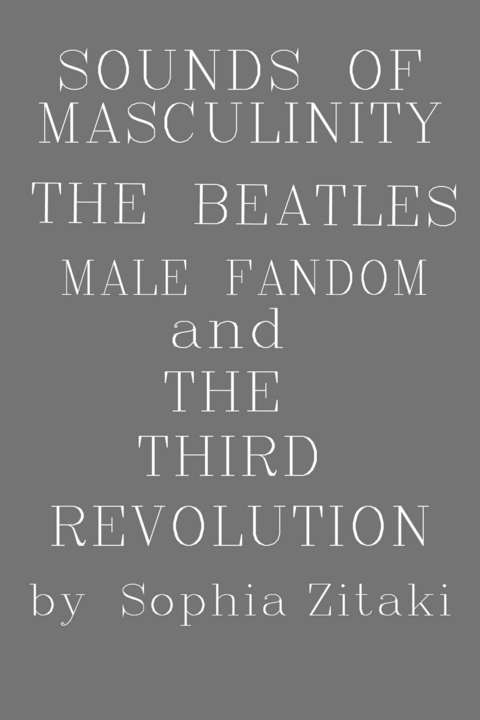
Sounds Of Masculinity (eBook)
251 Seiten
Sophia Zitaki (Verlag)
979-8-89901-701-8 (ISBN)
Sophia is a new author from New York. 'Sounds of Masculinity' is her first book. The author developed her theory about The Beatles with a view of masculinity and male fandom on the group's success and longevity while completing extensive study working on her Doctor of Musical Arts degree. She is delighted and honored to share her groundbreaking and thought-provoking work with the reader.
INTRODUCTION
When the BOAC plane touched down in South Australia in June 1964, the route to Mascot International Airport was congested with nearly 300,000 screaming fans—the largest gathering ever in Beatles history—a number nearly half the population of Adelaide.1 This event generated the largest crowd ever amassed in the city,2 doubling the turnout for Queen Elizabeth II’s Royal Tour the previous year.3 The Beatles’ stop in Australia took place four months after stepping on American soil for the first time, demonstrating that Beatles fandom was not only widespread but sustainable. Scheduled to perform just two shows in Sydney’s Centennial Hall, ticket requests exceeded 50,000. The hall held only 3,000.4
The enormity of this event in Australia can be understood from the cultural context of that period. Not everyone owned a television set, and news arrived late to Australia’s mainstream. Citizens felt themselves to be victim of “the tyranny of distance”—set up as an isolated British outpost. Travel overseas and international phone calls were expensive, and the people felt unsure of their nation’s place with the rest of the world.5 Popular music culture lagged slightly behind the general Western timeline, but once the energy of Beatlemania was felt, Australia’s feedback became a standard unmatched by any other. Australian concert promoter, Kenn Brodziak finalized preparations to invite The Beatles a year in advance when the group had not yet achieved international status. Had the contracts been signed later, the cost of the group’s arrival would have easily been doubled as their popularity had soared.6
We were just awestruck that a group so famous from the other side of the world was coming to see us. We all felt they knew all about us. The fact that it would suddenly drop in our laps, arrive in our world, that these gods of entertainment would spend time here, it was unimaginable. We couldn’t believe our good fortune. It connected us to the real world, to a world of exhilaration, driven by young people, with young people at the core. We had not seen that before in this country.7
Australians quickly recognized the explosion from a cultural shift that created a country-wide communal event. A link was forged between the energy of worldwide fame and the stepchild of British history. The future of Australia invited itself to a homecoming celebration, and all were welcome. Male fans fervently gripped the steering wheels toward their pop culture destiny. Boy bands began to form and imitate what they perceived of The Beatles’ power—Billy Thorpe and The Aztecs, the Easybeats, Normie Rowe, the Master’s Apprentices, The Twilights, and the Loved Ones. Indeed, The Beatles’ success and legacy of mid-century popular music culture worldwide would be driven by male musician fans who were smitten by The Beatles’ new masculine revolution.
Worldwide Beatlemania was sustained by the group’s exceptional work ethic. They toured inside a three-and-a-half-year period dominated by nearly nonstop performances that included over 1,400 concert appearances internationally. Touring ended without fanfare or announcement in San Francisco’s Candlestick Park on August 29, 1966,8 but recording productivity did not wane. Five core albums were written, recorded, and released within the group’s final, four-year span. To date, Nielsen’s Mid-Year Report posts The Beatles continue to be “rock’s only million-selling act through the first half of 2020.”9
While press media focused on the girls and distracted the public with their frenzied exhilaration, a closer inspection of rare photo and video footage shows a very different story. Male fans throughout the world demonstrated the extent to which they expressed their fanship by attempting to be in proximity to the group. They climbed trees, jumped onstage, swam across canals, manufactured illegal recordings, or cried during concerts. One Australian footage shows that the majority in the crowd were boys so tightly packed together, they appear as a swarm of bees from the purview of a distant camera.10
While girls provided an exciting spectacle for cameras, boys exposed how The Beatles’ cleverness and authenticity was recognized by an emotional connection that validated hidden yet powerful beliefs about themselves. Male fandom sensed how the group’s personal expressions were meaningful because they associated their own masculine personality with theirs. This was not a comparison on levels of achievement that were threatening or judgmental. Instead, The Beatles’ performance was an invitation for boys to consider what their personal reactions meant to them. Their awareness produced sharper distinctions on how they saw themselves as men. They quickly discovered that a third-party opinion was no longer relevant. Soon, new identities of masculinity—how men accepted a clearer path to their well-being—was their priority. Divergent masculine identities became socially acceptable as more men appreciated and imitated The Beatles’ new mindset, molding the essence of the group’s charisma into translations of their own personal preferences. Many future male musician fans knew almost instantly what The Beatles meant to them. Some futures were decided virtually on the spot after watching the group on the Ed Sullivan Show.
Older men who interacted with The Beatles before they achieved worldwide success discerned a bonded gang-unit with four distinct temperaments. These early mentors and allies grasped how the group’s captivating relationship could generate a profitable future enterprise if they supported that curious mystique that made everyone happy. The Beatles displayed an obvious, bold representation of self-awareness that affirmed how a new interpretation of masculinity was key. Fanship became an emotional state, nourished with every performance and record. Male fans grasped the genius of this paradox—how unity and individualism could provide a mutually sustaining relationship. For them, The Beatles represented a motivation to investigate another way of life and not settle for an unfulfilling occupation or unrewarding path. Future famous male musician fans were challenged to consider how they saw themselves in the creation of their own music and style. If successfully self-aware, they earned their own place in history while cultivating a fan following that carved new trajectories in mid-century popular music trends. These brave attempts at self-awareness of their own ingenuity exploded into a cultural shift felt worldwide. While not only consolidating their legacy with their own supporters, they also perpetuated The Beatles’ musical influence for future generations.
The Beatles represented the entrance into a leading-edge frontier that invited others who were curious about their unknown futures. Beatlemania was an ongoing thrill with repeating high points of the group’s achievements. In retrospect, The Beatles’ endgame legacy appears secondary to the journey toward their desired outcome. Success is only measured by the threshold one places on it and perhaps it is indeed the journey and not the destination. The legitimacy of their enduring success was termed a phenomenon, leading to baffling questions over how this type of genius was possible. Perhaps it is not wholly the group’s undeniable mystique that could fully satisfy the question of why the public turned out by the thousands to catch a glimpse of them. From the start, even manager Brian Epstein could not articulate what comprised their enigmatic lure.
This book has examined Beatles fandom from a perspective that speculates how men and boys were responsible for the group’s consistent success and influence. The data to support this premise was plentiful—the canon of Beatles literature has provided every detail on subjects that have intrigued us about the group over the years. The missing link, so to speak, seems instead to unveil a view that clarifies ideas surrounding how men think and behave—not in psychological terms, although traits and behaviors can be dissected to qualify and quantify. The translation of The Beatles’ masculinity occurred through real-time interplay, weighing aspects of manliness— attitudes and predispositions of preferences carefully chosen to reflect their optimum confidence. This idea alone would perplex anyone who was not participating in the experience of The Beatles’ live performance on the Sullivan show. Male fans were successful in interpreting the new Third Revolution that left no one out if interested in the gainful event.
The focus of this book has integrated features from a new field of scholarly inquiry in men’s studies to discuss the unfolding of The Beatles’ Third Masculine Revolution. It examines masculinity from a representation of how men view themselves as men and not from interpretations by society and culture. E. Anthony Rotundo initiated this concept in 1993 and his ideas have since been incorporated into other academic curricula. The historiography of masculinity, when viewed from the first-person perspective, clarifies a focus on men’s awareness of themselves and their masculine identity. Indeed, in our age of gender awareness, how a person defines him/her/they is a first-person responsibility. Moreover, Rotundo’s new insight of masculinity was encouraged by women’s studies of the 1970s and 1980s. Women correctly promoted the...
| Erscheint lt. Verlag | 24.4.2025 |
|---|---|
| Sprache | englisch |
| Themenwelt | Kunst / Musik / Theater ► Musik |
| ISBN-13 | 979-8-89901-701-8 / 9798899017018 |
| Informationen gemäß Produktsicherheitsverordnung (GPSR) | |
| Haben Sie eine Frage zum Produkt? |
 EPUB (Ohne DRM)
Größe: 5,8 MB
Digital Rights Management: ohne DRM
Dieses eBook enthält kein DRM oder Kopierschutz. Eine Weitergabe an Dritte ist jedoch rechtlich nicht zulässig, weil Sie beim Kauf nur die Rechte an der persönlichen Nutzung erwerben.
Dateiformat: EPUB (Electronic Publication)
EPUB ist ein offener Standard für eBooks und eignet sich besonders zur Darstellung von Belletristik und Sachbüchern. Der Fließtext wird dynamisch an die Display- und Schriftgröße angepasst. Auch für mobile Lesegeräte ist EPUB daher gut geeignet.
Systemvoraussetzungen:
PC/Mac: Mit einem PC oder Mac können Sie dieses eBook lesen. Sie benötigen dafür die kostenlose Software Adobe Digital Editions.
eReader: Dieses eBook kann mit (fast) allen eBook-Readern gelesen werden. Mit dem amazon-Kindle ist es aber nicht kompatibel.
Smartphone/Tablet: Egal ob Apple oder Android, dieses eBook können Sie lesen. Sie benötigen dafür eine kostenlose App.
Geräteliste und zusätzliche Hinweise
Buying eBooks from abroad
For tax law reasons we can sell eBooks just within Germany and Switzerland. Regrettably we cannot fulfill eBook-orders from other countries.
aus dem Bereich