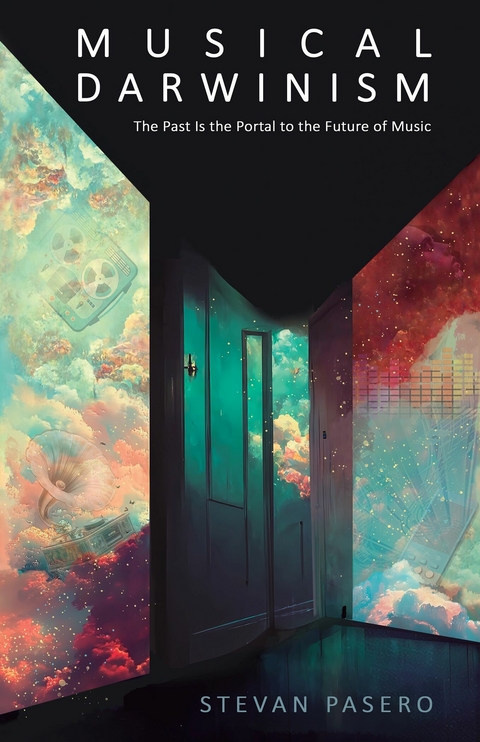
Musical Darwinism (eBook)
148 Seiten
Bookbaby (Verlag)
979-8-3509-9149-9 (ISBN)
Stevan Pasero is a renowned musician, composer, and music executive with a career spanning over four decades. He is best known for his 15 critically acclaimed albums, which highlight his virtuosic guitar performances and groundbreaking transcriptions of classical masterpieces. As a music executive, Pasero has made a lasting impact on the industry by founding Sugo Music Group, a leading independent label, publisher, and music distributor. His innovative contributions to production, licensing, and distribution have solidified his legacy as a trailblazer in the music world.
UNVEIL THE HIDDEN STORY OF THE EVOLUTION OF RECORDED MUSIC with Musical Darwinism! In this captivating insider's journey, a best-selling recording artist, record label owner, and music publisher pulls back the curtain on the ever-changing world of recorded music. Through his unique lens, you'll discover how the industry has evolved into what it is today-both as an art form and a business. Musical Darwinism reveals the transformations that have reshaped the landscape for artists and listeners alike, offering thought-provoking insights into music's past, present, and the thrilling future that awaits us all.
[Chapter One]
Voice of Music
“The most mysterious with which the human being is endowed.”
—Charles Darwin
IMAGINE A VOICE SO POWERFUL it can be heard everywhere, even in the faintest whisper. This voice possesses the extraordinary ability to express the inexpressible, conveying emotions and ideas that transcend language, logic, and time. Its sound weaves a vibrant tapestry of musical expression, from the calm of adagio to the vigor of allegretto, spanning ancient chants and contemporary urban works. Many of its creations are celebrated worldwide as pinnacles of artistic genius, akin to the masterpieces of da Vinci, the narratives of Hemingway, and the imagination of Gaudí. Timeless and boundless, this voice resonates through every corner of our existence, capturing the very essence of human expression in ways that words alone cannot.
To vivify music in words is not easy. It has become a vessel for the ineffable, the unspoken, and the elusive aspects of the human experience. Music can seamlessly transform from one moment to the next, continually etching new facets of life into its evolutionary jewel. As Charles Darwin noted in The Descent of Man, the ability to create music “must be ranked amongst the most mysterious with which the human being is endowed.” We can hear this ability throughout the ages—in the ancient “Hurrian Hymn to Nikkal” (c. 1400 BC), the intervallic theorems of Pythagoras (c. 550 BC), the psalm-texted chants of St. Gregory (c. 600 AD), the timeless concerti of Bach (1720), and in the brusque rap libretti of Biggie, Tupac, and Slim Shady Eminem from the 1980s to the present day.
Recently, we’ve witnessed the most transformative changes in music history. The evolution of music styles, advancements in music technologies, and the convergence of music cultures over the last century match those seen in millennia past. Soon, a global population of up to nine billion individuals will have the remarkable opportunity to stream hundreds of millions of songs on their mobile devices, in their cars, and within the confines of their homes, while connecting to another 100 billion gadgets comprising the Internet of Things, allowing for virtually endless musical opportunities.
Voice Interrupted—The Digital Transformation
December 31, 1999. As the second millennium drew to a close, the music industry faced a significant disruption. Initially subtle and almost imperceptible, traditional music product sales started to decline as online piracy rapidly increased. Consequently, music became more accessible, shareable, virtual …
Free.
New suspicions arose. Would musical playlists replace live performers? Could computer programmers render songwriters obsolete? Would AI-generated music become mainstream and eclipse the careers of recording and performing artists, ultimately spelling the end for the music industry?
The disruption continued. Music sales plummeted.
With the emergence of digital distribution services like Napster, Pandora, and iTunes, artist royalties became fragmented, dwindling from dollars to mere pennies, and eventually to fractions of pennies or even nothing at all. These harsh realities of digital music sales left many working-class musicians and their families struggling to survive. The result was a mass exodus, with countless musicians forced to abandon their careers and seek new ways to make a living.
I was almost one of them.
2000—Out of Time
Remember when Prince sang: “I was dreamin’ when I wrote this, so sue me if I go too fast. But life is just a party, and parties weren’t meant to last?” Little did we know that he was metaphorically dead-on when he sang the final coda: “Yeah hey, they say 2000-0-0 party over, oops, out of time. So tonight, we’re gonna party like it’s 1999.”
The year 2000 should have marked a high point for the music industry, with an unprecedented number of people listening to and buying music. We should’ve been celebrating, singing, and “dancing in the streets,” just like Martha and the Vandellas did back in the ’60s. However, contrary to expectations, we bawled Martha’s “nowhere to run to, nowhere to hide,” decrying this aberration, this abomination, this digital transformation of music.
A musical mystery. The first signs of problems appeared in 2000: rampant peer-to-peer file sharing, inferior-sounding mp3s, a sharp decrease in compact disc sales, and a sharper drop in music royalties for musicians. Consequently, several music colleagues quit their careers.
One good friend, a virtuoso pianist and one of the most accomplished recording artists I knew, vanished entirely and was never found again.
I reached out to some of my trusted music agents around the world and asked if they noticed any of these signs. Their response was worse than expected: music revenues were plummeting, and indie musicians were leaving the industry in droves. I panicked and called my guitar buddy for some words of encouragement, but he snapped, “It’s over, dude. I’ve stashed my ax, moved back home with my folks, and took a job spinning pies at Papa John’s. I’m never coming back.”
“I’m quitting music forever.”
I began to gather more data, initiating a thorough investigation to understand the underlying cause of the problem. Initially, my efforts were modest—making phone calls to record label partners, combing through industry reports and articles, logging midnight musings on cocktail napkins. Over time, however, I compiled a wealth of research, convinced it would someday prove invaluable in unraveling this musical mystery.
As time passed, the situation deteriorated even further. More colleagues left the industry, and artists’ royalties diminished significantly. It became clear that I needed more information and a thorough evaluation to fully understand the remarkable decline in music sales. So, I turned on the voice recorder, closed my eyes, and let myself be transported back to where it all began—the summer of ’85.
Lemonade Millions—The DIY Recording Artist
It was a typical late August night in Silicon Valley—mid-70s, whiffs of dry summer grass, and a silken southerly breeze tickled my tee as I moseyed down University Avenue in Palo Alto during summer break. However, this was no ordinary evening. It was an evening filled with accomplishment and promise. After two decades of diligent study in music theory, orchestration, and composition, I had just finished recording my first album. It was a transcription of Pyotr Ilyich Tchaikovsky’s The Nutcracker Suite, adapted for the guitar repertoire—the first of its kind. Within a few weeks, it would be published, manufactured, and distributed worldwide.
At that moment, I didn’t realize how successful the product would become.
I chose this winsome suite for my first recording project because it stood apart from all other ballet works and held a special place in my heart. The suite is unique: A delectable and deft essay in music laced with idealism and fastened with fanaticism, depicting a storybook pantomime bursting with ebullient melodies atop pirouetting rhythms, and … oh, uh … it was also one of my mom’s favorite tunes. (She’d always hum a few bars of the “Sugar Plum Fairy” while making cannoli and bomboloni on Sunday nights.) So, I bought the orchestra score, laid out hundreds of pages across my bedroom and hallway floors, purchased the very best pencils, erasers, and sharpeners money could buy, and transcribed the “March of the Wooden Soldiers,” “Waltz of the Flowers,” and eight other popular dances from Mr. Tchaikovsky’s timeless oeuvre.
It took years—two and a half, to be exact. The task of arranging 60 orchestral instruments onto six guitar strings initially seemed a bit daunting. However, music critics lauded the recording, and my Nutcracker concerts featuring the transcription received high praise. Encouraged by this, I arranged and recorded more symphonic works for the guitar repertoire, including Ravel’s Bolero, Bizet’s Carmen, Beethoven’s Fifth Symphony, and Tchaikovsky’s Swan Lake and Sleeping Beauty. These transcriptions marked my first set of recordings. They played a crucial role in launching my career in the music industry. (As of this writing, my recorded works have been compiled and released on over a thousand music albums, many of which include these early transcriptions.)
The morning after completing the Nutcracker recording, I was inspired to embark on my next big venture: starting a record label! Why not, I thought. It seemed logical—I had a music product, so why not have a label to go with it, right?
Sugo—The Essence of Good Things
My initial challenge was to devise a way to kickstart a professional, profitable, global record label without any seed funding. After careful consideration, the answer was obvious. Throw a party! And not just any party—a neighborhood-rattling record-release dinner bash.
I invited all my friends, a handful of popular musicians living in the Bay Area, my publicist and photographer, a few music execs and venture capitalists I knew in Hollywood, and my lawyer. I whipped out my calculator and...
| Erscheint lt. Verlag | 14.4.2025 |
|---|---|
| Sprache | englisch |
| Themenwelt | Kunst / Musik / Theater ► Musik |
| ISBN-13 | 979-8-3509-9149-9 / 9798350991499 |
| Informationen gemäß Produktsicherheitsverordnung (GPSR) | |
| Haben Sie eine Frage zum Produkt? |
 EPUB (Ohne DRM)
Größe: 4,0 MB
Digital Rights Management: ohne DRM
Dieses eBook enthält kein DRM oder Kopierschutz. Eine Weitergabe an Dritte ist jedoch rechtlich nicht zulässig, weil Sie beim Kauf nur die Rechte an der persönlichen Nutzung erwerben.
Dateiformat: EPUB (Electronic Publication)
EPUB ist ein offener Standard für eBooks und eignet sich besonders zur Darstellung von Belletristik und Sachbüchern. Der Fließtext wird dynamisch an die Display- und Schriftgröße angepasst. Auch für mobile Lesegeräte ist EPUB daher gut geeignet.
Systemvoraussetzungen:
PC/Mac: Mit einem PC oder Mac können Sie dieses eBook lesen. Sie benötigen dafür die kostenlose Software Adobe Digital Editions.
eReader: Dieses eBook kann mit (fast) allen eBook-Readern gelesen werden. Mit dem amazon-Kindle ist es aber nicht kompatibel.
Smartphone/Tablet: Egal ob Apple oder Android, dieses eBook können Sie lesen. Sie benötigen dafür eine kostenlose App.
Geräteliste und zusätzliche Hinweise
Buying eBooks from abroad
For tax law reasons we can sell eBooks just within Germany and Switzerland. Regrettably we cannot fulfill eBook-orders from other countries.
aus dem Bereich