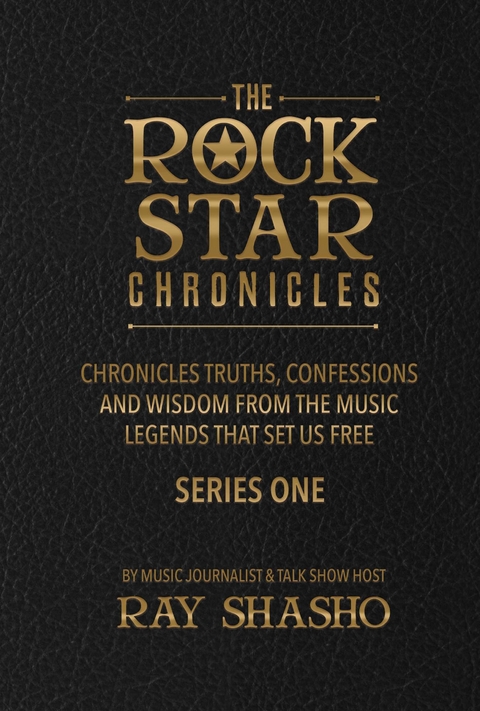
Rock Star Chronicles (eBook)
474 Seiten
Bookbaby (Verlag)
978-1-5439-9051-5 (ISBN)
WHERE HAVE ALL THE ROCK STARS GONE?Rock and Roll, the Blues, and Jazz are America's contribution to the arts, so why are we not fighting to preserve our own musical legacy and culture? Rooted from the early blues pioneers, the longevity of rock and roll is second to none. But strangely enough those legendary rock heroes that we were so accustomed to hearing every time we turned on our radios had mysteriously vanished from the mainstream. The music of the 1960's, 70's and even the 80's was an important juncture in all of our lives. So many of us timeline life's precious moments with the music we remember, when the music was so great, when the music mattered. The baby-boomer generation is financially imperative yet many of its entertainment standards have been renounced. One day, the plug was pulled on those legendary music artists. Hackers began stealing music across the internet. Online music stores popularized cheap digital singles and neglected to promote full-length albums. Radio stations changed formats to accommodate talk show radio jocks while rappers and electronic dance music menaced the airwaves. Notorious record companies began folding in droves. Record companies and radio stations that were once owned and operated by visionaries were now run by accountants and lawyers and the music world began promoting untalented wannabes. The economy plummeted, and radio stations became more concerned about how many consecutive commercials they could run instead of providing quality radio programming and entertainment value. Radio stations became corporate machines leaving no room for innovation. Throughout the 2000s, recording studios and live performances began using an audio processor called "e;Auto-Tune"e; to disguise off-key inaccuracies in vocal tracks. The device allowed virtually anyone without music skills to become a singer and new waves of mainstream radio stars were instantly fabricated. The business of music became stronger and more important than the art of music. For more than a decade, I've been on a rock and roll pilgrimage to help promote and save the greatest music the world has ever known. Before the internet and Napster, virtuoso musicians traditionally introduced their music by way of mainstream radio stations while anxious music enthusiasts hurried to their favorite record stores and purchased a copy of the artist's latest release. Talk radio wasn't popular because there was way too much great music to play over the airwaves. Advertisers didn't rule the airwaves, the music did. Rock legends toured the world to promote their latest albums and prices of concert tickets were extremely affordable. Proficient musicians, singers, and songwriters are what made the music so great.
Introduction:
WHERE HAVE ALL THE ROCK STARS GONE?
Rock and Roll, the Blues, and Jazz are America’s contribution to the arts, so why are we not fighting to preserve our own musical legacy and culture?
With roots from the early blues pioneers, the longevity of rock and roll is second to none. But strangely enough, those legendary rock heroes that we were so accustomed to hearing every time we turned our radios on, had mysteriously vanished from the mainstream. The music of the 1960s, 70s, and even the 80s was an important juncture in all of our lives. So many of us timeline life’s precious moments with the music we remember, when the music was so great, when the music mattered. The baby boomer generation is financially imperative to many, yet many of its entertainment standards have been renounced.
One day, the plug was pulled on those legendary music artists. Hackers began stealing music across the internet. Online music stores popularized cheap digital singles and neglected to promote full-length albums. Radio stations changed formats to accommodate talk show radio jocks, while rappers and electronic dance music menaced the airwaves. Notorious record companies began folding in droves. Record companies and radio stations that were once owned and operated by visionaries, were now run by accountants and lawyers, and the music world began promoting untalented wannabes. The economy plummeted, and radio stations became more concerned about how many consecutive commercials they could run instead of providing quality radio programming and entertainment value. Radio stations became corporate machines leaving no room for innovation. Throughout the 2000s, recording studios and live performances began using an audio processor called “Auto-Tune” to disguise off-key inaccuracies in vocal tracks. The device allowed virtually anyone without music skills to become a singer and new waves of mainstream radio stars were instantly fabricated. The business of music became stronger and more important than the art of music.
For more than a decade, I’ve been on a rock and roll pilgrimage to help promote and save the greatest music the world has ever known. Before the internet and Napster, virtuoso musicians traditionally introduced their music by way of mainstream radio stations while anxious music enthusiasts hurried to their favorite record stores and purchased a copy of the artist’s latest release. Talk radio wasn’t popular because there was way too much great music to play over the airwaves. Advertisers didn’t rule the airwaves, the music did. Rock legends toured the world to promote their latest albums and prices of concert tickets were extremely affordable. Proficient musicians, singers, and songwriters are what made the music so great.
I refused to simply write about the music and artists that influenced countless generations and millions upon millions of music fans worldwide, that would be way too easy. It has already been done a gazillion times over the years. Instead, I brought the actual music legend to the reader. From January 2010 through the present day, I’ve conducted over 1,000 candid interviews with some of the greatest music legends of our time. After reading each interview, it will seem like you’re the one chatting with your favorite rock hero. Even though their music lives on…the artists are vanishing and will soon be gone forever!
These recent and candid interviews include the following: life changing events, band feuds that have lasted for decades, love affairs with bandmates, drug induced stories, spirituality, metaphysical beliefs, Woodstock memories, Joplin and Hendrix tidbits, mafia-owned record companies, untold stories about The Beatles, royalty issues, management and record company thieving and conniving, political views, conspiracy theories, humorous and tragic anecdotes, transitioning to Christianity, and suicide.
Since I was a kid growing up in Baltimore, Maryland in the 1960s, I was dubbed “Rock Raymond” by friends and family for my bona fide love, passion, and obsession of rock music. In high school, I attended hundreds of rock concerts and even took a job at the famed Capital Centre arena to meet and greet my favorite rock stars before and after their shows. After graduating from a CBS owned broadcasting school in Ft. Lauderdale, Florida, I became a Top 40 radio deejay in the late 70s and early 80s, and my life became the music. Unfortunately, radio stations trusted computers (Arbitron ratings) over human instincts. It was the early radio jocks who discovered great music and put it out over the airwaves. Radio became mundane when they began mimicking each other based on the Arbitrons.
After my stint in radio, I became an entrepreneur in electronics, a family-owned and operated cutting-edge retail electronic business in Washington, D.C. I witnessed all the technological advancements firsthand, and how it affected the music industry. I followed the technology from early transistor radios, record players, reel-to-reel tape recorders, cassette and eight track tape players, Walkmans, and CD players, to MP3s. Some of my clients included the following: Chuck Norris, James Mason, Ted Williams, Alex Haley, Art Buchwald, Dick Gregory, Dionne Warwick, John Candy, Jon Voight and General Colin Powell.
I published my first novel entitled, Check the Gs, a comical and awe-inspiring novel about growing up in an eclectic family business. I subsequently released a second edition entitled, Wacky Shenanigans on F Street—Proud to be Politically Incorrect in Washington, D.C.
I became a classic rock music journalist in St. Petersburg, Florida. It started out as a fun gig to help promote my book, but something very extraordinary transformed. I began covering concerts and music events around the Tampa Bay area, and decided to take a crack at interviewing some of the rock music legends that I idolized all my life.
My very first “rock star” interview was Joe Lala who lived in Tampa, Florida. I contacted Joe by way of the internet and scheduled an interview at Joe’s home. I was surprised how cordial and amenable Joe was to tell the story about his rock and roll past. Joe and I spent hours together reliving his days of playing percussion with Blues Image, Stephen Stills and Manassas, The Bee Gees, and Firefall. Joe disclosed stories about jamming with Jimi Hendrix, and throwing Mick Jagger out of his hotel room in New York City. After the interview, Joe asked me to be his personal assistant, and later, to help write his own personal memoir. I was so overwhelmed with the ease of the interview that I immediately began my search for the next one.
I quickly became one of the top music journalists in the country. My column was read by thousands of music enthusiasts daily. My in-depth interviews, album and concert reviews continue to be featured on artist websites around the globe.
I began asking each legendary musician, singer, and songwriter one question. If you had a “Field of Dreams” wish (like the movie); to play or collaborate with anyone from the past or present, who would that be? The question became eminent to the interviewer and interviewee, and the responses will surely surprise the most discerning music enthusiast.
Today, I’m the director of The Publicity Works Agency, a public relations firm specializing in publicity plans for musicians and authors. I’m also the host of The Ray Shasho Show on BBS Radio, spotlighting exclusive interviews with both legendary, and up-and-coming music artists, and authors. I also feature the movers and shakers of the music and publishing industries.
My objective is a sincere and a genuine labor of love—to promote the greatest music the world will ever know!
Wolfman Jack, the legendary radio deejay and the host of the “Midnight Special” (TV series) had this to say about radio:
“In the old days I used to love the Top 40. We were getting 700 to 1,000 records a week, and out of that you had to pick three or four to go on the charts. The disc jockey had a lot more input about what would be played. A lot of people played their own thing. If a record came in, they would give it a try, and if it wasn’t that good, the public would take a shot at it to see if they liked it. If they didn’t like it, it would be off the air real fast.”
“Nowadays, computers pick everything out and it’s wrong. How many radio stations are not boring? That’s why the music business is not that hot, because radio is very boring. They’re listening more to computers, instead of gut feelings which used to make radio very interesting. It’s time for a change! I think we should turn everything around backwards and do it all differently. It would be terribly interesting; just throw all the rules out the window, and let’s go another way for a change and see what happens. I think there is so much music out there, and so many great new artists that aren’t getting any exposure. It’s ridiculous! To go with the same old thing repeatedly is boring me to death. I want to be entertained when I turn on the radio and I don’t find that anymore.”
Longtime artist and tour manager Derek Sutton, who currently manages guitar virtuoso Robin Trower, and represented Styx and Glass Tiger said:
“We did not educate the...
| Erscheint lt. Verlag | 9.10.2019 |
|---|---|
| Sprache | englisch |
| Themenwelt | Kunst / Musik / Theater ► Musik |
| ISBN-10 | 1-5439-9051-7 / 1543990517 |
| ISBN-13 | 978-1-5439-9051-5 / 9781543990515 |
| Informationen gemäß Produktsicherheitsverordnung (GPSR) | |
| Haben Sie eine Frage zum Produkt? |
 EPUB (Ohne DRM)
Größe: 84,7 MB
Digital Rights Management: ohne DRM
Dieses eBook enthält kein DRM oder Kopierschutz. Eine Weitergabe an Dritte ist jedoch rechtlich nicht zulässig, weil Sie beim Kauf nur die Rechte an der persönlichen Nutzung erwerben.
Dateiformat: EPUB (Electronic Publication)
EPUB ist ein offener Standard für eBooks und eignet sich besonders zur Darstellung von Belletristik und Sachbüchern. Der Fließtext wird dynamisch an die Display- und Schriftgröße angepasst. Auch für mobile Lesegeräte ist EPUB daher gut geeignet.
Systemvoraussetzungen:
PC/Mac: Mit einem PC oder Mac können Sie dieses eBook lesen. Sie benötigen dafür die kostenlose Software Adobe Digital Editions.
eReader: Dieses eBook kann mit (fast) allen eBook-Readern gelesen werden. Mit dem amazon-Kindle ist es aber nicht kompatibel.
Smartphone/Tablet: Egal ob Apple oder Android, dieses eBook können Sie lesen. Sie benötigen dafür eine kostenlose App.
Geräteliste und zusätzliche Hinweise
Buying eBooks from abroad
For tax law reasons we can sell eBooks just within Germany and Switzerland. Regrettably we cannot fulfill eBook-orders from other countries.
aus dem Bereich