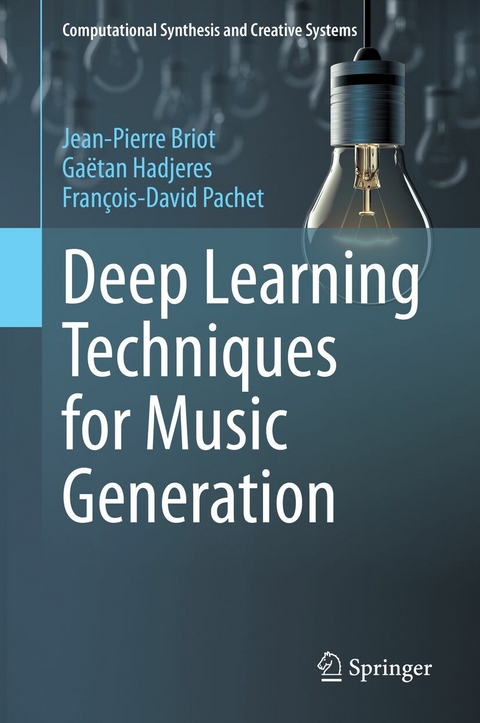
Deep Learning Techniques for Music Generation (eBook)
XXVIII, 284 Seiten
Springer International Publishing (Verlag)
978-3-319-70163-9 (ISBN)
This book is a survey and analysis of how deep learning can be used to generate musical content. The authors offer a comprehensive presentation of the foundations of deep learning techniques for music generation. They also develop a conceptual framework used to classify and analyze various types of architecture, encoding models, generation strategies, and ways to control the generation. The five dimensions of this framework are: objective (the kind of musical content to be generated, e.g., melody, accompaniment); representation (the musical elements to be considered and how to encode them, e.g., chord, silence, piano roll, one-hot encoding); architecture (the structure organizing neurons, their connexions, and the flow of their activations, e.g., feedforward, recurrent, variational autoencoder); challenge (the desired properties and issues, e.g., variability, incrementality, adaptability); and strategy (the way to model and control the process of generation, e.g., single-step feedforward, iterative feedforward, decoder feedforward, sampling). To illustrate the possible design decisions and to allow comparison and correlation analysis they analyze and classify more than 40 systems, and they discuss important open challenges such as interactivity, originality, and structure.
The authors have extensive knowledge and experience in all related research, technical, performance, and business aspects. The book is suitable for students, practitioners, and researchers in the artificial intelligence, machine learning, and music creation domains. The reader does not require any prior knowledge about artificial neural networks, deep learning, or computer music. The text is fully supported with a comprehensive table of acronyms, bibliography, glossary, and index, and supplementary material is available from the authors' website.
| Erscheint lt. Verlag | 8.11.2019 |
|---|---|
| Reihe/Serie | Computational Synthesis and Creative Systems | Computational Synthesis and Creative Systems |
| Zusatzinfo | XXVIII, 284 p. 143 illus., 91 illus. in color. |
| Sprache | englisch |
| Themenwelt | Kunst / Musik / Theater ► Musik |
| Mathematik / Informatik ► Informatik | |
| Mathematik / Informatik ► Mathematik | |
| Schlagworte | Artificial Intelligence • Deep learning • Encoding Models • Flow Machines • Interactivity • machine learning • music creation • Music generation • Neural networks • Representation |
| ISBN-10 | 3-319-70163-0 / 3319701630 |
| ISBN-13 | 978-3-319-70163-9 / 9783319701639 |
| Informationen gemäß Produktsicherheitsverordnung (GPSR) | |
| Haben Sie eine Frage zum Produkt? |
 PDF (Wasserzeichen)
DRM: Digitales Wasserzeichen
Dieses eBook enthält ein digitales Wasserzeichen und ist damit für Sie personalisiert. Bei einer missbräuchlichen Weitergabe des eBooks an Dritte ist eine Rückverfolgung an die Quelle möglich.
Dateiformat: PDF (Portable Document Format)
Mit einem festen Seitenlayout eignet sich die PDF besonders für Fachbücher mit Spalten, Tabellen und Abbildungen. Eine PDF kann auf fast allen Geräten angezeigt werden, ist aber für kleine Displays (Smartphone, eReader) nur eingeschränkt geeignet.
Systemvoraussetzungen:
PC/Mac: Mit einem PC oder Mac können Sie dieses eBook lesen. Sie benötigen dafür einen PDF-Viewer - z.B. den Adobe Reader oder Adobe Digital Editions.
eReader: Dieses eBook kann mit (fast) allen eBook-Readern gelesen werden. Mit dem amazon-Kindle ist es aber nicht kompatibel.
Smartphone/Tablet: Egal ob Apple oder Android, dieses eBook können Sie lesen. Sie benötigen dafür einen PDF-Viewer - z.B. die kostenlose Adobe Digital Editions-App.
Buying eBooks from abroad
For tax law reasons we can sell eBooks just within Germany and Switzerland. Regrettably we cannot fulfill eBook-orders from other countries.
aus dem Bereich