


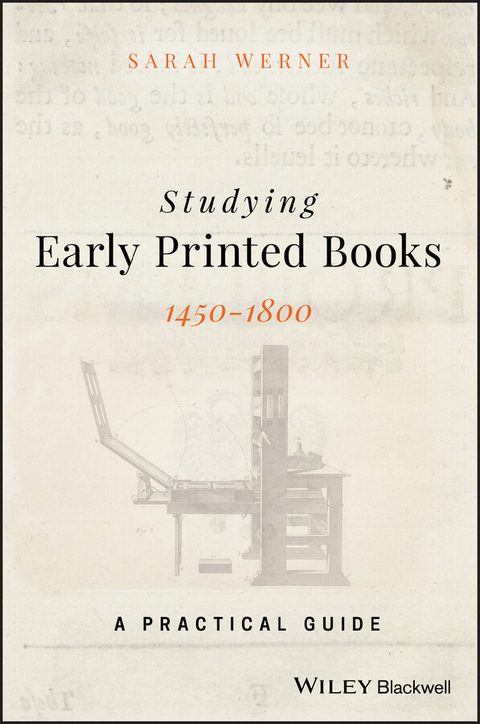
Studying Early Printed Books, 1450-1800 (eBook)
John Wiley & Sons (Verlag)
978-1-119-04994-4 (ISBN)
A comprehensive resource to understanding the hand-press printing of early books
Studying Early Printed Books, 1450 - 1800 offers a guide to the fascinating process of how books were printed in the first centuries of the press and shows how the mechanics of making books shapes how we read and understand them. The author offers an insightful overview of how books were made in the hand-press period and then includes an in-depth review of the specific aspects of the printing process. She addresses questions such as: How was paper made? What were different book formats? How did the press work? In addition, the text is filled with illustrative examples that demonstrate how understanding the early processes can be helpful to today's researchers.
Studying Early Printed Books shows the connections between the material form of a book (what it looks like and how it was made), how a book conveys its meaning and how it is used by readers. The author helps readers navigate books by explaining how to tell which parts of a book are the result of early printing practices and which are a result of later changes. The text also offers guidance on: how to approach a book; how to read a catalog record; the difference between using digital facsimiles and books in-hand. This important guide:
- Reveals how books were made with the advent of the printing press and how they are understood today
- Offers information on how to use digital reproductions of early printed books as well as how to work in a rare books library
- Contains a useful glossary and a detailed list of recommended readings
- Includes a companion website for further research
Written for students of book history, materiality of text and history of information, Studying Early Printed Books explores the many aspects of the early printing process of books and explains how their form is understood today.
SARAH WERNER is a book historian, Shakespearean, and digital media scholar based in Washington, DC. Werner worked for nearly a decade at the Folger Shakespeare Library and has taught book history and early modern literature at numerous universities.
A comprehensive resource to understanding the hand-press printing of early books Studying Early Printed Books, 1450 - 1800 offers a guide to the fascinating process of how books were printed in the first centuries of the press and shows how the mechanics of making books shapes how we read and understand them. The author offers an insightful overview of how books were made in the hand-press period and then includes an in-depth review of the specific aspects of the printing process. She addresses questions such as: How was paper made? What were different book formats? How did the press work? In addition, the text is filled with illustrative examples that demonstrate how understanding the early processes can be helpful to today s researchers. Studying Early Printed Books shows the connections between the material form of a book (what it looks like and how it was made), how a book conveys its meaning and how it is used by readers. The author helps readers navigate books by explaining how to tell which parts of a book are the result of early printing practices and which are a result of later changes. The text also offers guidance on: how to approach a book; how to read a catalog record; the difference between using digital facsimiles and books in-hand. This important guide: Reveals how books were made with the advent of the printing press and how they are understood today Offers information on how to use digital reproductions of early printed books as well as how to work in a rare books library Contains a useful glossary and a detailed list of recommended readings Includes a companion website for further research Written for students of book history, materiality of text and history of information, Studying Early Printed Books explores the many aspects of the early printing process of books and explains how their form is understood today.
SARAH WERNER is a book historian, Shakespearean, and digital media scholar based in Washington, DC. Werner worked for nearly a decade at the Folger Shakespeare Library and has taught book history and early modern literature at numerous universities.
List of Illustrations vii
Acknowledgments ix
Introduction 1
Part 1 Overview 8
Getting Ready to Print 8
At the Press 16
Also at the Press 19
After Printing 20
The Economics of Printing 23
Part 2 Step-by-Step 26
Paper 26
Type 34
Format 42
Printing 55
Corrections and Changes 61
Illustrations 65
Binding 71
Part 3 On the Page 79
Advertisements 79
Alphabet and Abbreviations 80
Blanks 83
Dates 83
Imprint Statements 85
Edition, Impression, Issue, State, Copy 86
Initial Letters 88
Marginal Notes 90
Music 91
Pagination and Foliation 92
Preliminary Leaves 92
Press Figures 93
Printer's Devices 95
Printer's Ornaments 95
Privileges, Approbations, and Imprimaturs 96
Signature Marks 96
Title Pages 98
Volvelles and Movable Figures 100
Part 4 Looking at Books 102
Good Research Habits 103
Handling Books 104
Appearance 106
Contents 108
Page Features 111
Usage 113
Digitization 114
Part 5 The Afterlives of Books 118
Loss Rates 118
Catalog Records 120
Books in Hand 132
Books on Screen 139
Conclusion 149
Appendix 1: Further Reading 152
Appendix 2: Glossary 171
Index 180
| Erscheint lt. Verlag | 13.12.2018 |
|---|---|
| Sprache | englisch |
| Themenwelt | Kunst / Musik / Theater ► Design / Innenarchitektur / Mode |
| Geisteswissenschaften ► Sprach- / Literaturwissenschaft ► Anglistik / Amerikanistik | |
| Geisteswissenschaften ► Sprach- / Literaturwissenschaft ► Literaturwissenschaft | |
| Schlagworte | 16th Century English Literature • 18th century • Bibliographer • Bibliography • Bildungswesen • book binding • bookmaking process • catalogs • digital facsimiles • Digital Images • digital reproductions • Early modern • Early printed books • Education • Englische Literatur / 16. Jhd. • examination of the book process • Facsimiles • hand press books • historical framework of the printed book • How to make a book • Information & Library Science • Informations- u. Bibliothekswissenschaft • introduction to printed books • Literature • Literature Special Topics • Literaturwissenschaft • <p>Guide to early printed books • manuscript and books • overview of early printed books • paper and book production • plan of action to studying a book • practical understanding of early printed books • printing and book production • provenance</p> • rare books libraries • Renaissance • researching old books • Rubrication • Special Collections • Spezialthemen Literaturwissenschaft • study early printed books • studying early printed books • the steps of making a book • typographic elements • understanding early printed books • using libraries |
| ISBN-10 | 1-119-04994-6 / 1119049946 |
| ISBN-13 | 978-1-119-04994-4 / 9781119049944 |
| Informationen gemäß Produktsicherheitsverordnung (GPSR) | |
| Haben Sie eine Frage zum Produkt? |
 PDF (Adobe DRM)
Kopierschutz: Adobe-DRM
Adobe-DRM ist ein Kopierschutz, der das eBook vor Mißbrauch schützen soll. Dabei wird das eBook bereits beim Download auf Ihre persönliche Adobe-ID autorisiert. Lesen können Sie das eBook dann nur auf den Geräten, welche ebenfalls auf Ihre Adobe-ID registriert sind.
Details zum Adobe-DRM
Dateiformat: PDF (Portable Document Format)
Mit einem festen Seitenlayout eignet sich die PDF besonders für Fachbücher mit Spalten, Tabellen und Abbildungen. Eine PDF kann auf fast allen Geräten angezeigt werden, ist aber für kleine Displays (Smartphone, eReader) nur eingeschränkt geeignet.
Systemvoraussetzungen:
PC/Mac: Mit einem PC oder Mac können Sie dieses eBook lesen. Sie benötigen eine
eReader: Dieses eBook kann mit (fast) allen eBook-Readern gelesen werden. Mit dem amazon-Kindle ist es aber nicht kompatibel.
Smartphone/Tablet: Egal ob Apple oder Android, dieses eBook können Sie lesen. Sie benötigen eine
Geräteliste und zusätzliche Hinweise
Buying eBooks from abroad
For tax law reasons we can sell eBooks just within Germany and Switzerland. Regrettably we cannot fulfill eBook-orders from other countries.
aus dem Bereich


