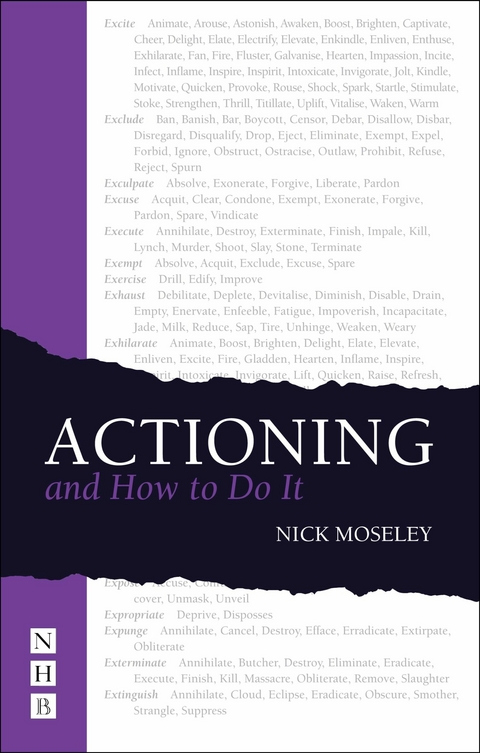
Actioning - and How to Do It (eBook)
160 Seiten
Nick Hern Books (Verlag)
9781780017334 (ISBN)
Nick Moseley worked as an actor before teaching drama in secondary school, and then in drama schools, first at Italia Conti and then at the Royal Central School of Speech and Drama, where he was Principal Lecturer in Acting for fifteen years. He is the author of several books: Acting and Reacting: Tools for the Modern Actor; Meisner in Practice: A Guide for Actors, Directors and Teachers; Actioning and How to Do It; and Getting into Drama School: The Compact Guide, all published by Nick Hern Books.
The two scenes we have looked at in the previous chapter are relatively simple in terms of the characters’ backstories and the social conventions which influence them. However, many plays, especially those from different eras/places from your own, can present you with difficulties when it comes to choosing the right verbs.
The excerpt below is from Act One of The Importance of Being Earnest by Oscar Wilde. I have chosen this play because, although it is a ‘well-made’ piece with boldly drawn characters and a clear ‘arc’ to the story, it has a complex plot involving a great deal of deception and subterfuge. This means that the characters’ real intentions are often hidden below the frothy, witty dialogue, requiring you, the actor, to do plenty of investigation before you start to ‘action’ the scene.
The scene is the London apartment of Algernon Moncrieff, a young aristocratic man-about-town of the 1890s. Algernon’s friend Jack Worthing, under his customary pseudonym of Ernest, has come up to London from his Hertfordshire estate in order to propose to Gwendolen Fairfax, daughter of Lord and Lady Bracknell, and Algernon’s cousin. Algernon considers Jack (whom he knows as Ernest) to be too serious, but since he has very little income of his own and Jack is quite wealthy, Algernon cultivates his friendship. Algernon is also very interested in Jack’s other life in the country, about which Jack will say nothing. This interest has been compounded by the fact that on a previous visit, Jack left behind a cigarette case inscribed ‘From little Cecily, with her fondest love to her dear Uncle Jack’. Cecily is in fact Jack’s eighteen-year-old ward, the granddaughter of his late guardian and benefactor. Algernon correctly guesses that Cecily is young and attractive, and is determined to meet her.
Sample Dialogue 3
From very near the beginning of the play.
ALGERNON. How are you, my dear Ernest? / What brings you up to town?
JACK. Oh, pleasure, pleasure! / What else should bring one anywhere? / Eating as usual, I see, Algy!
ALGERNON (stiffly). I believe it is customary in good society to take some slight refreshment at five o’clock. / Where have you been since last Thursday?
JACK (sitting down on the sofa). In the country.
ALGERNON. What on earth do you do there?
JACK (pulling off his gloves). When one is in town one amuses oneself. When one is in the country one amuses other people. / It is excessively boring.
ALGERNON. And who are the people you amuse?
JACK (airily). Oh, neighbours, neighbours.
ALGERNON. Got nice neighbours in your part of Shropshire?
JACK. Perfectly horrid! Never speak to one of them.
ALGERNON. How immensely you must amuse them! / (Goes over and takes sandwich.) By the way, Shropshire is your county, is it not?
JACK. Eh? Shropshire? / Yes, of course. / Hallo! / Why all these cups? / Why cucumber sandwiches? / Why such reckless extravagance in one so young? / Who is coming to tea?
ALGERNON. Oh! merely Aunt Augusta and Gwendolen.
____________EVENT FOR JACK___________
JACK. How perfectly delightful!
ALGERNON. Yes, that is all very well; but I am afraid Aunt Augusta won’t quite approve of your being here.
JACK. May I ask why?
ALGERNON. My dear fellow, the way you flirt with Gwendolen is perfectly disgraceful. / It is almost as bad as the way Gwendolen flirts with you.
JACK. I am in love with Gwendolen. / I have come up to town expressly to propose to her.
_________EVENT FOR ALGERNON________
ALGERNON. I thought you had come up for pleasure? / …I call that business.
JACK. How utterly unromantic you are!
ALGERNON. I really don’t see anything romantic in proposing. / It is very romantic to be in love. / But there is nothing romantic about a definite proposal. / Why, one may be accepted. / One usually is, I believe. / Then the excitement is all over. / The very essence of romance is uncertainty. / If ever I get married, I’ll certainly try to forget the fact.
Your first job, having read and re-read the text you are planning to ‘action’, is to start to delve below the surface of the dialogue, using Stanislavskian processes to reveal the detail of the situation and the motivating factors. (In most productions you will probably do this as a company, during the early stages of rehearsal.)
Superficially, this dialogue appears to be little more than a witty exchange between two leisured and slightly languid young men, and, sadly, it is all too often played as such. Hidden beneath the wit, however, is a mutual suspicion, and a need on the part of both men (for different reasons) to thwart each other’s designs.
As with most scenes, it is impossible to make useful and accurate action-verb choices without a full understanding of the play’s given circumstances. As a general principle, before attempting to ‘action’ a scene like this, you will need to:
• Read the whole play carefully at least twice, even if you are only Actioning one or two scenes, until you are absolutely clear about the plot, and have ‘sifted’ the text for information about the characters.
• Research the context, including the social structure, social and moral codes and any other relevant information about upper-class life of the time.
• Investigate and write down the given circumstances, in this case paying particular attention to the plot information offered through the course of Act One.
• Make yourself very familiar with all the characters and relationships, and the sequence of events. You may wish to construct charts and timelines to help you do this.
• Construct an actor’s notebook. This will usually be a bound notebook with a hard cover, in which you write or insert all your notes and research. You should also cut and paste your script, page by page, into the notebook, leaving a blank page opposite each page of text for notes and annotations.
• Within the text itself, note down the key events as they occur in the dialogue. Events can be the entrance or exit of a character, or a revelation by one character to another. In the dialogue above (marked in bold) the main events are Algernon’s revelation to Jack that Lady Bracknell and Gwendolen are expected, and Jack’s revelation to Algernon that he is intending to propose to Gwendolen. Events often change the energy and pace of a scene, and also alter the sub-objectives (the smaller objectives which lead to the bigger ones). An event signals the start of a new unit.
Below is an example of a chart of character circumstances. Here I have noted down the background information and motivating forces for the four main characters, using a mixture of fact and conjecture to build a picture which can stimulate the imagination of the actor, but is at the same time carefully rooted in the actual given circumstances. (There are many more characters in the play, and many more plot twists that you would also have to investigate were you to ‘action’ the whole play.)
| Jack (Ernest) Worthing | A foundling, discovered in a leather handbag (a kind of holdall rather than a ladies’ handbag) at Victoria Station by Thomas Cardew, a rich elderly gentleman who subsequently adopted him. Now a young man in his twenties with a large income and nothing particular to do with his time, he has been given responsibility for looking after Cecily Cardew, granddaughter of his late guardian, a task which he has taken very seriously. However, as Cecily has approached adulthood, Jack has felt the need to spend time in London rather than with Cecily on his sleepy Hertfordshire estate with neighbours he hates. He has therefore invented a fictional younger brother, Ernest, who lives in London and constantly gets into scrapes from which he needs rescuing. Once in London, he takes the name of Ernest himself, in order to enjoy himself in the flamboyant society of his friend Algernon and others. He conceals from Algernon the true whereabouts of his country estate, claiming to live nearly two hundred miles away in Shropshire. Recently he has fallen in love with Gwendolen Fairfax, daughter of Lord and Lady Bracknell, and Algernon’s cousin. This presents him with all sorts of difficulties, since once engaged he will no longer be able to keep his two lives separate. His feelings compel him to propose to Gwendolen, but he has no real plan beyond that, other than concealing from both Algernon and Gwendolen (for different reasons) that he has a very pretty young ward. |
| Algernon Moncrieff | The son of an army general and the nephew of Lady Bracknell. Although from aristocratic stock he has little income of his own, and lives on his debts. A flamboyant good-timer, he takes very little in life seriously. He values his freedom and often leaves London on exploratory jaunts, having invented an invalid friend called Bunbury whom he always claims to be visiting. Recently he has travelled all over Shropshire hunting for Jack’s estate and is now convinced that Jack has been lying to him. His interest in Jack’s private life has recently been exacerbated by the fact that Jack (whom he knows only as Ernest) has recently left behind in the apartment a silver cigarette case inscribed with the words ‘From little Cecily with fondest love to her dear Uncle Jack’. At the start of the play he is already in love with the idea of Cecily and is determined to find out who she... |
| Erscheint lt. Verlag | 14.4.2016 |
|---|---|
| Verlagsort | London |
| Sprache | englisch |
| Themenwelt | Literatur ► Lyrik / Dramatik ► Dramatik / Theater |
| Kunst / Musik / Theater ► Theater / Ballett | |
| ISBN-13 | 9781780017334 / 9781780017334 |
| Informationen gemäß Produktsicherheitsverordnung (GPSR) | |
| Haben Sie eine Frage zum Produkt? |
 EPUB (Wasserzeichen)
DRM: Digitales Wasserzeichen
Dieses eBook enthält ein digitales Wasserzeichen und ist damit für Sie personalisiert. Bei einer missbräuchlichen Weitergabe des eBooks an Dritte ist eine Rückverfolgung an die Quelle möglich.
Dateiformat: EPUB (Electronic Publication)
EPUB ist ein offener Standard für eBooks und eignet sich besonders zur Darstellung von Belletristik und Sachbüchern. Der Fließtext wird dynamisch an die Display- und Schriftgröße angepasst. Auch für mobile Lesegeräte ist EPUB daher gut geeignet.
Systemvoraussetzungen:
PC/Mac: Mit einem PC oder Mac können Sie dieses eBook lesen. Sie benötigen dafür die kostenlose Software Adobe Digital Editions.
eReader: Dieses eBook kann mit (fast) allen eBook-Readern gelesen werden. Mit dem amazon-Kindle ist es aber nicht kompatibel.
Smartphone/Tablet: Egal ob Apple oder Android, dieses eBook können Sie lesen. Sie benötigen dafür eine kostenlose App.
Geräteliste und zusätzliche Hinweise
Buying eBooks from abroad
For tax law reasons we can sell eBooks just within Germany and Switzerland. Regrettably we cannot fulfill eBook-orders from other countries.
aus dem Bereich