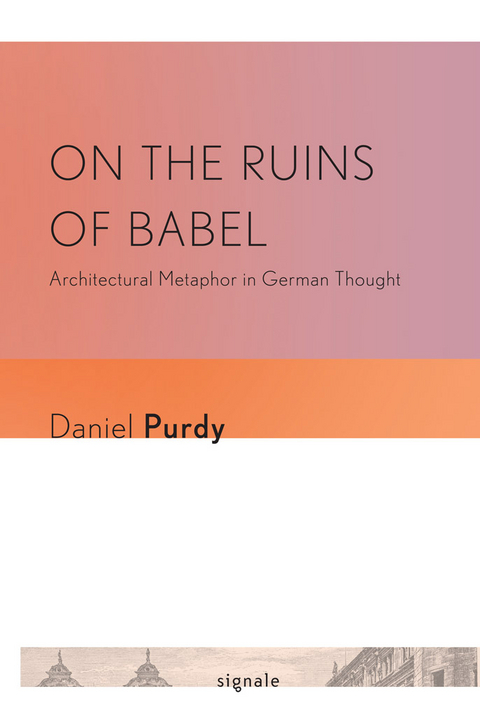
On the Ruins of Babel (eBook)
328 Seiten
Cornell University Press and Cornell University Library (Verlag)
978-0-8014-7696-9 (ISBN)
The eighteenth century struggled to define architecture as either an art or a science—the image of the architect as a grand figure who synthesizes all other disciplines within a single master plan emerged from this discourse. Immanuel Kant and Johann Wolfgang Goethe described the architect as their equal, a genius with godlike creativity. For writers from Descartes to Freud, architectural reasoning provided a method for critically examining consciousness. The architect, as philosophers liked to think of him, was obligated by the design and construction process to mediate between the abstract and the actual.
In On the Ruins of Babel, Daniel Purdy traces this notion back to its wellspring. He surveys the volatile state of architectural theory in the Enlightenment, brought on by the newly emerged scientific critiques of Renaissance cosmology, then shows how German writers redeployed Renaissance terminology so that "harmony," "unity," "synthesis," "foundation," and "orderliness" became states of consciousness, rather than terms used to describe the built world. Purdy's distinctly new interpretation of German theory reveals how metaphors constitute interior life as an architectural space to be designed, constructed, renovated, or demolished. He elucidates the close affinity between Hegel's Romantic aesthetic of space and Daniel Libeskind's deconstruction of monumental architecture in Berlin's Jewish Museum.
Through a careful reading of Walter Benjamin's writing on architecture as myth, Purdy details how classical architecture shaped Benjamin's modernist interpretations of urban life, particularly his elaboration on Freud's archaeology of the unconscious. Benjamin's essays on dreams and architecture turn the individualist sensibility of the Enlightenment into a collective and mythic identification between humans and buildings.
Daniel Purdy is Director of Graduate German Studies at Penn State University. He is the author of The Tyranny of Elegance and editor of The Rise of Fashion.
AcknowledgmentsIntroduction
1. The Decline of the Classical Orders
2. Science or Art? Architecture's Place within the Disciplines
3. Architecture in Kant's Thought: The Metaphor's Genealogy
4. How Much Architecture Is in Kant's Architectonic of Pure Reason?
5. The House of Memory: Architectural Technologies of the Self
6. Goethe’s Architectural Epiphanies
7. The Building in Bildung: Goethe, Palladio, and the Architectural Media
8. Goethe and the Disappointing Site: Buildings That Do Not Live Up to Their Images
9. Gothic Deconstruction: Hegel, Libeskind, and the Avant-Garde
10. Benjamin’s Mythic ArchitectureBibliography
Index
| Reihe/Serie | Signale: Modern German Letters, Cultures, and Thought |
|---|---|
| Signale: Modern German Letters, Cultures, and Thought | Signale: Modern German Letters, Cultures, and Thought |
| Verlagsort | Ithaca |
| Sprache | englisch |
| Maße | 150 x 150 mm |
| Themenwelt | Kunst / Musik / Theater ► Kunstgeschichte / Kunststile |
| Geisteswissenschaften ► Geschichte ► Regional- / Ländergeschichte | |
| Geisteswissenschaften ► Philosophie | |
| Technik ► Architektur | |
| Schlagworte | architecture, what is an architect, architectural theory in the Enlightenment, modernist interpretations of urban life, states of consciousness, relationship between humans and buildings, buildings as a metaphor for life |
| ISBN-10 | 0-8014-7696-8 / 0801476968 |
| ISBN-13 | 978-0-8014-7696-9 / 9780801476969 |
| Informationen gemäß Produktsicherheitsverordnung (GPSR) | |
| Haben Sie eine Frage zum Produkt? |
 EPUB (Adobe DRM)
Kopierschutz: Adobe-DRM
Adobe-DRM ist ein Kopierschutz, der das eBook vor Mißbrauch schützen soll. Dabei wird das eBook bereits beim Download auf Ihre persönliche Adobe-ID autorisiert. Lesen können Sie das eBook dann nur auf den Geräten, welche ebenfalls auf Ihre Adobe-ID registriert sind.
Details zum Adobe-DRM
Dateiformat: EPUB (Electronic Publication)
EPUB ist ein offener Standard für eBooks und eignet sich besonders zur Darstellung von Belletristik und Sachbüchern. Der Fließtext wird dynamisch an die Display- und Schriftgröße angepasst. Auch für mobile Lesegeräte ist EPUB daher gut geeignet.
Systemvoraussetzungen:
PC/Mac: Mit einem PC oder Mac können Sie dieses eBook lesen. Sie benötigen eine
eReader: Dieses eBook kann mit (fast) allen eBook-Readern gelesen werden. Mit dem amazon-Kindle ist es aber nicht kompatibel.
Smartphone/Tablet: Egal ob Apple oder Android, dieses eBook können Sie lesen. Sie benötigen eine
Geräteliste und zusätzliche Hinweise
Buying eBooks from abroad
For tax law reasons we can sell eBooks just within Germany and Switzerland. Regrettably we cannot fulfill eBook-orders from other countries.
aus dem Bereich