Kitchen and Bath Lighting (eBook)
John Wiley & Sons (Verlag)
978-1-119-12456-6 (ISBN)
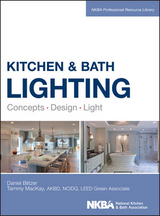
Co-published by the National Kitchen and Bath Association (NKBA), Kitchen and Bath Lighting is the go-to resource for designing, planning, and installing light in residential kitchen and bath projects. Full color illustrations throughout the book make Kitchen and Bath Lighting a visually absorbing experience. This beautiful volume begins with the basics of light, color, and vision, progressing from there through every stage of the residential lighting design process. With special attention to sustainability and lighting for older eyes, this book contains the information you need to know about the latest trends impacting the lighting industry.
Because the NKBA established the standard kitchen and bath guidelines for both new construction and remodels, Kitchen and Bath Lighting is aligned with the practices that are in high demand. This book is also an excellent choice for anyone hoping to obtain credentials as a Certified Kitchen Designer or Certified Bath Designer.
- Comprehensive coverage of the kitchen and bath lighting process, from the fundamentals of color to design documentation to construction
- Illustrated guidelines for using lighting tools like sources, luminaries, and controls in design development
- Glossary and end-of-chapter exercises for quickly learning and referencing key terminology and lighting techniques
- Companion website offering resources for instructors
This new addition to the NKBA's Professional Resource Library is an essential reference for kitchen and bath designers, lighting designers, and interior designers, as well as contractors, retrofitters, specifiers, and anyone else involved in lighting kitchens and bathrooms. Kitchen and Bath Lighting will give you the visual understanding of lighting that can lead directly to client satisfaction.
Daniel Blitzer is Lighting Certified and is a member and past president of the Designer's Lighting Forum of NY, member of IESNA, and a director of The Nuckolls Fund for Lighting Education.
Tammy MacKay, AKBD, NCIDQ, LEED Green Associate is an Edmonton, Alberta-based registered interior designer and certified kitchen and bath designer, and teaches lighting at the University of Alberta.
The industry standard illustrated guide from the National Kitchen and Bath Association Co-published by the National Kitchen and Bath Association (NKBA), Kitchen and Bath Lighting is the go-to resource for designing, planning, and installing light in residential kitchen and bath projects. Full color illustrations throughout the book make Kitchen and Bath Lighting a visually absorbing experience. This beautiful volume begins with the basics of light, color, and vision, progressing from there through every stage of the residential lighting design process. With special attention to sustainability and lighting for older eyes, this book contains the information you need to know about the latest trends impacting the lighting industry. Because the NKBA established the standard kitchen and bath guidelines for both new construction and remodels, Kitchen and Bath Lighting is aligned with the practices that are in high demand. This book is also an excellent choice for anyone hoping to obtain credentials as a Certified Kitchen Designer or Certified Bath Designer. Comprehensive coverage of the kitchen and bath lighting process, from the fundamentals of color to design documentation to construction Illustrated guidelines for using lighting tools like sources, luminaries, and controls in design development Glossary and end-of-chapter exercises for quickly learning and referencing key terminology and lighting techniques Companion website offering resources for instructors This new addition to the NKBA's Professional Resource Library is an essential reference for kitchen and bath designers, lighting designers, and interior designers, as well as contractors, retrofitters, specifiers, and anyone else involved in lighting kitchens and bathrooms. Kitchen and Bath Lighting will give you the visual understanding of lighting that can lead directly to client satisfaction.
Daniel Blitzer is Lighting Certified and is a member and past president of the Designer's Lighting Forum of NY, member of IESNA, and a director of The Nuckolls Fund for Lighting Education. Tammy MacKay, AKBD, NCIDQ, LEED Green Associate is an Edmonton, Alberta-based registered interior designer and certified kitchen and bath designer, and teaches lighting at the University of Alberta.
Preface xv
Acknowledgments xvii
Chapter 1 How We See 1
Physics of Light 1
Vision 2
Measuring Light 5
Measurement versus Perception 7
Summary 8
Review Questions 8
Chapter 2 Seeing Materials 9
Color 9
Form and Texture 12
Matte and Gloss 14
Summary 15
Review Questions 15
Chapter 3 Seeing the Space and Each Other 17
Appearance of Light 17
Light and Our Sense of Space 20
Light and People 21
Summary 22
Review Questions 22
Chapter 4 Seeing the Work 23
Task Visibility 23
Visual Performance 28
Illuminance 28
Challenges to Task Visibility 30
Summary 33
Review Questions 33
Chapter 5 Seeing as We Age 35
Vince Butler, CGR, GMB, CAPS
How Vision Changes with Age 35
Lighting and Safety 39
Summary 41
Review Questions 42
Chapter 6 Speaking about Lighting 43
Lighting Effects, Not Equipment 43
How Should a Space Feel? 44
Layering 48
Experiential Layers of Light 48
Functional Layers of Light 54
Applying Light 59
Summary 65
Review Questions 65
Chapter 7 Sustainable Lighting 67
Definition of Sustainability 67
Environmental Impacts of Lighting 68
Sustainability and the Cost of Lighting 74
Sustainable Lighting Strategies 77
Summary 79
Review Questions 80
Chapter 8 The Importance of Daylight 81
Daylight and Human Experience 81
From the Outside In 82
Daylight in Different Forms 85
Characteristics of Daylight 86
Admitting Daylight 88
Integrating Daylight and Electric Lighting 97
Summary 103
Review Questions 103
Chapter 9 Schematic Design 105
Program 105
Schematic Design 106
Lighting for Kitchen Activities 108
Lighting for Bathroom Activities 113
Experience 123
Architectural Integration 127
Communicating the Concept 133
Summary 135
Review Questions 135
Chapter 10 Choosing Electric Light Sources 137
Light Sources for Kitchens and Baths 137
Attributes of Light Sources 138
Summary 145
Review Questions 145
Chapter 11 Comparing Electric Light Sources 147
Light Sources for Kitchens and Baths 147
Incandescent Sources 148
Fluorescent Sources 157
LED Sources 164
Product Quality 169
Summary 171
Review Questions 171
Chapter 12 Light Fixtures 173
Light Fixture Selection Criteria 173
Types of Fixtures (Luminaires) 180
Summary 191
Review Questions 191
Chapter 13 Lighting Controls 193
Benefits and Objectives 193
The Language of Controls 195
How Dimmers Work 198
Sensors 203
Control Systems 206
Wireless Control of LED Lamps 211
Applying Controls 211
Summary 212
Review Questions 212
Chapter 14 Design Development 213
Developing the Design 213
Code Compliance 214
Locating Luminaires 217
Selecting Luminaires 228
Sizing the Light Source 235
Controls 238
Summary 241
Review Questions 241
Chapter 15 Documenting the Lighting Design 243
Lighting and Controls Plans 243
Summary 252
Review Questions 252
Chapter 16 Getting Lighting Built 253
Lighting in the Construction Process 253
Submittals 256
Lighting Supply Channel 257
Summary 262
Review Questions 262
Glossary 263
Index 265
1
How We See
Light, how it enables us to see, and lighting terminology together provide the necessary foundation for understanding lighting. In this chapter, we begin to consider these fundamental concepts. In subsequent chapters, we investigate lighting fundamentals in more detail.
- Learning Objective 1: Describe the physics of light and the physiology of the eye.
- Learning Objective 2: Explain in plain language how we see.
- Learning Objective 3: Recognize and use key lighting terms and metrics.
- Learning Objective 4: Distinguish between perceived and measured illumination.
PHYSICS OF LIGHT
Light is the energy that enables us to see. Technically, light is part of the broad spectrum of electromagnetic energy and is defined as visually evaluated radiant energy (see Figure 1.1).
Figure 1.1 Light in the electromagnetic spectrum
Courtesy of Peter Hermes Furian
As you may recall from classes in physics, light exhibits the properties of both waves and particles. As a radiating wave, light can be described by its wavelength, which ranges from about 380 to 760 nanometers (billionths of a meter), the limits of human visual sensitivity. In the next chapter, we explain that describing light by its wavelength helps us to understand the interaction of light and materials. Later, when we look at light sources, we encounter the particle nature of light—especially in understanding LED technology.
A few observations:
- Light itself is invisible. We see it only when it interacts with materials (e.g., the filament of an electric light source, fabrics, or faces). More on this important idea shortly.
- Light can travel through some materials.
- Transparent materials allow the passage of light without significant distortion so you can see the details of objects behind them (see Figure 1.2a).
- Translucent materials allow light through but mix it up so that the details are obscured. (The entire object may be obscured, depending on the translucent material and the nature and location of the object.) (see Figure 1.2b).
- Opaque materials block the passage of light altogether (see Figure 1.2c).
- Light changes direction when it reflects off surfaces or when it passes through materials, refracting (bending) or scattering (see Figure 1.3).
- Light that neither passes through nor reflects off materials is absorbed. Its energy becomes heat. Some light is absorbed in virtually every encounter with materials. Put your hand on the hood of a car that has been sitting in sunlight and see for yourself.
Figure 1.2 Transparent, translucent, opaque
Figure 1.3 Reflection, refraction, scattering
VISION
Although vision is not our oldest sense (we touch before we see), it dominates our perception. Basically, human vision is simple: Light interacts with objects; travels to, then enters, our eyes, where it is transformed into electrical signals; these signals travel neurological pathways to reach our brain, where they are interpreted into visual perception. Another way to express this basic process is by its four essential components (see Figure 1.4):
- Light source
- Object
- Eye
- Brain
Figure 1.4 Light source, object, eye, brain
We know a great deal about the physics of light and how it interacts with objects. We also know a great deal about the physiology of the human eye, how it receives light and creates neurological connections. We know considerably less about the complexities of how our neurological signals are combined with memory and interpretive algorithms into dynamic, three-dimensional perception.
Pause for a moment to consider the following. The signals received on the two-dimensional “screen” of our retina are fundamentally ambiguous: Is the retinal image a small object close by or a large one at a distance? Yet, apart from some notable optical illusions, we see the world unambiguously. This is only the most obvious example of our remarkable powers of visual perception. Good lighting can enhance these powers, while poorly designed lighting just makes seeing that much harder.
Contrast
Our visual system compares the incoming signals, searching for differences in light intensity and color. It does not measure or quantify them in technical photometric (light measurement) terms. Instead, the essence of how we see is the contrast between dark and light or among various colors.
Later in this chapter, we discuss how we measure light and all the technical terms associated with these quantities. When we do this, we also discuss the problems created by measurements that do not adequately represent perception.
Adaptation
Remarkably, our visual system operates effectively in a range of about 20,000:1, that is, from a bright sunny day to a starlit night. We manage to see in such a broad range by adjusting both the amount of light reaching the eye and the sensitivity of the photoreceptors. In darkened conditions, our pupils dilate to admit more light, and the eye's chemistry becomes more sensitive to the limited amount of light available. In bright conditions, in contrast, pupils contract, and sensitivity diminishes to avoid overload.
Adaptation takes time; it takes as much as 30 minutes to adapt to darkened conditions. Adapting to bright conditions takes less time. However, rushing the process (e.g., by emerging from a darkened theater to a bright afternoon) can prove painful.
Indoors, your vision adapts as you move from darker spaces to brighter ones and back again. Shifting your gaze from a brightly lighted task to a much darker surface also involves adaptation. Frequent and extreme adaptation can cause eye fatigue and discomfort.
Physiology of the Eye
The physiology of the eye helps us understand lighting—and how to design it for different applications and users of different ages and visual impairments. Take a moment to study the diagram of the human eye in Figure 1.5.
Figure 1.5 Diagram of the eye
We have already discussed an important function for the pupil: regulating the quantity of light received. The rays of light ultimately enter the eye through a lens that receives them onto the retina, which contains the photo sensors and connective neural networks that translate incident light into neurological signals. When the lens malfunctions (focuses improperly or simply loses clarity), vision is impaired.
Inside the eye, light travels through liquid from the lens to the retina. Impurities can disrupt light's passage and, with it, vision. Degradation in the retina (macular degeneration is one important example) also diminishes vision.
The retina contains three basic types of photoreceptors:
- Those capable of detecting only the quantity of light, not its color, are called rods due to their shape. They are also capable of sensing very small quantities of light; we rely on them to see in the (near) dark. Located throughout the retina, rods also provide peripheral vision.
- Those capable of detecting color are called cones. They require more stimulation than rods, so we enjoy very limited color vision in darkened conditions. Concentrated in an area called the fovea, cones provide the visual acuity to distinguish small tasks.
- The third type of photoreceptor is not part of the visual system but detects light as part of our circadian, or 24-hour, clock system.
We return to the photoreceptors in more detail when we discuss color in Chapter 2, “Seeing Materials” (and to nonvisual photoreceptors when we discuss lighting for aging eyes).
Finally, notice how an overhanging brow protects the entire eye, limiting the glare from overhead sources of bright light—to some degree at least.
MEASURING LIGHT
Light emanates from a source and (some of it) arrives at an object. Light then leaves that object (reflects off or passes through it) and travels to the next object, and so on. Thus, if we want to measure light, we need to do so at the various points in its travel.
Lumen—the Flow of Light
Let's start with the source itself. A lumen is a unit of measure for quantifying the amount of light energy emitted by a light source. A typical light source in your dining room might emit 800 lumens, one in the laundry room might emit 2500 lumens, and one in the streetlight outside might emit 16,000 lumens.
LUMEN VALUES FOR VARIOUS LIGHT SOURCES
| Light Source | Luminous Flux (lumens) | Typical Use |
| LED light bulb (12W) | 800 lumens | Table fixture |
| Halogen flood (60W) | 1100 lumens | Retail display |
| Linear fluorescent (28W) | 2500 lumens | Office lighting |
| High-pressure sodium (150W) | 16,000 lumens | Street... |
| Erscheint lt. Verlag | 16.3.2015 |
|---|---|
| Reihe/Serie | NKBA Professional Resource Library |
| NKBA Professional Resource Library | NKBA Professional Resource Library |
| Sprache | englisch |
| Themenwelt | Kunst / Musik / Theater ► Design / Innenarchitektur / Mode |
| Technik ► Architektur | |
| Schlagworte | Architecture • Architektur • basics of light • Certified Bath Designer • Certified Kitchen Designer • Color • Construction • Contractors • Controls • Dan Blitzer • design development • design documentation • full color illustrations • image bank • Innenarchitektur • installing light fixtures • Interior design • Kitchen and Bath Lighting • lighting designers • lighting for older eyes • lighting kitchens and bathrooms • lighting techniques • lighting tools • Luminaries • National Kitchen and Bath Association • NKBA • planners • Professional Resource Library • residential kitchen and bath • residential lighting design • retrofitters • Sources • Specifications • specifiers • sustainability • Tammy Mackay • Vision |
| ISBN-10 | 1-119-12456-5 / 1119124565 |
| ISBN-13 | 978-1-119-12456-6 / 9781119124566 |
| Informationen gemäß Produktsicherheitsverordnung (GPSR) | |
| Haben Sie eine Frage zum Produkt? |
 EPUB (Adobe DRM)
Kopierschutz: Adobe-DRM
Adobe-DRM ist ein Kopierschutz, der das eBook vor Mißbrauch schützen soll. Dabei wird das eBook bereits beim Download auf Ihre persönliche Adobe-ID autorisiert. Lesen können Sie das eBook dann nur auf den Geräten, welche ebenfalls auf Ihre Adobe-ID registriert sind.
Details zum Adobe-DRM
Dateiformat: EPUB (Electronic Publication)
EPUB ist ein offener Standard für eBooks und eignet sich besonders zur Darstellung von Belletristik und Sachbüchern. Der Fließtext wird dynamisch an die Display- und Schriftgröße angepasst. Auch für mobile Lesegeräte ist EPUB daher gut geeignet.
Systemvoraussetzungen:
PC/Mac: Mit einem PC oder Mac können Sie dieses eBook lesen. Sie benötigen eine
eReader: Dieses eBook kann mit (fast) allen eBook-Readern gelesen werden. Mit dem amazon-Kindle ist es aber nicht kompatibel.
Smartphone/Tablet: Egal ob Apple oder Android, dieses eBook können Sie lesen. Sie benötigen eine
Geräteliste und zusätzliche Hinweise
Buying eBooks from abroad
For tax law reasons we can sell eBooks just within Germany and Switzerland. Regrettably we cannot fulfill eBook-orders from other countries.
aus dem Bereich