


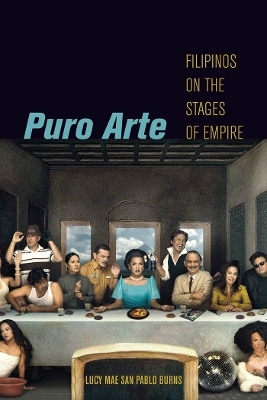
Puro Arte
Filipinos on the Stages of Empire
Seiten
2012
New York University Press (Verlag)
978-0-8147-2545-0 (ISBN)
New York University Press (Verlag)
978-0-8147-2545-0 (ISBN)
Turns to performance as a way of understanding complex historical processes of racialization in relation to empire and colonialism
Winner of the 2012 Outstanding Book Award in Cultural Studies, Association for Asian American Studies
Puro Arte explores the emergence of Filipino American theater and performance from the early 20th century to the present. It stresses the Filipino performing body's location as it conjoins colonial histories of the Philippines with U.S. race relations and discourses of globalization.
Puro arte, translated from Spanish into English, simply means "pure art." In Filipino, puro arte however performs a much more ironic function, gesturing rather to the labor of over-acting, histrionics, playfulness, and purely over-the-top dramatics. In this book, puro arte functions as an episteme, a way of approaching the Filipino/a performing body at key moments in U.S.-Philippine imperial relations, from the 1904 St. Louis World's Fair, early American plays about the Philippines, Filipino patrons in U.S. taxi dance halls to the phenomenon of Filipino/a actors in Miss Saigon. Using this varied archive, Puro Arte turns to performance as an object of study and as a way of understanding complex historical processes of racialization in relation to empire and colonialism.
Winner of the 2012 Outstanding Book Award in Cultural Studies, Association for Asian American Studies
Puro Arte explores the emergence of Filipino American theater and performance from the early 20th century to the present. It stresses the Filipino performing body's location as it conjoins colonial histories of the Philippines with U.S. race relations and discourses of globalization.
Puro arte, translated from Spanish into English, simply means "pure art." In Filipino, puro arte however performs a much more ironic function, gesturing rather to the labor of over-acting, histrionics, playfulness, and purely over-the-top dramatics. In this book, puro arte functions as an episteme, a way of approaching the Filipino/a performing body at key moments in U.S.-Philippine imperial relations, from the 1904 St. Louis World's Fair, early American plays about the Philippines, Filipino patrons in U.S. taxi dance halls to the phenomenon of Filipino/a actors in Miss Saigon. Using this varied archive, Puro Arte turns to performance as an object of study and as a way of understanding complex historical processes of racialization in relation to empire and colonialism.
Lucy Mae San Pablo Burns is Assistant Professor of Asian American Studies at the University of California, Los Angeles.
1. "Which Way to the Philippines?" United Stages of Empire2. "Splendid Dancing": Of Filipinos and Taxi Dance Halls3. Coup de Theatre: The Drama of Martial Law4. "How in the Light of One Night Did We Come So Far?" Working Miss Saigon Coda: Culture Shac
| Reihe/Serie | Postmillennial Pop |
|---|---|
| Verlagsort | New York |
| Sprache | englisch |
| Maße | 152 x 229 mm |
| Gewicht | 318 g |
| Themenwelt | Kunst / Musik / Theater ► Theater / Ballett |
| Geschichte ► Teilgebiete der Geschichte ► Wirtschaftsgeschichte | |
| Geisteswissenschaften ► Sprach- / Literaturwissenschaft ► Anglistik / Amerikanistik | |
| Sozialwissenschaften ► Ethnologie | |
| Sozialwissenschaften ► Soziologie | |
| ISBN-10 | 0-8147-2545-7 / 0814725457 |
| ISBN-13 | 978-0-8147-2545-0 / 9780814725450 |
| Zustand | Neuware |
| Informationen gemäß Produktsicherheitsverordnung (GPSR) | |
| Haben Sie eine Frage zum Produkt? |
Mehr entdecken
aus dem Bereich


aus dem Bereich
wie Tech-Konzerne und Großmächte die Welt unter sich aufteilen
Buch | Hardcover (2025)
C.H.Beck (Verlag)
CHF 39,20
Aufstieg und Fall der Deutschland AG
Buch | Hardcover (2025)
Suhrkamp (Verlag)
CHF 41,95


