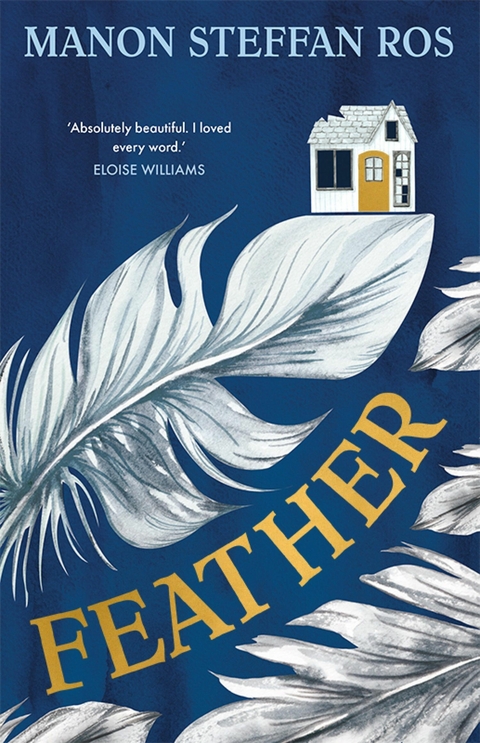
Feather (eBook)
176 Seiten
Firefly Press Ltd (Verlag)
978-1-915444-38-7 (ISBN)
‘You sure you’re okay?’ asked Kieran over the sound of the football game we were playing on his console.
‘I’m sure.’
‘Because you’re rubbish at this today.’
I shook my head, pretending to be annoyed, although I knew that he was telling the truth. ‘I just need to warm up.’
We were in his bedroom, which was huge and had a bed, a sofa, two consoles and a computer. He even had his own mini fridge with all the drinks Dad only let me have on special occasions. His mum let him do what he wanted, and always seemed to be on his side, even when he was being a pain. When he got in trouble with school for being lazy or rude, his mum would complain that the teachers had it in for him. (Some of them did, but only because he could be lazy and rude.)
I hadn’t told Kieran about what happened with Nan, because I couldn’t quite find the words to explain it. And anyway, how was he meant to respond? Sorry that your nan’s losing it? People just didn’t talk about things like that, especially me and Kieran. We only really talked about gaming and football and which cars we liked.
All my friends loved Nan. Her house backed onto the huge car park by the Dingle, the nature reserve in town. Nan would always keep ice cream and freezing lemonade for my friends and me on the long summer days when we did nothing but sunbathe and paddle in the water. Everyone adored her, and was jealous that I had such a cool Nan. Even Kieran, who was quite fussy about who he liked. I wasn’t ready to tell him that she was becoming someone else.
Nan had realised pretty quickly that I wasn’t Johnny – it was as if she woke up from some kind of weird dream, and she corrected herself. ‘What am I on about – Johnny! You’re not Johnny!’ And then she carried on as if nothing had happened. But I still told Dad about it that night because it felt like the right thing to do. Nan hadn’t just mixed up our names – everyone does that sometimes. I’d seen it in her eyes. For a few seconds, she’d actually thought that I was her long-dead brother.
If I’d been hoping that speaking to Dad would make me feel better, I was disappointed. He’d just finished his shift and was in one of his moods when he doesn’t have much to say. Sometimes, it felt difficult to say anything in our house, just in case it started one of Dad’s quiet moods, I don’t say that much. It was one of the reasons I loved Nan’s house, with her music blaring and her constant chatter. There was so much silence at home.
But I’d decided that what had happened with Nan was too important to keep to myself, so that night, when we’d both sat down to some tinned spaghetti bolognaise, I told him what she had said.
‘I knew it,’ Dad said flatly.
‘She definitely thought I was Johnny. It wasn’t a slip of the tongue.’
‘Something’s up. She hasn’t been able to talk about him, ever. Not even when I was a little boy.’
That was true. Nan could talk about anything – the weather, the books she was reading, her favourite programmes, trees and flowers, even politics – and make it interesting. But she didn’t like to talk about her brother, Johnny. Whenever anyone mentioned him, she’d turn her face away and say as little as possible. Once, when she was telling me a story about when she was little, I’d asked about him, what he was like. But she’d become very quiet and said that it was all such a long time ago now. I hadn’t asked again. It must have made her sad, to talk about someone she’d lived with so long ago.
So the fact that Nan had mistaken me for Johnny was a big deal. A very big deal. Thinking about it made my stomach feel odd, all queasy and unsettled. Nan was going to be fine, I silently told myself. Nan was always fine.
But, as if he could read my mind, Dad wasn’t sure. He rubbed his eyes, which always seemed tired but were particularly exhausted now. ‘I suppose I ought to do something about it really.’
As we half-heartedly picked at our dinner, we started listing the odd things Nan had been doing recently. It didn’t seem so bad to begin with – they were tiny things, things that could happen to anyone. But putting them all together made me realise that she really wasn’t well.
- She had forgotten where she’d left her car keys and became flustered because she wanted to go to Bangor to do her shopping and couldn’t go. The keys finally appeared in a plastic shopping bag under the sink. (I didn’t think that this was much of a big deal – Dad lost his keys all the time or left precious things in stupid places. Dad once mistakenly put his bank card in the bin by mistake. Even my phone charger had somehow ended up in the laundry basket one time.)
- She’d return from the shops having forgotten to buy a few things, although she always took a list with her. This wasn’t a big problem – I could always run down to the supermarket to get her some milk or a bag of onions – but that wasn’t the point. (Again, I didn’t think that this meant all that much – she probably just got chatting to people in the shop and forgot what she’d already put in her trolley. Dad disagreed with me. He said that what I was saying sounded reasonable, except for the fact that Nan had been shopping at the same place for almost fifty years, with the same list, more or less, always buying the same things. It was only recently that she’d started to forget things.)
- Dad thought that Nan was avoiding using people’s names, because she was trying to hide the fact that she couldn’t always remember who we were or what we were called. I was about to protest about this – of course she knew who I was. I went there nearly every day after school! – but before I said anything, I remembered how often Nan called me ‘love’ or ‘sweetheart’ these days. When was the last time she’d called me Huw? Had she really forgotten?
- She was having exactly the same conversations with us, at different times. I must admit that this shocked me. ‘She always talks about the same old stuff,’ Dad said. ‘That the traffic’s busier than it was. And about how lovely the librarians are. And about the…’
‘Schools.’ I finished Dad’s sentence for him. ‘Saying that they don’t teach the right things anymore.’ And Dad and I looked at one another and realised that Nan had been having the same conversation over and over again, only with different people. She’d probably been saying the same to the people next door, and to the friends she met down at the cafe.
- The Snows They Melt the Soonest is an old English folk song, really sad and depressing, that somehow didn’t match Nan at all. She loved Abba and Queen and Cher, and she knew all the words to the pop songs on the radio. She had always loved upbeat, happy music. Music you can dance to. But recently, she’d started singing random lines from this folk song under her breath, as if it was always in her head. ‘The snows they melt the soonest when the wind begins to sing…’ I didn’t know what snow had to do with anything, but I have to admit that the change from Another One Bites the Dust to The Snows They Melt the Soonest did worry me.
- A few weeks earlier, Dad had popped upstairs to Nan’s bedroom to fix a window that wouldn’t open. He was surprised to see that her dressing table was covered in old black and white photos: Nan’s parents, who, of course, had died a long time ago, and Johnny, who died in the Second World War; photos of Dad when he was little and of Grandad, who died when I was a baby.
I was very shocked to hear this, because Nan hated the sort of old people who go on and on about the olden days instead of enjoying the days they were living right now. For the first time, as I thought of those photos in her bedroom, I started to pity Nan. Did she often think about the old days? Did thinking about the past make her feel sad, seeing as she’d lost so many people?
- Obviously, Nan had mistaken me for her brother, Johnny. Of course, people mix names up all the time, but not with people who had died so long ago. It didn’t feel right.
‘I think she’s looking at those old photos and thinking about her brother and parents, and then she’s getting mixed up about then and now. I didn’t know that there were any photos of Johnny. She must have kept them hidden all these years.’ Dad shook his head, having long abandoned his spaghetti. ‘I wouldn’t have known it was him if it wasn’t for the fact that...
| Erscheint lt. Verlag | 10.10.2024 |
|---|---|
| Verlagsort | London |
| Sprache | englisch |
| Themenwelt | Kinder- / Jugendbuch ► Jugendbücher ab 12 Jahre |
| Kinder- / Jugendbuch ► Sachbücher ► Geschichte / Politik | |
| Schlagworte | conscientous objection • dementia • Family • History • Nan • school • Secrets • World War Two |
| ISBN-10 | 1-915444-38-1 / 1915444381 |
| ISBN-13 | 978-1-915444-38-7 / 9781915444387 |
| Informationen gemäß Produktsicherheitsverordnung (GPSR) | |
| Haben Sie eine Frage zum Produkt? |
 EPUB (Wasserzeichen)
DRM: Digitales Wasserzeichen
Dieses eBook enthält ein digitales Wasserzeichen und ist damit für Sie personalisiert. Bei einer missbräuchlichen Weitergabe des eBooks an Dritte ist eine Rückverfolgung an die Quelle möglich.
Dateiformat: EPUB (Electronic Publication)
EPUB ist ein offener Standard für eBooks und eignet sich besonders zur Darstellung von Belletristik und Sachbüchern. Der Fließtext wird dynamisch an die Display- und Schriftgröße angepasst. Auch für mobile Lesegeräte ist EPUB daher gut geeignet.
Systemvoraussetzungen:
PC/Mac: Mit einem PC oder Mac können Sie dieses eBook lesen. Sie benötigen dafür die kostenlose Software Adobe Digital Editions.
eReader: Dieses eBook kann mit (fast) allen eBook-Readern gelesen werden. Mit dem amazon-Kindle ist es aber nicht kompatibel.
Smartphone/Tablet: Egal ob Apple oder Android, dieses eBook können Sie lesen. Sie benötigen dafür eine kostenlose App.
Geräteliste und zusätzliche Hinweise
Buying eBooks from abroad
For tax law reasons we can sell eBooks just within Germany and Switzerland. Regrettably we cannot fulfill eBook-orders from other countries.
aus dem Bereich