


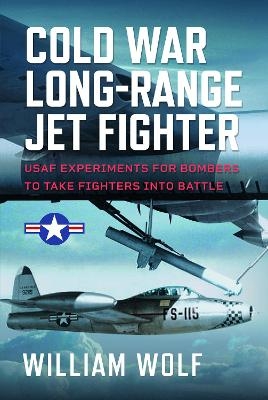
Cold War Long-Range Jet Fighter Program
USAF Experiments for Bombers to Take Fighters into Battle
Seiten
2026
Pen & Sword Books Ltd (Verlag)
978-1-0361-9608-0 (ISBN)
Pen & Sword Books Ltd (Verlag)
978-1-0361-9608-0 (ISBN)
- Noch nicht erschienen (ca. September 2026)
- Versandkostenfrei
- Auch auf Rechnung
- Artikel merken
After the Second World War, the introduction of the six-engine Consolidated-Vultee B-36 Peacemaker bomber, capable of intercontinental ranges of 5,000 miles or more, reignited the long-standing problem of fighter escort. Early-generation US jet fighters consumed enormous amounts of fuel and lacked the endurance to accompany the B-36 over extended distances. Designing a jet fighter with enough fuel capacity for such missions would result in an aircraft far too large and unwieldy to engage smaller, more agile enemy interceptors effectively.
In response, during the early Cold War, the United States Air Force explored two experimental methods to extend fighter range. The first was wingtip-to-wingtip towing, in which a fighter would attach itself to the bomber’s wing for fuel support. The second involved carrying a fighter inside the bomber’s bomb bay on a trapeze mechanism, allowing it to be launched and later recovered in flight.
Because the B-36 faced developmental delays, the widely available Boeing B-29 Superfortress initially served as the test platform. Boeing ETB-29A bombers were paired with Republic EF-84D Thunderjet fighters, which practiced attaching and detaching from the B-29 wingtips. Following these early trials, the concept of the bomb-bay-mounted ‘parasite’ fighter resurfaced with the diminutive, jet-powered XP-85 Goblin. Designed exclusively as a parasite aircraft, the Goblin could launch from the B-36 to intercept enemy aircraft and later dock again in midair. Despite promising test flights, docking challenges and the Goblin’s underwhelming performance relative to enemy jets led to cancellation.
In 1952–53, the FICON (FIghter CONveyor) program tested carrying an RF-84F/K Thunderflash inside the B-36’s trapeze-equipped bomb bay. While escort missions were initially envisioned, the program shifted toward tactical reconnaissance and strike missions. The B-36 would deliver the faster, more agile fighter near a target for reconnaissance or nuclear strike, then recover it afterward. The success of the U-2 spy plane and midair refueling ultimately rendered parasite aircraft experiments obsolete.
Packed with over 150 photographs, this book is the first to examine this extraordinary and unusual chapter in Cold War aviation history, highlighting some of the most inventive and unconventional experiments ever attempted.
In response, during the early Cold War, the United States Air Force explored two experimental methods to extend fighter range. The first was wingtip-to-wingtip towing, in which a fighter would attach itself to the bomber’s wing for fuel support. The second involved carrying a fighter inside the bomber’s bomb bay on a trapeze mechanism, allowing it to be launched and later recovered in flight.
Because the B-36 faced developmental delays, the widely available Boeing B-29 Superfortress initially served as the test platform. Boeing ETB-29A bombers were paired with Republic EF-84D Thunderjet fighters, which practiced attaching and detaching from the B-29 wingtips. Following these early trials, the concept of the bomb-bay-mounted ‘parasite’ fighter resurfaced with the diminutive, jet-powered XP-85 Goblin. Designed exclusively as a parasite aircraft, the Goblin could launch from the B-36 to intercept enemy aircraft and later dock again in midair. Despite promising test flights, docking challenges and the Goblin’s underwhelming performance relative to enemy jets led to cancellation.
In 1952–53, the FICON (FIghter CONveyor) program tested carrying an RF-84F/K Thunderflash inside the B-36’s trapeze-equipped bomb bay. While escort missions were initially envisioned, the program shifted toward tactical reconnaissance and strike missions. The B-36 would deliver the faster, more agile fighter near a target for reconnaissance or nuclear strike, then recover it afterward. The success of the U-2 spy plane and midair refueling ultimately rendered parasite aircraft experiments obsolete.
Packed with over 150 photographs, this book is the first to examine this extraordinary and unusual chapter in Cold War aviation history, highlighting some of the most inventive and unconventional experiments ever attempted.
Dr William Wolf was a dentist for twenty-two years before retiring at the age of 45 to pursue his aviation interests and outdoor pastimes. Over the past forty-five years he has amassed an archive of over 27,000 books and magazines, 10,000 or more images, and hundreds of reels of microfilm, among other material, on the subject. He is the author of twenty-four books on aerial warfare in World War Two, including nine on American bombers, two on US fighters, five on American flying units, and three volumes on US aerial armament.
| Erscheint lt. Verlag | 30.9.2026 |
|---|---|
| Zusatzinfo | 150 mono illustrations |
| Verlagsort | Barnsley |
| Sprache | englisch |
| Maße | 156 x 234 mm |
| Themenwelt | Geschichte ► Allgemeine Geschichte ► Zeitgeschichte |
| ISBN-10 | 1-0361-9608-9 / 1036196089 |
| ISBN-13 | 978-1-0361-9608-0 / 9781036196080 |
| Zustand | Neuware |
| Informationen gemäß Produktsicherheitsverordnung (GPSR) | |
| Haben Sie eine Frage zum Produkt? |
Mehr entdecken
aus dem Bereich



aus dem Bereich
die großen Jahre der Soziologie 1949-1969
Buch | Hardcover (2025)
Klett-Cotta (Verlag)
CHF 39,20
eine Deutschlandreise im Jahr 1958
Buch | Hardcover (2024)
C.H.Beck (Verlag)
CHF 29,90


