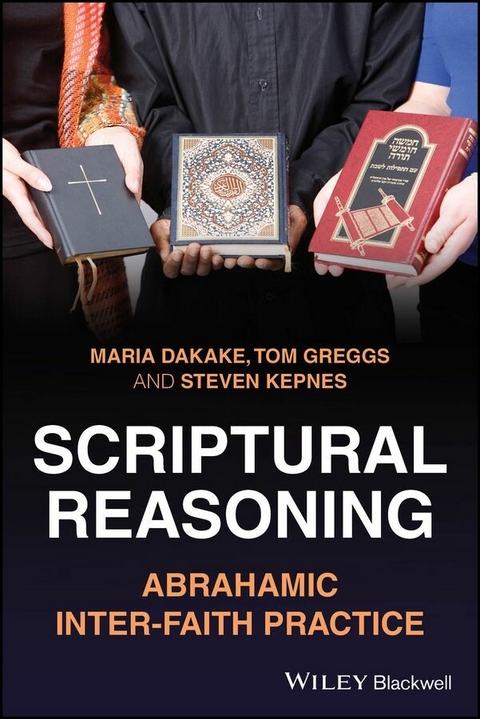
Scriptural Reasoning (eBook)
204 Seiten
Wiley-Blackwell (Verlag)
978-1-394-36659-0 (ISBN)
Fosters deep inter-faith understanding through shared scriptural study and mutual religious hospitality
Scriptural Reasoning: Abrahamic Inter-faith Practice provides an accessible and practical introduction to a unique form of inter-faith engagement centered on shared sacred text study. Rather than minimizing deep commitments to one's own faith, this approach encourages participants to enter more fully into their own traditions while offering and receiving hospitality across religious boundaries. Focusing on the Abrahamic faiths-Judaism, Christianity, and Islam-this book equips students and lay practitioners to participate meaningfully in Scriptural Reasoning (SR) groups, where members of different faiths read and reason together from their respective Scriptures.
The authors-scholars and practitioners from the three traditions-guide readers through the origins, aims, and methods of SR while offering theological context, practical guidance, and real-world examples. Chapters explore common questions about the nature of Scripture, revelation, interpretation, and the challenges and promises of inter-religious study. Designed for classroom use, religious institutions, or community initiatives, this concise and clear resource helps participants 'hit the ground running.' By grounding the practice in deep respect, conviction, and curiosity, the authors position Scriptural Reasoning as a tool not only for dialogue, but for healing and reconciliation across difference.
Encouraging cross-faith understanding in a world marked by religious plurality and social fragmentation, Scriptural Reasoning:
- Provides the foundation for understanding, practicing, and reflecting on Abrahamic Scriptural Reasoning
- Contains tools and texts for launching SR in classroom, religious, and civic settings
- Includes foundational background on the Scriptures and interpretive traditions of Judaism, Christianity, and Islam
- Addresses common questions and misconceptions about inter-faith engagement and religious pluralism
- Features real-world examples of SR used in diverse contexts, from prisons to hospitals to inter-faith dialogue programs
Combining theological reflection with practical instruction for first-time SR facilitators and participants, Scriptural Reasoning: Abrahamic Inter-faith Practice is ideal for undergraduate and graduate students in theology, religious studies, and interfaith engagement programs. It can be used in courses such as Interfaith Dialogue, Comparative Religion, and Abrahamic Traditions, and is appropriate for degrees in divinity, religious studies, and civic leadership.
MARIA DAKAKE is Associate Professor of Religious Studies at George Mason University, where she directs programs in Islamic Studies and Middle East Studies. She holds a PhD from Princeton University and is widely published in Islamic intellectual history, Qur'anic studies, Shiism, Sufism, and women's spirituality She is co-author and co-editor of The Study Quran (HarperOne 2015) and co-editor of The Routledge Companion to the Qur'an (Routledge, 2022).
TOM GREGGS is Director of the Center of Theological Inquiry, Princeton, New Jersey. He previously held the Marischal Chair of Divinity at the University of Aberdeen, UK. A Methodist preacher and international ecumenical leader, his many publications include Dogmatic Ecclesiology, The Breadth of Salvation, and Barth and Bonhoeffer as Contributors to a Postliberal Ecclesiology.
STEVEN KEPNES is Professor of Religion and Jewish Studies at Colgate University. A prominent voice in Jewish theology, he is the author of Jewish Liturgical Reasoning, Reviving Jewish Theology, and editor of the Cambridge Companion to Jewish Theology. He has also taught at the Jewish Theological Seminary and the Gregorian University in Rome, Italy.
Chapter 2
Delving Deeper: Guidelines and Practical Advice
Having given a very basic introduction and history of Scriptural Reasoning (SR) in the introductory chapter, this chapter seeks to delve deeper and to consider some wise guidelines for the practice as well as to offer some more practical advice to help organize and practice SR. In this chapter, one of the first practitioners of SR, Steven Kepnes, offers the guidelines he has written, which emerge from years of actually doing SR.
In what follows, the reader will find 15 “guidelines” that I have set forth to define the nature and goals of the practice of Abrahamic SR. I use the term “guidelines” loosely as a series of assumptions, principles, and attitudes that I have gleaned from observations of SR sessions and discussions with practitioners of the practice. This is followed by a brief discussion of how SR is done. The guidelines are authored by one person (Steven Kepnes), who cannot be seen to represent the diverse views of the many people who have led and participated in SR activities, but are a provisional starting point for SR. However, given these limitations, these guidelines have been written for teaching purposes to introduce SR to those who have little experience in and knowledge of the practice of SR. A version of this chapter was published in an early form in the July 2006 issue of the journal Modern Theology (22:3) and is revised for this book in accord with discussions of the SR in the university group which met in August 2015 and again in August 2018 at Cambridge University. The notion of a guideline rather than a “principle” or “statement” is utilized to indicate that it is meant to be suggestive for newcomers to the practice.
Fifteen Guidelines of SR
What Is Abrahamic SR?
1. Abrahamic SR is a practice of small group study of the Scriptures of Judaism, Christianity, and Islam by Jews, Christians, and Muslims and their interested friends. The practice intends to build sociality and friendship among its practitioners and release sources of reason, compassion, and spirit for healing relations between our communities and for repair of the world. The word “Abrahamic” is meant to signal a focus on Scriptures from the three monotheistic religions that consider Abraham to be a central origin figure. Recent SR meetings have experimented with study of non‐Abrahamic religions with fruitful results, but this book will focus mainly on the Abrahamic religions.
Scriptures as Living Texts
2. SR assumes that Scriptures are among the central religious expressions of the monotheistic religious traditions. Scripture is understood by these traditions as forms of revelation of the nature and will of God, sources of wisdom, and guidance for the lives of its followers. This means that SR participants read the Hebrew Bible, New Testament, and Qur'an not as just any series of texts, but as highly valued texts, “living texts,” “holy texts,” in other words “Scriptures,” that have special meaning for their traditions, for them, and for members of their religious communities.
Scripture's Surplus of Meaning
3. SR functions with the assumption that scriptural meaning is not fixed, either by the historical situation from which the text arose or by the specific tradition—Jewish, Christian, Islamic—in which it sits. This means that SR opposes all attempts to limit definitively, and for all time, what a scriptural text means. The assumption of SR is that scriptural texts display multiple meanings, and also that the meaning of Scripture changes in accordance with the time and place and community in which it is read. Thus, as Peter Ochs has argued, the meaning of a text is known by its use.1 Because Scripture displays what has been called by philosophical hermeneutics, a “surplus” of meaning, which goes beyond the confines of history and tradition, all participants in SR can propose hypotheses about the meaning of a text, whether they come from the tradition in which the text sits or not.
Scriptural Warrants for SR
4. Although conversations between Jews, Christians, and Muslims based on their Scriptures is something of a new enterprise in the contemporary world, it is clear that this is not the first time such dialog has taken place. One can mention medieval discussions between Jewish, Christian, and Muslim philosophers as an important precedent. However, it is clear that the early Christians were highly knowledgeable of the Hebrew Scriptures, and the respect that Christianity gives to these Scriptures is seen in the fact that they constitute the first part of the Christian Bible as the “Old Testament.” When one reads the Qur'an, it also becomes instantly clear that materials from the Hebrew Scriptures and New Testament were known to Muhammad and the early Muslims, since the Qur'an interprets and retells many of the Biblical stories in an abbreviated and elliptical fashion that suggests an audience already familiar with these stories in their broad outlines. Moreover, the Qur'an itself also refers to the Torah and Gospel as Scripture (Qur'an 3:3–4). Since the Hebrew Bible predates the New Testament and the Qur'an, it does not engage directly with the Scriptures that came after it. However, we do see that Rabbinic literature saw in Esau the precursor to Christianity and in Ishmael the precursor to Islam. This phenomenon of inter‐scriptural commentary in the primary texts of Judaism, Christianity, and Islam is, then, a fundamental religious warrant for the practice of SR. For a fuller discussion of scriptural warrants for SR in all three traditions, see Chapter 8.
Bringing Your Internal Library—Nothing Is Alien, The Text Is Judge
5. SR is the thinking that occurs when Scripture is taken up and discussed by a group of interpreters. It therefore works through both the reasoning that is implicit in Scripture and the reasoning that practitioners, as interpreters, bring to Scripture. One practitioner of SR has suggested that every individual who comes to a meeting brings their own “internal library” with them to a session. These internal libraries may include knowledge of traditional interpreters, philosophy, and theology, as well as literary or historical methods of study. This means that although the texts SR members study together are brief, participants are encouraged to bring to these texts the full range of their own sources of knowledge and wisdom, so that in approaching the interpretation of Scriptures, one may say that, for SR, “nothing is alien.” However, a fundamental rule of SR is that all interpretations should be tested and retested with careful reference to the text that is being interpreted. Thus, typical SR observations include: “Where do you see that in the text?” “How does your interpretation make sense of this text?” Or, “I just don't see that interpretation emerging from this particular text.”
SR Space as a Tent of Meeting
6. Participants in SR practice come to it with a variety of motives—educational, religious, philosophical, and political. Participants are often leaders, teachers, or students of academic institutions and particular “houses” (churches, mosques, synagogues) of worship. But SR is also practiced by persons with none of these affiliations, and SR welcomes such people into its sessions. SR ideally occurs in neutral sites, in special times, and in retreat locations that have been likened by Dan Hardy to Biblical “tents of meeting.” Practitioners come together in these tents of meeting to read and reason with Scriptures.
The SR tent of meeting is intended to create a space set apart from our religious communities and institutions (and for those who are academics, even apart from the usual business of the institution of the university). The hope is that this is a space where participants may feel more free to experiment. We do not study together in some false context of neutrality: unlike many academic discourses regarding religion and comparative religious study, where disciplined neutrality and the use of the personal voice is discouraged, SR encourages participants to use the personal “I” voice. Unlike contexts in which participants “defend” their arguments and “attack” the arguments of others, SR asks participants to leave their academic or dogmatic “swords” outside the tent and enter into mutually supportive, generous, and hospitable conversations. Unlike meetings in houses of worship, where individuals might be expected to articulate and defend authoritative interpretations, laws, and doctrines, inside the SR tent of meeting, authoritative positions can be set aside and new interpretations of texts suggested. These interpretations are offered in a creative, hypothetical, and experimental sense without demanding extensive argument or traditional warrant. Those who hear interpretations of this sort are asked to respond with the generosity and openness with which they are given. Inside the SR tent of meeting, participants take turns, now being host and now being guests, in another person's religious world.
SR and Prophetic Critique
7. SR sees religion as a complex social, political, and spiritual force that must be regarded with respect and care but...
| Erscheint lt. Verlag | 16.12.2025 |
|---|---|
| Sprache | englisch |
| Themenwelt | Geisteswissenschaften ► Religion / Theologie |
| Schlagworte | Abrahamic religions • Comparative theology • interfaith dialogue guide • interreligious learning • Jewish Muslim Christian study • Religious pluralism • scriptural reasoning intro • scriptural reasoning religious literacy • scriptural reasoning sacred texts |
| ISBN-10 | 1-394-36659-0 / 1394366590 |
| ISBN-13 | 978-1-394-36659-0 / 9781394366590 |
| Informationen gemäß Produktsicherheitsverordnung (GPSR) | |
| Haben Sie eine Frage zum Produkt? |
 EPUB (Adobe DRM)
Kopierschutz: Adobe-DRM
Adobe-DRM ist ein Kopierschutz, der das eBook vor Mißbrauch schützen soll. Dabei wird das eBook bereits beim Download auf Ihre persönliche Adobe-ID autorisiert. Lesen können Sie das eBook dann nur auf den Geräten, welche ebenfalls auf Ihre Adobe-ID registriert sind.
Details zum Adobe-DRM
Dateiformat: EPUB (Electronic Publication)
EPUB ist ein offener Standard für eBooks und eignet sich besonders zur Darstellung von Belletristik und Sachbüchern. Der Fließtext wird dynamisch an die Display- und Schriftgröße angepasst. Auch für mobile Lesegeräte ist EPUB daher gut geeignet.
Systemvoraussetzungen:
PC/Mac: Mit einem PC oder Mac können Sie dieses eBook lesen. Sie benötigen eine
eReader: Dieses eBook kann mit (fast) allen eBook-Readern gelesen werden. Mit dem amazon-Kindle ist es aber nicht kompatibel.
Smartphone/Tablet: Egal ob Apple oder Android, dieses eBook können Sie lesen. Sie benötigen eine
Geräteliste und zusätzliche Hinweise
Buying eBooks from abroad
For tax law reasons we can sell eBooks just within Germany and Switzerland. Regrettably we cannot fulfill eBook-orders from other countries.
aus dem Bereich