


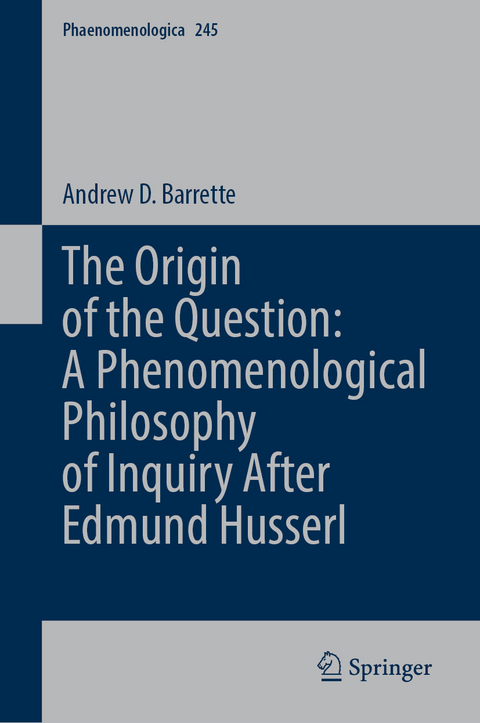
The Origin of the Question: Phenomenological Philosophy after Edmund Husserl
Springer International Publishing (Hersteller)
978-3-032-13569-8 (ISBN)
- Noch nicht erschienen - erscheint am 18.02.2026
- Versandkostenfrei
- Auch auf Rechnung
- Artikel merken
I. First chapter: The Act and Intentional Essence of Inquiry.- Preliminary Remarks— Toward a logic of question and answer with the transcendental question.- A. Classical logic and the place of questions.- B. Provisional sketch of Husserl’s campaign against skepticism.- 1. Toward the essence of inquiry via intentional analysis.- A. Beginnings and breakthroughs of phenomenology.- B. Objectivating and non-objectivating acts and relevant relations of foundation.- C. The act of inquiry as mediating fulfillment: the logic of question-answer.- 2. Concluding remarks: the interior and exterior voice.- II. Second chapter: Toward the Source and Horizon of Acts of Inquiry.- Preliminary Remarks— The radicalization of the transcendental question.- A. An elucidation of δόξα and ἐπιστήμη vis-à-vis inquiry.- 1. Natural and transcendental questions.- A. Metaphysics: the transcendental question and a demand for absolute cognition.- B. Doubt compared to inquiry.- C. Inquiry in the intuitive method of transcendental phenomenology.- 2. Natural inquiry within the world.- A. The pure ego as source of inquiry.- B. Inquiry in the natural practical attitude.- 3. Concluding Remarks: correlation analysis and the regressive procedure.- III. Third chapter: The Genesis of Inquiry.- Preliminary remarks—Toward a transcendental logic of question and answer.- A. Aristotle’s “analyses”: questions in science as about causes and origins.- 1. Husserl’s discovery and description of genesis.- A. Passivity and Activity.- B. Normativity as a theme of genetic phenomenology.- 2. Inquiry as a multi-layered striving for determination and differentiation.- A. The origin of inquiry in passivity.- B. Intellectus agens: the noetic activity of inquiry.- C. Interested and disinterested inquiry and the constitution of inquiring attitudes.- 3. Concluding Remarks: the need for further genetic analysis.- IV. Fourth Chapter: Knowing, valuing, and further reflections on inquiry and method.- Preliminary remarks—Ethics as a practical science.- A. The unity of the sciences and their unifying principle.- 1. The relationships of knowing and valuing.- A. Objectivation and Values.- B. The “Why and Because” in philosophical ethics.- 2. Some senses of method.- A. Methods and Techniques.- B. Leitfaden and Leitmotifs: Clues appearing in and obtaining between methods.- 3. Concluding remarks: toward a generative analysis of inquiry.- V. Fifth chapter: The generative roots of inquiry.- Preliminary Remarks—The question of history.- A. Principles and givenness.- 1. Preliminary sketch of some generative themes.- A. The home/alien problematic in the question of generativity.- B. Instinct and reason.- 2. The generation of world-inquiry as participating in the world-horizon.- A. Birth, Childhood, and the development of instinct toward inquiry.- B. Instinct, Imitation, and the original question of history – Why?.- 3. From myth to philosophy: a transformation of the “Why” question.- A. Myth: meaning and value relative to the homeworld.- B. The meeting of mythical worlds and the appearance of wonder in Greece.- VI. Concluding Overview: from latent to patent unto manifest reason.- VII. Appendices.
| Erscheint lt. Verlag | 18.2.2026 |
|---|---|
| Reihe/Serie | Phaenomenologica |
| Philosophy and Religion (R0) | Religion and Philosophy |
| Zusatzinfo | IV, 223 p. 1 illus. |
| Verlagsort | Cham |
| Sprache | englisch |
| Themenwelt | Geisteswissenschaften ► Philosophie ► Philosophie der Neuzeit |
| Schlagworte | Edmund Husserl • generative method and phenomenology • generativity and phenomenology • genesis and phenomenology • genetic method and phenomenology • Husserl and inquiry • Inquiry and phenomenology • Phenomenological Method • phenomenological philosophy • questions in phenomenology • values and phenomenology • valuing and phenomenology |
| ISBN-10 | 3-032-13569-9 / 3032135699 |
| ISBN-13 | 978-3-032-13569-8 / 9783032135698 |
| Zustand | Neuware |
| Informationen gemäß Produktsicherheitsverordnung (GPSR) | |
| Haben Sie eine Frage zum Produkt? |


