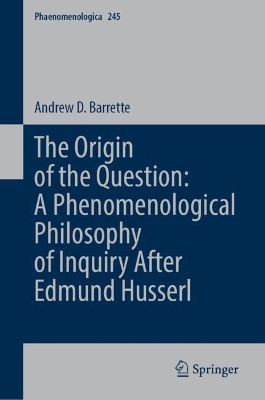
The Origin of the Question: Phenomenological Philosophy after Edmund Husserl
Springer International Publishing (Verlag)
978-3-032-13568-1 (ISBN)
- Noch nicht erschienen - erscheint am 18.02.2026
- Versandkostenfrei
- Auch auf Rechnung
- Artikel merken
This book offers a phenomenology of inquiry by tracing the history of Edmund Husserl s work. Through following Husserl s development from the beginnings of his phenomenology to his final writings, it shows that inquiry is a significant theme in his work and how inquiry influences the development of his own phenomenology. Indeed, the book argues that inquiry is an essential operation in phenomenological philosophy, and shows how that is so by following after Husserl's inquiry itself. The result is an account of the structure of inquiry, its genesis in the individual, and how generations participate in a questioning spirit that unites them in a philosophical task to answer the last and highest questions. As such, the book s target audience includes Husserl scholars, students of phenomenology, and students of philosophy in general.
Andrew Barrette is Professor of the Practice at Boston College. Prior to that, he was a Visiting Professor and a Research Fellow at the Institute for Advanced Jesuit Studies and Lonergan Institute, both at Boston College. He completed his dissertation at Southern Illinois University Carbondale, during which he was a Fullbright Scholar at the Husserl-Archives at KU-Leuven. He is also the translator of the first two volumes of Husserlian Legacies: Themes for the 21st Century and is currently finishing translations of Husserl's ethical lectures and manuscripts for Springer.
I. First chapter: The Act and Intentional Essence of Inquiry.- Preliminary Remarks Toward a logic of question and answer with the transcendental question.- A. Classical logic and the place of questions.- B. Provisional sketch of Husserl s campaign against skepticism.- 1. Toward the essence of inquiry via intentional analysis.- A. Beginnings and breakthroughs of phenomenology.- B. Objectivating and non-objectivating acts and relevant relations of foundation.- C. The act of inquiry as mediating fulfillment: the logic of question-answer.- 2. Concluding remarks: the interior and exterior voice.- II. Second chapter: Toward the Source and Horizon of Acts of Inquiry.- Preliminary Remarks The radicalization of the transcendental question.- A. An elucidation of and vis-à-vis inquiry.- 1. Natural and transcendental questions.- A. Metaphysics: the transcendental question and a demand for absolute cognition.- B. Doubt compared to inquiry.- C. Inquiry in the intuitive method of transcendental phenomenology.- 2. Natural inquiry within the world.- A. The pure ego as source of inquiry.- B. Inquiry in the natural practical attitude.- 3. Concluding Remarks: correlation analysis and the regressive procedure.- III. Third chapter: The Genesis of Inquiry.- Preliminary remarks Toward a transcendental logic of question and answer.- A. Aristotle s analyses : questions in science as about causes and origins.- 1. Husserl s discovery and description of genesis.- A. Passivity and Activity.- B. Normativity as a theme of genetic phenomenology.- 2. Inquiry as a multi-layered striving for determination and differentiation.- A. The origin of inquiry in passivity.- B. Intellectus agens: the noetic activity of inquiry.- C. Interested and disinterested inquiry and the constitution of inquiring attitudes.- 3. Concluding Remarks: the need for further genetic analysis.- IV. Fourth Chapter: Knowing, valuing, and further reflections on inquiry and method.- Preliminary remarks Ethics as a practical science.- A. The unity of the sciences and their unifying principle.- 1. The relationships of knowing and valuing.- A. Objectivation and Values.- B. The Why and Because in philosophical ethics.- 2. Some senses of method.- A. Methods and Techniques.- B. Leitfaden and Leitmotifs: Clues appearing in and obtaining between methods.- 3. Concluding remarks: toward a generative analysis of inquiry.- V. Fifth chapter: The generative roots of inquiry.- Preliminary Remarks The question of history.- A. Principles and givenness.- 1. Preliminary sketch of some generative themes.- A. The home/alien problematic in the question of generativity.- B. Instinct and reason.- 2. The generation of world-inquiry as participating in the world-horizon.- A. Birth, Childhood, and the development of instinct toward inquiry.- B. Instinct, Imitation, and the original question of history Why?.- 3. From myth to philosophy: a transformation of the Why question.- A. Myth: meaning and value relative to the homeworld.- B. The meeting of mythical worlds and the appearance of wonder in Greece.- VI. Concluding Overview: from latent to patent unto manifest reason.- VII. Appendices.
| Erscheint lt. Verlag | 18.2.2026 |
|---|---|
| Reihe/Serie | Phaenomenologica |
| Zusatzinfo | IV, 223 p. 1 illus. |
| Verlagsort | Cham |
| Sprache | englisch |
| Maße | 155 x 235 mm |
| Themenwelt | Geisteswissenschaften ► Philosophie ► Philosophie der Neuzeit |
| Schlagworte | Edmund Husserl • generative method and phenomenology • generativity and phenomenology • genesis and phenomenology • genetic method and phenomenology • Husserl and inquiry • Inquiry and phenomenology • Phenomenological Method • phenomenological philosophy • questions in phenomenology • values and phenomenology • valuing and phenomenology |
| ISBN-10 | 3-032-13568-0 / 3032135680 |
| ISBN-13 | 978-3-032-13568-1 / 9783032135681 |
| Zustand | Neuware |
| Informationen gemäß Produktsicherheitsverordnung (GPSR) | |
| Haben Sie eine Frage zum Produkt? |
aus dem Bereich