


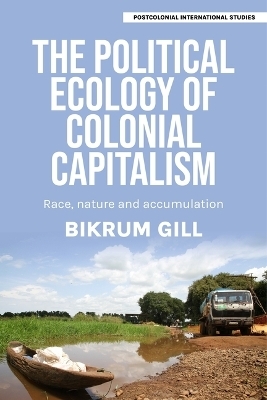
The Political Ecology of Colonial Capitalism
Race, Nature, and Accumulation
Seiten
2026
Manchester University Press (Verlag)
9781526198068 (ISBN)
Manchester University Press (Verlag)
9781526198068 (ISBN)
- Noch nicht erschienen (ca. Juni 2026)
- Versandkostenfrei
- Auch auf Rechnung
- Artikel merken
The political ecology of colonial capitalism reveals how the co-production of race and nature is a fundamental dynamic of the capitalist world-system. -- .
This book situates the post financial crisis phenomenon of the “global land grab” within the longue duree of the capitalist world system. It does so by advancing a theoretical and historical framework, called the political ecology of colonial capitalism, that clarifies the key role played by the co-production of race and nature in provisioning the “ecological surplus” that has historically secured the emergence and reproduction of capitalist development. The key premise of this book is that the global land grab constitutes another such attempted moment of re-securing the cheap food premise through racialized frontier appropriation. The argument advanced here is that, within the neoliberal crisis conjuncture, the hegemonic resolution of capital’s escalating social-ecological contradictions necessitates, through the practice of “global primitive accumulation,” the racialized construction of frontiers of unused nature in emergent zones of appropriation. -- .
This book situates the post financial crisis phenomenon of the “global land grab” within the longue duree of the capitalist world system. It does so by advancing a theoretical and historical framework, called the political ecology of colonial capitalism, that clarifies the key role played by the co-production of race and nature in provisioning the “ecological surplus” that has historically secured the emergence and reproduction of capitalist development. The key premise of this book is that the global land grab constitutes another such attempted moment of re-securing the cheap food premise through racialized frontier appropriation. The argument advanced here is that, within the neoliberal crisis conjuncture, the hegemonic resolution of capital’s escalating social-ecological contradictions necessitates, through the practice of “global primitive accumulation,” the racialized construction of frontiers of unused nature in emergent zones of appropriation. -- .
Bikrum Gill is Lecturer of Politics and International Relations at Cardiff University -- .
Introduction
Chapter One: The World-Historical Agrarian Question: Global Land Rush and the Reproduction of the Capitalist World-System
Chapter Two: Colonialism, Capitalism, and Planetary Crisis
Chapter Three: Beyond the Premise of Conquest: The Political Ecology of Colonial Capitalism
Chapter Four: The ‘Re-awakening of the South’ within and against the Capitalist World-Ecology
Chapter Five: Land Grab or Land Reform? Colonial and Anti-colonial Trajectories in an Emergent Multipolar Conjuncture
Conclusion -- .
| Erscheint lt. Verlag | 23.6.2026 |
|---|---|
| Reihe/Serie | Postcolonial International Studies |
| Verlagsort | Manchester |
| Sprache | englisch |
| Maße | 156 x 234 mm |
| Themenwelt | Geschichte ► Teilgebiete der Geschichte ► Wirtschaftsgeschichte |
| Naturwissenschaften ► Biologie ► Ökologie / Naturschutz | |
| Sozialwissenschaften ► Politik / Verwaltung ► Politische Systeme | |
| Sozialwissenschaften ► Politik / Verwaltung ► Politische Theorie | |
| ISBN-13 | 9781526198068 / 9781526198068 |
| Zustand | Neuware |
| Informationen gemäß Produktsicherheitsverordnung (GPSR) | |
| Haben Sie eine Frage zum Produkt? |
Mehr entdecken
aus dem Bereich

aus dem Bereich
wie Tech-Konzerne und Großmächte die Welt unter sich aufteilen
Buch | Hardcover (2025)
C.H.Beck (Verlag)
CHF 39,20


