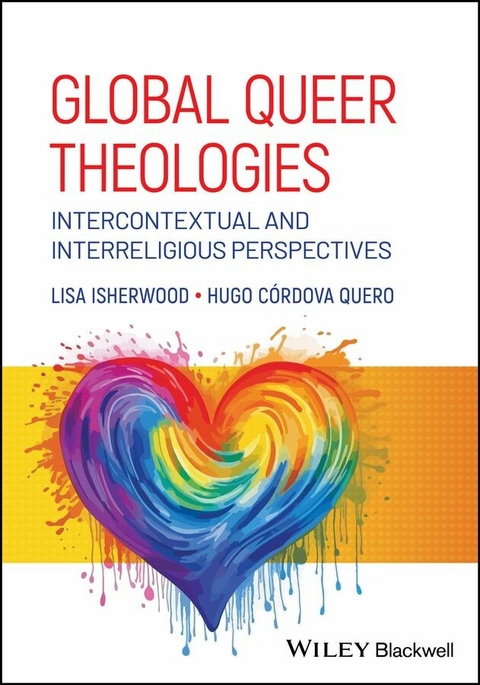
Global Queer Theologies (eBook)
497 Seiten
Wiley-Blackwell (Verlag)
978-1-394-19924-2 (ISBN)
Presents a groundbreaking global exploration of queer theologies across religions, regions, and spiritual traditions
Global Queer Theologies: Intercontextual and Interreligious Perspectives is an essential and timely resource for those seeking a comprehensive understanding of queer theologies as they emerge and evolve within diverse cultural, regional, and religious frameworks. While much of queer theological discourse has historically centered on the Global North and Christian traditions, this landmark volume decisively expands the conversation, drawing on multilingual scholarship and diverse lived experiences to illuminate the theological expressions of queer believers across global contexts.
Demonstrating how queer communities actively reinterpret sacred texts and spiritual practices, the text serves not only as an introduction to queer theological thought but also as a teaching tool designed to foster inclusive classroom engagement. Structured for clarity and pedagogical effectiveness, each chapter presents a focused exploration of a religious tradition or theme, complemented by visual aids and discussion prompts that encourage critical reflection and dialogue. The contributing authors map the rich, complex intersections of faith, sexuality, and identity, amplify voices long silenced or overlooked, and illuminate the sacred narratives of queer believers from across the globe.
Bridging theory with lived experience, emphasizing theological agency in marginalized contexts, Global Queer Theologies: Intercontextual and Interreligious Perspectives:
- Includes analysis of underexplored spiritual systems such as Shinto, Confucianism, paganism, and ancestral religions
- Employs a thematic and regional organizational structure that engages readers with both theory and practice
- Incorporates glossaries for enhanced clarity and reader accessibility in each section and original diagrams and graphics that map religious structures and spiritual genealogies throughout
- Features highlight boxes within chapters that introduce key thinkers, terms, and movements without disrupting the narrative flow
- Contains discussion questions at the end of each chapter to support student reflection and faculty-led dialogue
The first volume of its kind to offer truly global coverage of queer theologies across major and minor religious traditions, Global Queer Theologies: Intercontextual and Interreligious Perspectives is ideal for upper-level undergraduate and graduate students in theology, religious studies, gender studies, and queer theory.
LISA ISHERWOOD is Professor Emerita of Feminist Liberation Theologies at the University of Winchester and a research supervisor at the University of Wales, Trinity St David. A founder and Executive Editor of Feminist Theology, she has authored and edited more than 30 books. Her work centers on embodiment, sexuality, and eco-theology, and she is a leading voice in global feminist and liberation theology.
HUGO CÓRDOVA QUERO is Associate Professor of Critical Theories and Queer Theologies and Director of Digital Learning at Starr King School for the Ministry. He holds a PhD from the Graduate Theological Union and is affiliated with international research networks on queer religion and migration. He specializes in queer theologies, decolonial theory, and interreligious engagement.
Introduction
Why a Book on Global Queer Theologies?
This book serves as an initiation into the realms of queer theory and theologies, providing readers with a comprehensive overview. It meticulously traces the evolution and influence of queer theory within theological contexts, shedding light on its profound impact. By delving into the intersection of these disciplines, the text unveils a diverse panorama of theologies that have flourished worldwide across various faiths. This exploration highlights the transformative power of the amalgamation of queer theory and theology, showcasing the vibrant tapestry of beliefs and perspectives that have emerged as a result of this dynamic intersection.
The aim is to span different contexts in which we observe the agency of people and faith communities in deconstructing spirituality, sacred texts and beliefs. The volume makes the Divine's relationalities visible to all people in different spiritual paths and contexts. We will draw from various sources, experiences and realities to analyse how queer believers theologise and counter the discourses that seek to ostracise them from the faith communities. We will obtain an enriching global perspective beyond the traditional attention to Global North–rooted experiences.
In response to a growing imperative, this book directs attention to the unfolding landscape of queer theologies, particularly within Christianity, the pioneer of this discourse in the twentieth century. Recognising the expanding relevance across various religious traditions, the text extends its focus to encompass the diverse expressions of queer theologies within different faiths. By delving into Christianity's historical role and broadening the scope to include all religious bodies, the book seeks to illuminate the evolving narratives and perspectives within the context of diverse faith traditions. This approach underscores the necessity of understanding and engaging with the multifaceted dimensions of queer theologies as they manifest across the rich tapestry of religious beliefs and practices.
Most academic research has focused on the Global North for the last 30 years. The consequences are varied, ranging from the invisibility of religious experiences of queer believers in the global South to the Western ignorance of the development of literary and theological works in languages other than English. The authors' multilingual abilities can make much of this work known through this book. There is a lack of research into examining popular saint biographies, the statements of religious institutions regarding the relationship between faith and sexuality, and the creation of contextual spiritualities that takes into account the daily lived experiences of queer believers. Therefore, this book will provide various resources to foster this needed and much‐awaited stage in current research from a global perspective.
Who Are We?
Lisa Isherwood was made Professor of Feminist Liberation Theologies at the University College of St Mark & St John in 2020, the first such chair in the United Kingdom. She is now Professor Emerita in Feminist Liberation Theologies at the University of Winchester and a research supervisor at the University of Wales, Trinity St David. As a feminist liberation theologian she believes theology to be a communal project fuelled by notions of radical equality and empowered by divine companionship. Her work explores the nature of incarnation within contemporary contexts and includes such areas as the body, gender, sexuality and eco‐theology. She has written, co‐authored or edited 3 books and written numerous book chapters and journal articles. She is a founder and Executive Editor of the international journal Feminist Theology [Sage] and sits on the international editorial board of the Journal of Feminist Studies in Religion (USA). She has lectured around the world and was honoured to be a visiting scholar at Garrett Evangelical Seminary, Evanston, in 1997; the Episcopal Divinity School, Cambridge Massachusetts, in 2000 and visiting professor in the University of Western Australia in 2004. In 2010 she was Vice President of the European Society of Women in Theological Research.
Lisa is a proud Welsh woman and feminist liberation theologian who employs queer theory to illuminate all areas of her work. Some context—The Welsh kingdoms were conquered by Edward 1 of England in 1284 and from that time onwards Wales became a colonised and reduced nation. There were a number of risings, but each was in time quelled and our royal houses never regained their power over our lands. Wales has continued to suffer from a colonial attitude imposed by the English most prominently in their efforts to stamp out our language by the use of the Welsh Not in schools. This was a piece of wood placed around the neck of children heard speaking Welsh, at the end of the day those with the Not would be punished. This practice carried on until the 1940s had a profound effect on the use of English particularly in the south of Wales. There were multiple ‘reports’ carried out by English government officials which caricatured the Welsh, particularly Welsh women, as immoral and lacking in any form of education and indeed dignity. It also goes without saying that any trace of indigenous Celtic religion was frowned on; every effort was made to imbed the Anglican faith in Wales. Take note of the Anglican which stands for anglicisation in many parts of the world. Thankfully, although not without its problems a large number of Welsh people opted for Methodism which did have a dire effect on certain parts of Welsh culture. However, the most insidious attack on culture often came from within the community itself, from those who aspired to be viewed as cultured and educated and subsequently looked down on what they often termed as ‘too Welshy or taffy’. The latter being a term still used for the Welsh. A well‐known ditty talks of Taffy as a thief and not too bright and deserving of murder. While our language is once again being heard and Welsh‐speaking schools are popular with parents there is a legacy that still lingers in the psyche of my people, and it was not until 1999 that we had our own National Assembly which since 2006 has been known as the Senedd. However, the Senedd while being democratically elected by the people of Wales has limited powers granted by Westminster who also control the major budget that Wales receives.
Hugo Córdova Quero is an academic and theologian whose research focuses on the intersections of migration, gender, sexuality, and religion. He is known for his pioneering work in these fields, challenging conventional narratives and broadening the understanding of migration experiences from an interdisciplinary perspective. Córdova Quero was born in Argentina and received his education at various prestigious institutions in Latin America, the United States and Asia. He earned his doctorate at the Graduate Theological Union in Berkeley, California, and completed his post‐doctoral studies at Sophia University in Tokyo, Japan. His academic training is characterised by a solid foundation in theology, cultural and ethnic studies, sociology and anthropology—especially his studies at the University of California, Berkeley—which has allowed him to approach his research from a holistic and integrative perspective. Throughout his career, he has collaborated with numerous scholars and participated in a wide range of international research projects.
One of Córdova Quero's most significant contributions is his analysis of the experience of queer immigrants and their relationship with religion. In his research, he explores how gender and sexuality identities influence the migration experience and how these intersections are mediated by religious institutions. He argues that migration and religion are not isolated phenomena but are intricately intertwined, profoundly affecting the lives of queer migrants. His work highlights the need to understand how power structures and gender and sexuality norms within religions impact individuals in migratory contexts.
Córdova Quero has also been influential in the study of religious and cultural diversity. His research encompasses various religious traditions, including Christianity, Islam, Hinduism and Buddhism, and how these religions interact with migrant communities. His inclusive approach and commitment to social justice have earned him recognition as a dedicated and respected scholar. In addition to his academic work, Córdova Quero has been actively involved in community and human rights initiatives. He has worked with organisations that support migrants and LGBTIQ+ communities, advocating for more inclusive and equitable policies. His dedication to research and activism demonstrates his commitment to creating a more just and understanding world.
What Are Our Aims With a Book Like This One?
In the realm of queer theology, numerous books address its multifaceted issues, yet our unique approach distinguishes this work. Positioned at a level suitable for introducing students to this discipline, our book stands as a pioneering resource for faculty members teaching theology courses. Unlike existing publications, our comprehensive approach not only demystifies the complexities of queer theology but also serves as a vital tool for educators to impart a nuanced understanding to students.
As envisioned, this book emerges as an indispensable resource in the hands of faculty members worldwide, providing a carefully crafted guide for teaching theology...
| Erscheint lt. Verlag | 11.11.2025 |
|---|---|
| Sprache | englisch |
| Themenwelt | Geisteswissenschaften ► Religion / Theologie |
| Schlagworte | global religions queer perspectives • interreligious studies queer theology • LGBTQ spirituality • LGBTQ theology • queer feminist theology • queer religion • Queer theology • queer theology education • Religion and Sexuality • religions queer theory |
| ISBN-10 | 1-394-19924-4 / 1394199244 |
| ISBN-13 | 978-1-394-19924-2 / 9781394199242 |
| Informationen gemäß Produktsicherheitsverordnung (GPSR) | |
| Haben Sie eine Frage zum Produkt? |
 EPUB (Adobe DRM)
Kopierschutz: Adobe-DRM
Adobe-DRM ist ein Kopierschutz, der das eBook vor Mißbrauch schützen soll. Dabei wird das eBook bereits beim Download auf Ihre persönliche Adobe-ID autorisiert. Lesen können Sie das eBook dann nur auf den Geräten, welche ebenfalls auf Ihre Adobe-ID registriert sind.
Details zum Adobe-DRM
Dateiformat: EPUB (Electronic Publication)
EPUB ist ein offener Standard für eBooks und eignet sich besonders zur Darstellung von Belletristik und Sachbüchern. Der Fließtext wird dynamisch an die Display- und Schriftgröße angepasst. Auch für mobile Lesegeräte ist EPUB daher gut geeignet.
Systemvoraussetzungen:
PC/Mac: Mit einem PC oder Mac können Sie dieses eBook lesen. Sie benötigen eine
eReader: Dieses eBook kann mit (fast) allen eBook-Readern gelesen werden. Mit dem amazon-Kindle ist es aber nicht kompatibel.
Smartphone/Tablet: Egal ob Apple oder Android, dieses eBook können Sie lesen. Sie benötigen eine
Geräteliste und zusätzliche Hinweise
Buying eBooks from abroad
For tax law reasons we can sell eBooks just within Germany and Switzerland. Regrettably we cannot fulfill eBook-orders from other countries.
aus dem Bereich