


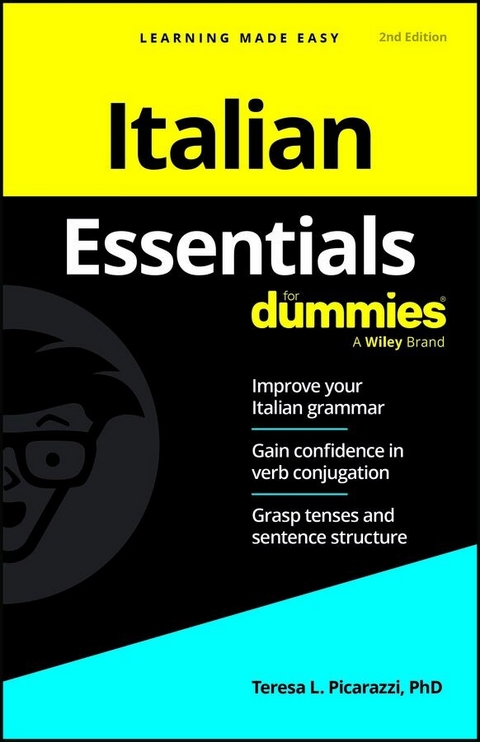
Italian Essentials For Dummies (eBook)
233 Seiten
For Dummies (Verlag)
978-1-394-37329-1 (ISBN)
An essential guide for Italian language learners
Italian Essentials For Dummies walks you through the foundations and essentials of introductory Italian. It covers Italian grammar, vocabulary, pronunciation, verb forms and tenses, and more, demonstrating exactly what you need to know to quickly get up to speed on the basics.
The book offers coverage of key Italian language concepts, skipping the fluff in favor of clear, concise, and applicable tips you can apply immediately as part of your language learning program, whether it's in a classroom, on your own, or as part of a language app.
Inside:
- Know conjugation, pronoun, and verb tense rules, as well as their exceptions
- Understand central, foundational Italian language concepts, including grammar rules and sentence structure
- Get Italian definitions and conversational examples that explain the ideas discussed in the book
Perfect for Italian learners looking for an effective supplement to in-classroom, self-guided, or app-based instruction, Italian Essentials For Dummies is a great resource for anyone looking to brush up or review basic, conversational Italian.
Teresa L. Picarazzi, PhD, has taught Italian language, literature, and cinema for more than 40 years. She has lived, studied, conducted research, and directed study-abroad programs in Florence, Siena, Urbino, Cortona, and Ravenna, Italy. She's also written several For Dummies books, including Italian Workbook For Dummies.
An essential guide for Italian language learners Italian Essentials For Dummies walks you through the foundations and essentials of introductory Italian. It covers Italian grammar, vocabulary, pronunciation, verb forms and tenses, and more, demonstrating exactly what you need to know to quickly get up to speed on the basics. The book offers coverage of key Italian language concepts, skipping the fluff in favor of clear, concise, and applicable tips you can apply immediately as part of your language learning program, whether it's in a classroom, on your own, or as part of a language app. Inside: Know conjugation, pronoun, and verb tense rules, as well as their exceptions Understand central, foundational Italian language concepts, including grammar rules and sentence structure Get Italian definitions and conversational examples that explain the ideas discussed in the book Perfect for Italian learners looking for an effective supplement to in-classroom, self-guided, or app-based instruction, Italian Essentials For Dummies is a great resource for anyone looking to brush up or review basic, conversational Italian.
Chapter 1
Focusing on the Basics
IN THIS CHAPTER
Perfecting your pronunciation
Getting to know you
Counting and putting two and two together
Exploring dates
Telling time versus asking at what time?
Brushing up on the basics with parts of speech
You’re reading this book because you’re interested in learning Italian or brushing up on what you already know — molto bene! (great!) You’re in the right place: Benvenute/Benvenuti! (Welcome!)
What are some essential first steps in getting your feet wet in another language? This chapter introduces you to important Italian skills that aid in everyday spoken and written communication as it walks you through pronunciation, greetings, numbers, time, basic parts of speech, and gender. Although you need to approach the language holistically and in context, you also have to grasp the individual parts of the whole, which is where this book comes in.
Italian is a living language. I can’t emphasize enough how important it is for you to practice saying and hearing Italian while you go through this book. I highly recommend finding sources online, from the alphabet to podcasts, to music, to television series. I also suggest you consult the latest edition of Italian For Dummies by Giuseppe Cavatorta and me, and my Italian Workbook for Dummies (John Wiley & Sons, Inc.), for more on Italian pronunciation and direct application of skills and practice dialogues.
Mouthing Off: Basic Pronunciation
Italian provides many opportunities for your tongue to do acrobatics. This is really fun, because the language offers you some new sounds. In this section, I give you some basic pronunciation hints that are important both for surfing through this book and for good articulation when you speak Italian. If you learn the correct pronunciation in this chapter, starting with the alphabet, you’ll be reading and speaking like a real Italian in no time.
These sections provide you with a rough phonetic spelling of the Italian pronunciation, just to get you started. Place extra umph on the stressed (italicized) syllables.
The alphabet
What better way is there to start speaking a language than to familiarize yourself with its alphabet? Table 1-1 shows you all the letters as well as how each one sounds. Note that there are only 21 letters in the Italian alphabet: missing are j, k, w, x, and y (which have crept into some Italian words now used in Italy, such as the words kiwi and yogurt).
TABLE 1-1 Alfabeto (ahl-fah-beh-toh)
| Letter | Pronunciation | Letter | Pronunciation | Letter | Pronunciation |
|---|
| a | ah | h | ahk-kah | q | kooh |
| b | bee | i | ee | r | ehr-reh |
| c | chee | l | ehl-leh | s | ehs-seh |
| d | dee | m | ehm-meh | t | tee |
| e | eh | n | ehn-neh | u | ooh |
| f | ehf-feh | o | oh | v | vooh |
| g | jee | p | pee | z | dzeh-tah |
Vowels
I start with the tough ones: vowels. The sounds aren’t that new, but the connection between the written letter and the actual pronunciation in Italian isn’t quite the same as it is in English.
Italian has five written vowels: a, e, i, o, and u. The following sections tell you how to pronounce them. The stress goes on the italicized syllable.
The vowel a
In Italian, the letter a has just one pronunciation. Think of the sound of the a in the English word father. The Italian a sounds just like that. I transcribe the Italian a as (ah), as in casa (kah-zah) (house) and sale (sah-leh) (salt).
The vowel e
Try to think of the sound in the French word gourmet (you don’t pronounce the t). This sound comes very close to the Italian e. I transcribe the e sound as (eh). For example, sole (soh-leh) (sun).
The vowel i
The Italian i is simply pronounced (ee), as in the English word see. Here are some examples: cinema (chee-neh-mah) (cinema) and vita (vee-tah) (life).
The vowel o
The Italian o is pronounced as in the English piano generally. I list the pronunciation as (oh). Try it out on the following words: domani (doh-mah-nee) (tomorrow) and piccolo (peek-koh-loh) (little; small). However, the o can also sound like the o in off. The word botte, for example, has different meanings (beating/barrel).
The vowel u
The Italian u sounds always like the English (ooh), as in zoo. I use (ooh) to transcribe the Italian u. Here are some sample words: luna (looh-nah) (moon) and frutta (frooht-tah) (fruit).
Consonants
Here are some consonants that are pronounced differently in Italian than they are in English.
The consonant c
The Italian c has three sounds, depending on which letter follows it:
- Hard c: When c is followed by a, o, u, or any consonant, pronounce it as in the English word cat. I transcribe this pronunciation as (k). Examples include casa (kah-zah) (house), colpa (kohl-pah) (fault/guilt).
- Soft c: When c is followed by e or i, pronounce it as you do the first and last sound in the English word church. Examples include cena (cheh-nah) (dinner), cibo (chee-boh) (food).
- Soft sh sound (as in shame): When you have sc followed by e or i, pronounce it like you do in the English word show. Examples include scena (sheh-nah) (scene), and capisci (kah-pee-shee) (you understand).
This pronunciation scheme sounds terribly complicated, but in the end, it’s not that difficult. And it’s super important. Here I present it in another way, which you can take as a little memory support:
Follow a scheme like this:
- C + i, e = ch
- C+ h, o, u, a = k
- Sc + i or e = sh
The Italian g behaves essentially the same as the c, with hard and soft sounds:
- G + i, e = g as in Gina (jee-nah) and gelato (geh-lah-toh) (ice-cream, sort of)
- G + h, o, u, a = g as in spaghetti (spah-ghet-tee) (spaghetti), gondola (gohn-doh-lah) (a type of boat in Venice), figura (fee-gooh-rah) (figure), and gala (gah-lah).
The consonant h is always silent! It appears in some forms of the verb avere (ah-veh-reh) (to have), such as io ho (ee-oh oh), tu hai (tooh i), and some words of foreign origin, such as hobby (ohb-bee).
Consonant clusters
Certain consonant clusters have special sounds in Italian: it’s important to get these down as well. Here are a couple to get you started:
- gn is pronounced as the English ny sound in canyon. You may already know the Italian words gnocchi (nyohk-kee) (a delicious dumpling type of pasta) and signora (see-nyoh-rah) (Mrs.).
-
gl is pronounced in the back of the throat like the English word million in words like gli (lyee) (the, masc. pl.) and famiglia (fah-mee-lyah) (family).
Don’t ever say anything like the English g as in glamour with the gl consonant cluster.
Stressing words properly
Stress is the audible accent that you put on a syllable as you speak it. One syllable always gets more stress than all the others.
Some words give you a hint as to where to...
| Erscheint lt. Verlag | 6.11.2025 |
|---|---|
| Sprache | englisch |
| Themenwelt | Schulbuch / Wörterbuch ► Wörterbuch / Fremdsprachen |
| Geisteswissenschaften ► Sprach- / Literaturwissenschaft ► Sprachwissenschaft | |
| Technik | |
| Schlagworte | basic italian • Beginning Italian • conversational italian • easy Italian • Italian basics • Italian for beginners • Italian fundamentals • italian grammar • Italian language tips • italian phrases • Italian Pronunciation • Italian tips • learning italian |
| ISBN-10 | 1-394-37329-5 / 1394373295 |
| ISBN-13 | 978-1-394-37329-1 / 9781394373291 |
| Informationen gemäß Produktsicherheitsverordnung (GPSR) | |
| Haben Sie eine Frage zum Produkt? |
 EPUB (Adobe DRM)
Kopierschutz: Adobe-DRM
Adobe-DRM ist ein Kopierschutz, der das eBook vor Mißbrauch schützen soll. Dabei wird das eBook bereits beim Download auf Ihre persönliche Adobe-ID autorisiert. Lesen können Sie das eBook dann nur auf den Geräten, welche ebenfalls auf Ihre Adobe-ID registriert sind.
Details zum Adobe-DRM
Dateiformat: EPUB (Electronic Publication)
EPUB ist ein offener Standard für eBooks und eignet sich besonders zur Darstellung von Belletristik und Sachbüchern. Der Fließtext wird dynamisch an die Display- und Schriftgröße angepasst. Auch für mobile Lesegeräte ist EPUB daher gut geeignet.
Systemvoraussetzungen:
PC/Mac: Mit einem PC oder Mac können Sie dieses eBook lesen. Sie benötigen eine
eReader: Dieses eBook kann mit (fast) allen eBook-Readern gelesen werden. Mit dem amazon-Kindle ist es aber nicht kompatibel.
Smartphone/Tablet: Egal ob Apple oder Android, dieses eBook können Sie lesen. Sie benötigen eine
Geräteliste und zusätzliche Hinweise
Buying eBooks from abroad
For tax law reasons we can sell eBooks just within Germany and Switzerland. Regrettably we cannot fulfill eBook-orders from other countries.
aus dem Bereich


