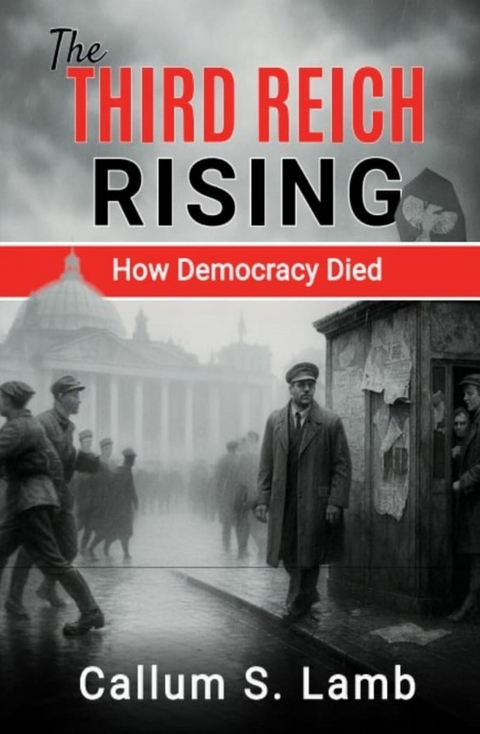
The Third Reich Rising (eBook)
435 Seiten
Seahorse Pub (Verlag)
978-0-00-108870-2 (ISBN)
In the shadow of a shattered empire, a fragile experiment in freedom teetered on the brink. From the revolutionary chaos of 1918-where sailors mutinied in Kiel and crowds stormed Berlin's streets-to the fateful morning of January 30, 1933, when an aging war hero's trembling hand sealed Germany's doom, this gripping chronicle unveils the harrowing unraveling of the Weimar Republic.
Drawing on over thirty years of groundbreaking archival research from newly reunified German collections, Lamb weaves a masterful narrative of hubris, betrayal, and human frailty. Witness the 'stab-in-the-back' myth poisoning a defeated nation's soul; the hyperinflation nightmare of 1923 that wheeled wheelbarrows of worthless cash through middle-class ruins; and the Great Depression's iron grip, catapulting Nazis from fringe fanatics to electoral juggernauts with 37% of the vote by 1932.
At its heart, this is no dry textbook-it's a pulse-pounding drama of flawed visionaries and ruthless opportunists. Relive Friedrich Ebert's desperate pact with the military to stave off Bolshevik terror; Franz von Papen's aristocratic arrogance, whispering that he'd 'push Hitler into a corner until he squeaks'; and Paul von Hindenburg's tragic miscalculation, handing absolute power to a corporal turned demagogue. Through vivid vignettes, forgotten diaries, and street-level terror-from Spartacist bloodbaths to SA brownshirt rampages-the book exposes how economic despair, elite conspiracies, and cultural despair eroded democratic norms, one decree at a time.
Yet The Emergence of the Third Reich transcends tragedy, offering urgent lessons for our polarized age: how fragile institutions crumble under crisis, and why vigilance against authoritarian whispers is democracy's last defense. With stunning maps of electoral upheavals, rare photographs of torchlit triumphs, and a cast of heroes, villains, and everyday Germans caught in the maelstrom, this definitive account illuminates the darkest path to power. Discover how liberty dies not with a bang, but a signature. Your essential guide to the roots of tyranny.
Prologue
The Moment of Decision
January 30, 1933, 11:15 AM, Presidential Palace Berlin
The morning light filtered weakly through the tall windows of Paul von Hindenburg's office on the second floor of the Presidential Palace, casting pale shadows across the heavy oak furniture that had witnessed the rise and fall of German chancellors for more than a decade. Outside on Wilhelmstraße, a thin layer of snow covered the cobblestones, muffling the sounds of Berlin's morning traffic, while inside the ornate chamber, five men gathered around the massive mahogany desk that would serve as the altar for democracy's final sacrifice.
At eighty-four, Reich President Paul von Hindenburg sat stiffly in his leather chair, his once-commanding frame now diminished by age and the weight of impossible decisions. The victor of Tannenberg, the man who had saved East Prussia from Russian invasion in 1914, now struggled with the simplest conversations, his legendary memory failing him at crucial moments. His weathered hands, which had once signed military orders that moved armies across continents, now trembled slightly as they rested on the desk blotter, beneath which lay the documents that would transform Germany forever.
Standing before the presidential desk, Adolf Hitler maintained an outward composure that belied the revolutionary fire burning within him. At forty-three, the Austrian-born politician had traveled an extraordinary distance from the beer halls of Munich to this moment of supreme political triumph. His dark hair was carefully combed, his simple brown party uniform pressed and immaculate, his mustache precisely trimmed. Nothing in his controlled demeanor suggested the radical transformation he intended to unleash upon the German people. His pale blue eyes remained fixed on Hindenburg's face, watching for any sign of last-minute hesitation that might derail his carefully orchestrated ascent to power.
Franz von Papen stood slightly to Hitler's left, his aristocratic bearing radiating the confidence that would prove so catastrophically misplaced. The former cavalry officer and previous chancellor carried himself with the easy assurance of a man born to privilege, educated at the finest military academies, and accustomed to political maneuvering among Germany's conservative elite. His perfectly waxed mustache and expensive morning coat spoke of a world where gentlemen's agreements could contain revolutionary movements and where breeding and education provided adequate armor against crude populist appeals. At fifty-three, Papen possessed the fatal certainty that his superior intellect and social position would enable him to manipulate the upstart Hitler for conservative purposes.
Otto Meißner, the State Secretary who had served as constitutional advisor to three different presidents, stood near the window with a leather portfolio containing the formal documents required for the transition of power. His bureaucratic precision and encyclopedic knowledge of legal procedures had made him indispensable to the functioning of the presidential office, but his technical expertise could not navigate the unprecedented political crisis that had brought these men together. Meißner understood the constitutional mechanics of appointing chancellors, but he failed to grasp the revolutionary implications of this particular appointment.
Behind his father's chair, Oskar von Hindenburg observed the proceedings with the nervous attention of a man whose behind-the-scenes influence had helped orchestrate this moment. The younger Hindenburg had been instrumental in the secret negotiations that convinced his father to abandon his previous resistance to appointing Hitler as chancellor. His presence in the room represented the personal family dynamics that had intersected with national political calculations to produce this fateful decision.
The atmosphere in the room carried an almost ceremonial quality, despite the revolutionary implications of the proceedings. Portraits of Prussian kings gazed down from the walls, their stern faces seeming to judge the politicians who now prepared to hand Germany's democratic government to a movement that had explicitly rejected parliamentary democracy. The heavy curtains, ornate moldings, and formal furniture created an environment of traditional authority that provided a deceptive sense of continuity and control.
Hindenburg's voice, when he finally spoke, carried the weariness of a man who had outlived his era and found himself making decisions he could not fully comprehend. "I have grave doubts about this whole business," he said, his words barely audible above the ticking of the grandfather clock in the corner. "This Austrian corporal will be the ruin of Germany." The president's reluctance was palpable, his instinctive distrust of Hitler warring against the political pressures that had brought him to this moment.
Papen moved quickly to reassure his elderly patron, his voice carrying the smooth confidence that had characterized his political maneuvering throughout the crisis. "Herr President, you need have no concerns about this arrangement. We have hired him for our work. In two months we will have pushed Hitler so far into the corner that he'll squeak." The former chancellor's words revealed the fundamental miscalculation that would prove so devastating—the belief that traditional politicians could control and manipulate a revolutionary movement that had already demonstrated its capacity for violence and its contempt for democratic norms.
Hitler responded with the formal courtesy that masked his true intentions, his acceptance speech emphasizing legal constitutional process and respect for presidential authority. "I am deeply honored by your confidence, Herr President, and I pledge to uphold the constitution and serve the German people within the framework of our democratic institutions." Every word had been carefully chosen to reassure conservative politicians that they were dealing with a conventional political leader who would operate within established parliamentary boundaries.
Meißner stepped forward with the constitutional documents, his bureaucratic precision ensuring that every legal formality would be properly observed. "If you would sign here, Herr President, the appointment will be constitutionally complete." The state secretary's focus on procedural correctness reflected the broader German faith in legal mechanisms and institutional safeguards that would prove so inadequate against revolutionary assault.
As Hindenburg's trembling hand signed the document that appointed Adolf Hitler as Chancellor of Germany, the pale winter sunlight seemed to dim slightly, as if nature itself recognized the significance of this moment. The constitutional transfer of power was complete, accomplished with perfect legal propriety and ceremonial dignity. Yet the five men in that room had just engineered the destruction of German democracy through the very institutions designed to protect it.
The sound of the pen scratching across paper marked the end of the Weimar Republic's fifteen-year experiment in parliamentary government. Outside the palace windows, ordinary Berliners continued their daily routines, unaware that their political world had just been fundamentally altered by the signatures on Otto Meißner's carefully prepared documents. The conservative politicians who had orchestrated Hitler's appointment congratulated themselves on their political cleverness, confident that they had found a solution to Germany's crisis that would restore stability while keeping the Nazi leader under their control.
Fifteen Years of Democratic Experiment
The German Republic that died in Hindenburg's office that January morning had been born fifteen years earlier amid the chaos of military defeat and revolutionary upheaval. On November 9, 1918, as German armies collapsed on the Western Front and revolution erupted in Berlin's streets, Kaiser Wilhelm II had abdicated his throne and fled to exile in Holland, leaving behind a political vacuum that democratic politicians struggled to fill. The Social Democrat Friedrich Ebert, thrust into power by circumstances beyond his control, had proclaimed the German Republic from the Reichstag balcony while revolutionary workers and soldiers seized control of key institutions throughout the country.
From its inception, the Weimar Republic faced challenges that would have tested even the most established democracy. The new government inherited responsibility for Germany's defeat in the Great War, accepting the humiliating terms of the Versailles Treaty that imposed massive reparations, territorial losses, and military restrictions on the German people. Conservative politicians and military leaders, led by General Erich Ludendorff and other prominent figures, immediately began propagating the "stab-in-the-back" legend, claiming that Germany's armies had been betrayed by democratic politicians rather than defeated on the battlefield. This foundational myth poisoned German political discourse from the republic's earliest days, creating a powerful narrative that extremist movements would exploit throughout the democratic experiment.
The Weimar Constitution, drafted in 1919 by some of Germany's most brilliant legal minds, represented a sophisticated attempt to create a stable parliamentary democracy that could balance competing political interests while protecting individual rights. The document established a federal system with strong state governments, a proportional representation electoral system designed to ensure fair representation for all political parties, and extensive civil liberties protections. Yet the constitution also contained fatal structural weaknesses that would prove decisive in the republic's final...
| Erscheint lt. Verlag | 28.10.2025 |
|---|---|
| Sprache | englisch |
| Themenwelt | Geisteswissenschaften ► Geschichte ► Regional- / Ländergeschichte |
| ISBN-10 | 0-00-108870-X / 000108870X |
| ISBN-13 | 978-0-00-108870-2 / 9780001088702 |
| Informationen gemäß Produktsicherheitsverordnung (GPSR) | |
| Haben Sie eine Frage zum Produkt? |
 EPUB (Adobe DRM)
Größe: 1,2 MB
Kopierschutz: Adobe-DRM
Adobe-DRM ist ein Kopierschutz, der das eBook vor Mißbrauch schützen soll. Dabei wird das eBook bereits beim Download auf Ihre persönliche Adobe-ID autorisiert. Lesen können Sie das eBook dann nur auf den Geräten, welche ebenfalls auf Ihre Adobe-ID registriert sind.
Details zum Adobe-DRM
Dateiformat: EPUB (Electronic Publication)
EPUB ist ein offener Standard für eBooks und eignet sich besonders zur Darstellung von Belletristik und Sachbüchern. Der Fließtext wird dynamisch an die Display- und Schriftgröße angepasst. Auch für mobile Lesegeräte ist EPUB daher gut geeignet.
Systemvoraussetzungen:
PC/Mac: Mit einem PC oder Mac können Sie dieses eBook lesen. Sie benötigen eine
eReader: Dieses eBook kann mit (fast) allen eBook-Readern gelesen werden. Mit dem amazon-Kindle ist es aber nicht kompatibel.
Smartphone/Tablet: Egal ob Apple oder Android, dieses eBook können Sie lesen. Sie benötigen eine
Geräteliste und zusätzliche Hinweise
Buying eBooks from abroad
For tax law reasons we can sell eBooks just within Germany and Switzerland. Regrettably we cannot fulfill eBook-orders from other countries.
aus dem Bereich