


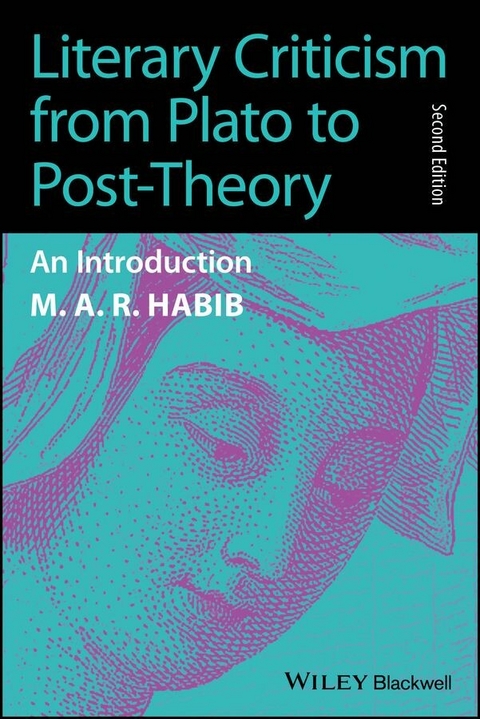
Literary Criticism from Plato to Post-Theory (eBook)
613 Seiten
Wiley-Blackwell (Verlag)
978-1-394-18889-5 (ISBN)
Provides a comprehensive account of the evolution of literary criticism from antiquity to the present
Spanning more than two millennia of intellectual history, Literary Criticism from Plato to Post-Theory: An Introduction offers the most thorough and accessible survey of Western literary theory available today. M.A.R. Habib presents a lucid and detailed chronological account of key movements, texts, and thinkers-from Plato and Aristotle to posthumanism and digital studies-making complex ideas intelligible without sacrificing scholarly rigor. This second edition is expanded to address the rapidly evolving landscape of contemporary criticism, including new and revised chapters on affect theory, cognitive literary studies, gender theory, world literature, and digital humanities.
For students and scholars of literature, theory, and cultural studies, Literary Criticism from Plato to Post-Theory provides indispensable insight into how literary criticism has responded to-and helped shape-major intellectual and political developments throughout history. With clear attention to philosophical foundations and cultural context, Habib explores not just what key theorists believed, but why their ideas emerged when they did and how they continue to resonate today.
Enabling readers to trace the deep roots and dynamic shifts in literary thought with clarity and critical depth, Literary Criticism from Plato to Post-Theory:
- Situates literary theory within historical and philosophical developments across cultures and eras
- Emphasizes contextualization, helping readers understand criticism in relation to its time and place
- Introduces lesser-known thinkers alongside canonical figures, offering a broad intellectual spectrum
- Highlights the connections between literary criticism and political, cultural, and social change
- Bridges classical traditions and emerging technologies/ media in literary analysis
- Encourages close textual reading while maintaining attention to philosophical underpinnings
Ideal for use alongside anthologies or as a stand alone text, Literary Criticism from Plato to Post-Theory: An Introduction, Second Edition remains a foundational resource for understanding the traditions and transformations of literary criticism. It is ideal for undergraduate and graduate students taking courses in English, comparative literature, cultural studies, or critical theory. It is particularly suited to core courses such as Introduction to Literary Theory, Foundations of Criticism, and World Literature in English, Liberal Arts, and Interdisciplinary Humanities programs.
M. A. R. HABIB is Distinguished Professor of English at Rutgers University and a leading scholar in literary criticism, philosophy, and translation. He is the author of Hegel and the Foundations of Literary Theory, Hegel and Empire: From Postcolonialism to Globalism, and Literary Studies: A Norton Guide. Habib has edited The Cambridge History of Literary Criticism: Volume VI and the Penguin Dictionary of Literary Terms and Literary Theory. His work also includes several translations of Urdu poetry and Islamic texts.
Introduction
Our English word “criticism” comes from the ancient Greek noun krites, meaning “judge.” But what does it mean to be a “judge” of literature? We might break this down into several basic questions: what is the purpose of literary criticism? How broad is this field of inquiry, and who gets to define it? What are its connections with other disciplines such as philosophy and religion? How does it relate to the realms of morality, of knowledge, and of learning? Does it have any political implications? How does it impinge on our practices of reading and writing? Above all, what significance does it have, or could it possibly have, in our own lives? Why should we even bother to study literary criticism? Is it not enough for us to read the great works of literature, of poetry, fiction, and drama? Why should we trouble ourselves to read what people say about literature? And surely, after all the obscure “theory” of the last 50 years or so, what we need to get back to is the texts themselves. We need to appreciate literature for its beauty and its technical artistry. In short, we need to read literature as literature – without the interference of some “judge” telling us what to look for or how to read.
How can we answer such skepticism? We might begin by recalling that “theory” and critical reflection on literature began at least 2500 years ago, and have been conducted by some of the greatest Western thinkers and writers, ranging from Plato and Aristotle, through Augustine and St Thomas Aquinas, Johnson, Pope, and the great Romantics to the great modern figures such as Locke, Hume, Kant, Hegel, Freud, W. B. Yeats, and Sartre. Until 200 years ago, most great thinkers, critics, and literary artists would not have understood what was meant by reading literature as literature. They knew that literature had integral connections with philosophy, religion, politics, and morality; they knew, in other words, that literature was richly related to all aspects of people’s lives.
If we had no tradition of critical interpretation, if we were left with the “texts” themselves, we would be completely bewildered. We would not know how to classify a given writer as Romantic, classical, or modern. We would not know that a given poem was epic or lyric, mock‐heroic, or even that it was a poem. We would be largely unaware of which tradition a given writer was working in and how she was trying to subvert it in certain ways. We would not be able to arrive at any comparative assessment of writers in terms of literary merit. We would not even be able to interpret the meanings of individual lines or words in any appropriate context. It has been the long tradition of literary interpretation – refined and evolved over many centuries – which has addressed these questions. It is surely naive to think that we are all endowed with some superior sensibility which can automatically discern which writers are great and which are mediocre. We do not even know for certain how the ancient Greek of Homer was pronounced; most of us cannot read the Greek of Plato or the Latin of Aquinas or the Italian of Dante or the Arabic of al‐Ghazzali. How would we ever, independently, arrive at any estimation of these writers or their backgrounds or their contributions without a body of critical apparatus, without a tradition of critical expertise and interpretation, to help us? Shakespeare “is” a great writer because that has been the enduring consensus of influential critics. The reputations of writers can vary quite dramatically. At the beginning of the twentieth century, T. S. Eliot was a powerful critical voice, denigrating the Romantics, extolling the metaphysical poets and revaluating the very idea of tradition. Nowadays, Eliot commands far less critical authority, though his high status as a poet endures.
We can try to illustrate our actual reliance on the traditions of criticism and theory by using a particular example, Matthew Arnold’s famous poem “Dover Beach”:
The sea is calm to‐night.
The tide is full, the moon lies fair
Upon the straits; on the French coast the light
Gleams and is gone; the cliffs of England stand;
Glimmering and vast, out in the tranquil bay.
Come to the window, sweet is the night‐air!
Only, from the long line of spray
Where the sea meets the moon‐blanched land,
Listen! you hear the grating roar
Of pebbles which the waves draw back, and fling,
At their return, up the high strand,
Begin, and cease, and then again begin,
With tremulous cadence slow, and bring
The eternal note of sadness in.
Sophocles long ago
Heard it on the Aegean, and it brought
Into his mind the turbid ebb and flow
Of human misery; we
Find also in the sound a thought,
Hearing it by this distant northern sea.
The Sea of Faith
Was once, too, at the full, and round earth’s shore
Lay like the folds of a bright girdle furled.
But now I only hear
Its melancholy, long, withdrawing roar,
Retreating, to the breath
Of the night‐wind, down the vast edges drear
And naked shingles of the world.
Ah, love, let us be true
To one another! for the world, which seems
To lie before us like a land of dreams,
So various, so beautiful, so new,
Hath really neither joy, nor love, nor light,
Nor certitude, nor peace, nor help for pain;
And we are here as on a darkling plain
Swept with confused alarms of struggle and flight,
Where ignorant armies clash by night.
A conventional reading of this poem based on the immediate “text” might go like this: “Dover Beach” is a lyric poem which expresses the painful doubt and disorientation of the Victorian age. The poem is unified by the image and symbolism of the sea, which is used to express the decline of religious faith. In the first section the calm of the sea is complemented by the “grating roar,” and the motion of the waves, which the poem’s language imitates, symbolizes the cyclical movement of human history, an idea which Arnold may have derived from his father, Thomas Arnold. This symbolism is intensified as the sea meets the “moon‐blanched” land, the moon also symbolizing change, in which case “moon‐blanched land” might refer to a civilization bleached or made colorless by change or progress. The picturesque opening presents a visual scene of the moonlit ocean whose calm is interrupted only when it is heard, as a “grating roar” which prepares the transition from the sea as physical image to symbol, infused with “The eternal note of sadness.” The second section makes more precise the sea’s significance: the “hearing” of the sea, and the “finding” of “a thought” in its sound, has a classical precedent, not only inscribing Arnold within a literary tradition going back to Sophocles but also stressing the universality of the human predicament. The third section uses the sea as a powerful symbol of both religious faith, which once clothed the world, and the process of secularization, which leaves the world “naked”; the symbolic “long, withdrawing roar” echoes the literal “roar” of the first section, once again creating a fusion of general and particular. The last section warns of the deceptive nature of the world’s apparent beauty and variety (as presented in the poem’s opening): beneath these “glimmering” surfaces are other, more threatening sounds, foreboding chaos, war, and destruction.
On a technical level, we might observe that the poem is written as a dramatic monologue, melancholy in tone, in four sections. It has no regular rhythm or rhyme scheme but traces of a sonnet form may be discernible in the first two sections; we might discern the ghost of an eroded blank verse in the gesture of many lines toward iambic pentameter, with the preceding and subsequent lines cut short to achieve various effects, as in “The Sea of Faith” which, in its present eroded state, stands alone as merely four syllables, while its comforting fullness in the past is evoked in two full pentameters beginning “Was once, too, at the full, and round earth’s shore.” We might also point out that the already irregular rhyme scheme abacdbdc breaks down in the middle of the first section: there is no word to rhyme with “roar,” which might also mimic the fragmentation of the Victorian world. The poem employs numerous literary devices, most notably the metaphors (inherited from Romanticism) ascribing intelligence or sentience to elements of nature such as the sea and the night wind, the simile comparing the sea of faith to a protective “girdle,” and various obvious devices such as anaphora, as in the repetition of “so” and “nor” in the final section.
It is simply not possible to ascribe any meaning to the poem without referring its words to broader trends in Victorian society. We might say that the poem represents the anxiety of a world where religious faith was called into question by numerous developments in science, scholarship, and technology: the various theories and philosophies of evolution, the German Higher Criticism which discredited much of the Bible, and the Industrial Revolution which caused a...
| Erscheint lt. Verlag | 14.10.2025 |
|---|---|
| Sprache | englisch |
| Themenwelt | Geisteswissenschaften ► Sprach- / Literaturwissenschaft ► Anglistik / Amerikanistik |
| Geisteswissenschaften ► Sprach- / Literaturwissenschaft ► Literaturwissenschaft | |
| Schlagworte | digital humanities • English literature criticism textbook • literary criticism cultural studies • literary criticism textbook • literary theory intro • literary theory textbook • posthumanism literary criticism • world literature criticism textbook |
| ISBN-10 | 1-394-18889-7 / 1394188897 |
| ISBN-13 | 978-1-394-18889-5 / 9781394188895 |
| Informationen gemäß Produktsicherheitsverordnung (GPSR) | |
| Haben Sie eine Frage zum Produkt? |
 EPUB (Adobe DRM)
Kopierschutz: Adobe-DRM
Adobe-DRM ist ein Kopierschutz, der das eBook vor Mißbrauch schützen soll. Dabei wird das eBook bereits beim Download auf Ihre persönliche Adobe-ID autorisiert. Lesen können Sie das eBook dann nur auf den Geräten, welche ebenfalls auf Ihre Adobe-ID registriert sind.
Details zum Adobe-DRM
Dateiformat: EPUB (Electronic Publication)
EPUB ist ein offener Standard für eBooks und eignet sich besonders zur Darstellung von Belletristik und Sachbüchern. Der Fließtext wird dynamisch an die Display- und Schriftgröße angepasst. Auch für mobile Lesegeräte ist EPUB daher gut geeignet.
Systemvoraussetzungen:
PC/Mac: Mit einem PC oder Mac können Sie dieses eBook lesen. Sie benötigen eine
eReader: Dieses eBook kann mit (fast) allen eBook-Readern gelesen werden. Mit dem amazon-Kindle ist es aber nicht kompatibel.
Smartphone/Tablet: Egal ob Apple oder Android, dieses eBook können Sie lesen. Sie benötigen eine
Geräteliste und zusätzliche Hinweise
Buying eBooks from abroad
For tax law reasons we can sell eBooks just within Germany and Switzerland. Regrettably we cannot fulfill eBook-orders from other countries.
aus dem Bereich


