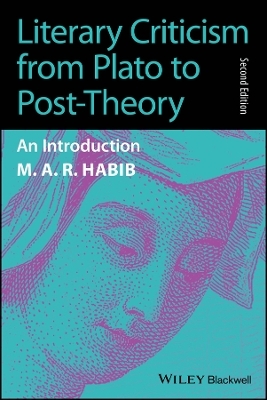
Literary Criticism from Plato to Post-Theory
Wiley-Blackwell (Verlag)
978-1-394-18887-1 (ISBN)
Spanning more than two millennia of intellectual history, Literary Criticism from Plato to Post-Theory: An Introduction offers the most thorough and accessible survey of Western literary theory available today. M.A.R. Habib presents a lucid and detailed chronological account of key movements, texts, and thinkers—from Plato and Aristotle to posthumanism and digital studies—making complex ideas intelligible without sacrificing scholarly rigor. This second edition is expanded to address the rapidly evolving landscape of contemporary criticism, including new and revised chapters on affect theory, cognitive literary studies, gender theory, world literature, and digital humanities.
For students and scholars of literature, theory, and cultural studies, Literary Criticism from Plato to Post-Theory provides indispensable insight into how literary criticism has responded to—and helped shape—major intellectual and political developments throughout history. With clear attention to philosophical foundations and cultural context, Habib explores not just what key theorists believed, but why their ideas emerged when they did and how they continue to resonate today.
Enabling readers to trace the deep roots and dynamic shifts in literary thought with clarity and critical depth, Literary Criticism from Plato to Post-Theory:
Situates literary theory within historical and philosophical developments across cultures and eras
Emphasizes contextualization, helping readers understand criticism in relation to its time and place
Introduces lesser-known thinkers alongside canonical figures, offering a broad intellectual spectrum
Highlights the connections between literary criticism and political, cultural, and social change
Bridges classical traditions and emerging technologies/ media in literary analysis
Encourages close textual reading while maintaining attention to philosophical underpinnings
Ideal for use alongside anthologies or as a stand alone text, Literary Criticism from Plato to Post-Theory: An Introduction, Second Edition remains a foundational resource for understanding the traditions and transformations of literary criticism. It is ideal for undergraduate and graduate students taking courses in English, comparative literature, cultural studies, or critical theory. It is particularly suited to core courses such as Introduction to Literary Theory, Foundations of Criticism, and World Literature in English, Liberal Arts, and Interdisciplinary Humanities programs.
M. A. R. HABIB is Distinguished Professor of English at Rutgers University and a leading scholar in literary criticism, philosophy, and translation. He is the author of Hegel and the Foundations of Literary Theory, Hegel and Empire: From Postcolonialism to Globalism, and Literary Studies: A Norton Guide. Habib has edited The Cambridge History of Literary Criticism: Volume VI and the Penguin Dictionary of Literary Terms and Literary Theory. His work also includes several translations of Urdu poetry and Islamic texts.
Acknowledgments xi
Introduction 1
Part I Classical Literary Criticism and Rhetoric 7
1 Classical Literary Criticism 9
Introduction to the Classical Period 9
Plato (428– ca. 347 BC) 10
Aristotle (384– 322 BC) 15
2 The Traditions of Rhetoric 23
Greek Rhetoric 23
Roman Rhetoric 27
The Subsequent History of Rhetoric: An Overview 30
The Legacy of Rhetoric 31
3 Greek and Latin Criticism During the Roman Empire 35
Horace (65– 8 BC) 35
Longinus (First Century AD) 37
Neo- Platonism 39
Part II The Medieval Era 47
4 The Early Middle Ages 49
Historical Background 49
Intellectual and Theological Currents 51
5 The Later Middle Ages 57
Historical Background 57
Intellectual Currents of the Later Middle Ages 58
The Traditions of Medieval Criticism 60
Transitions: Medieval Humanism 71
Part III The Early Modern Period to the Enlightenment 77
6 The Early Modern Period 79
Historical Background 79
Intellectual Background 80
Confronting the Classical Heritage 86
Defending the Vernacular 89
Poetics and the Defense of Poetry 91
Poetic Form and Rhetoric 94
7 Neoclassical Literary Criticism 98
French Neoclassicism 100
Neoclassicism in England 102
8 The Enlightenment 114
Historical and Intellectual Background 114
Enlightenment Literary Criticism: Language, Taste, and Imagination 119
9 The Aesthetics of Kant and Hegel 129
Immanuel Kant (1724– 1804) 129
Hegel (1770– 1831) 134
Part IV Romanticism and the Later Nineteenth Century 143
10 Romanticism 145
Germany 148
France 151
England 153
America 160
11 Realism, Naturalism, Symbolism, and Aestheticism 168
Historical Background: The Later Nineteenth Century 168
Realism and Naturalism 169
Symbolism and Aestheticism 174
12 The Heterological Thinkers 181
Arthur Schopenhauer (1788– 1860) 181
Friedrich Nietzsche (1844– 1900) 182
Henri Bergson (1859– 1941) 185
Matthew Arnold (1822– 1888) 185
Part V The Twentieth Century: A Brief Introduction 189
Introduction 189
13 From Liberal Humanism to Formalism 193
The Background of Modernism 194
The Poetics of Modernism: W. B. Yeats, Ezra Pound, and T. S. Eliot 196
Formalism 197
Russian Formalism 197
The New Criticism 202
14 Socially Conscious Criticism of the Earlier Twentieth Century 206
F. R. Leavis 206
Marxist and Left- Wing Criticism 207
The Fundamental Principles of Marxism 208
Marxist Literary Criticism: A Historical Overview 210
Early Feminist Criticism: Simone de Beauvoir and Virginia Woolf 212
15 Phenomenology, Existentialism, Structuralism 219
Phenomenology 220
Existentialism 220
Heterology 223
Structuralism 224
16 The Era of Poststructuralism (I): Later Marxism, Psychoanalysis, Deconstruction 230
Later Marxist Criticism 231
Psychoanalysis 233
Deconstruction 240
17 The Era of Poststructuralism (II): Postmodernism, Modern Feminism, Gender Studies 247
Jürgen Habermas (b. 1929) 250
Jean Baudrillard (1929– 2007) 251
Jean- François Lyotard (1924– 1998) 252
bell hooks (Gloria Jean Watkins; b. 1952) 253
Modern Feminism 253
Gender Studies 258
18 The Later Twentieth Century: New Historicism, Reader-Response Theory, Postcolonial Criticism, Cultural Studies 264
The New Historicism 265
Reader- Response and Reception Theory 268
Postcolonial Criticism 270
Cultural Studies 276
Part VI The Twenty- First Century: A Brief Introduction 279
19 Criticism and the Public Sphere 283
A New Liberalism 283
The New Theorists of Revolution 284
Critical Race Feminism 287
20 The Aesthetic (Re)Turn 291
Introduction 291
The New Aestheticism 291
Surface Reading 294
21 Post- Freudian Perspectives 299
Trauma Theory 299
Affect Theory 304
Cognitive Literary Studies 312
Evolutionary Literary Theory 315
22 Developments in Gender Studies 322
Queer Theory 322
Transgender Studies 328
23 World Literature and Globalization 336
World Literature: Definitions and Developments 336
The Phenomenon of Globalization 337
World Literature in the Context of Globalization 340
24 Posthumanism 346
Donna Haraway 349
Rosi Braidotti 351
25 The Digital Era 354
Digital Literary Studies 354
New Media Studies 361
A Note on AI 368
Epilogue: Post-Theory? 372
Index 381
| Erscheinungsdatum | 11.11.2025 |
|---|---|
| Sprache | englisch |
| Maße | 152 x 226 mm |
| Gewicht | 522 g |
| Themenwelt | Geisteswissenschaften ► Sprach- / Literaturwissenschaft ► Anglistik / Amerikanistik |
| Geisteswissenschaften ► Sprach- / Literaturwissenschaft ► Literaturwissenschaft | |
| ISBN-10 | 1-394-18887-0 / 1394188870 |
| ISBN-13 | 978-1-394-18887-1 / 9781394188871 |
| Zustand | Neuware |
| Informationen gemäß Produktsicherheitsverordnung (GPSR) | |
| Haben Sie eine Frage zum Produkt? |
aus dem Bereich