Tale of Tea (eBook)
104 Seiten
Bookbaby (Verlag)
9798317819620 (ISBN)
Susan Anthony-Tolbert, Professor Emeritus, is a native of Scranton, Pa. She received her doctorate in Social Psychology from Temple University and served as a Professor of Psychology and Director of the Undergraduate Psychology Program during a tenure of thirty years at Gallaudet University in Washington, D.C. She has numerous publications in psychology journals as well as having authored textbooks in personality, social psychology, cross-cultural psychology and observational methods. She has worked in clinical and rehab settings as a psychologist. Music has always played an important part in her life. Currently, she is a free-lance harpist, guitarist and marimbaist with CDs selling both locally and nationally. In addition, Susan has been a lifelong equine, feline and canine enthusiast. She has written several books for children and the young at heart including 'And the Purple Pig Played Piccolo; Fanny-Grace: Herself the Harp; McCue, My Wonder Horse; Snow Prince: The Magic Christmas Pony of Heathsville, Virginia' as well as adult novels such as 'When the Red Jacket Sings; Harmonic; Tin Noses, Tim Roses: Love Stories from World War One; Woman to Woman: Two Novellas of Friends and Enemies; Signs, Songs, Silences and Secrets; and When the Paved Road Ends.' These paper-back books and e-books have continued to sell well. Her latest books are collections of rhyme stories and poetry: 'Rhymes without Reasons! Stories for All Seasons; Traces! Poems from My Everyday Life; Cat Songs, Smiles and Stories: Some Sweet Things in Life; Impressions: From Someone of a Certain Age and Searching the Shadows: Here and There.' In addition, she has also written historical articles and books. The articles have been published in the Bulletin of the Northumberland County Historical Society on whose Board she served for more than 10 years. Her books on historical events and topics include: A Quiet Glory: The Life and Times of Dr. James Skelton Gilliam of Northumberland and Lancaster Counties, Virginia; Robert E. Lee's Other Warhorse: The Mare with Mysteries; Not Quite as Smooth as Silk, The Disappearance of Joseph N. Butler, Textile Supervisor, From Buena Vista, Virginia; Behind Lady Liberty's Right Shoulder! Women of Courage in the Explosions at Black Tom Island and Kingsland, New Jersey, 1916-1917; The Ditch of the Bells, World War I: The Story of Red Cross Nurse, Bessie W. Omohundro, from Northumberland County, Virginia; Menominee, Lost Lights! The Sinking of the Unarmed Tug and Its Barges off the Virginia Coast in World War II; Barge Dog: Virginia Coast, 1942; Horse of the Sand Pounder: East Coast, World War II; and Adrienne, Lafayette's Sweet Fire; Almost in the Clouds, The Miskimon Fire Tower of Northumberland and Lancaster Counties, Virginia and The Lady Mary Tea Room, A Tale of Tea.
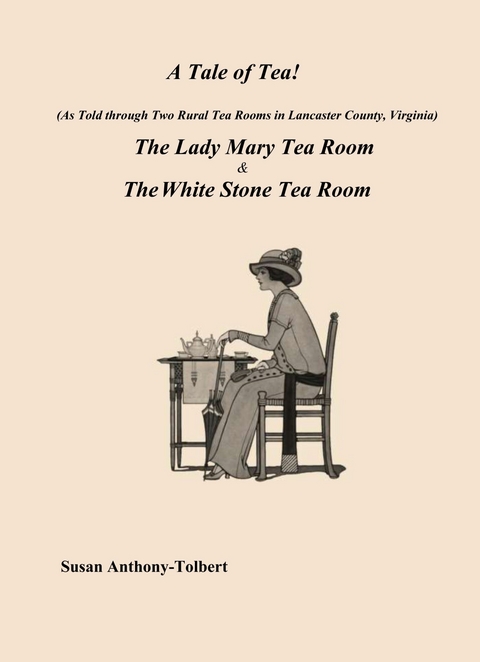
If you like tea and like having quiet chats with friends and family in a home-like setting over a cup of the brew or you would like to know more about the history of tea rooms throughout the U.S., "e;A Tale of Tea"e; as told through two rural tea rooms in Lancaster County, Virginia might be a good read for you. These two tea rooms were found in the Northern Neck of Virginia: a peninsula on the eastern side of the state. The area is certainly rural and at the time of the tea rooms was mainly accessible by water. That such a Southern area was able to support two tea rooms, though briefly, supports the popularity or 'craze' of tea rooms in the early to mid-20th century. The book begins with a discussion of the discovery of tea as a drink; its unique history, its growth and harvesting; and its increase in popularity over centuries. The various types of tea are presented along with some information on oxidation and how it can influence the tea in our cups. Tea consumption in the American colonies and interesting sidebars on the Boston Tea Party are mentioned. The reader may be surprised that we didn't always have tea bags! The book explains how and by whom these were developed and explores the often ignored contribution of two women in the early 1900s to that development. Though there were tea rooms in the United States as early as the late 1800s and extending into the 1940s, the 'heyday' for the tea room movements was in the 1920s. These early years of the 20th century were an interesting period in history: the Spanish Flu; World War I; the fight for women's rights; prohibition; and the proliferation of automobiles. However, the heyday of the tea room movement slowed with World War II. Establishing a tea room of their very own was a step for women to emerge as more independent in the early days of the 20th century. These were basically run by women for women! Many of the earliest tea rooms in the U.S. (turn-of-the-century through 1920s and 30s) could be found in homes or in converted freestanding abandoned buildings such as barns, storage sheds, mills and yes, even gas stations. The location and placement were only limited by the imagination of the women who would design, decorate, own and manage them. Three types were prevalent during this time: the home-based tea room set up in a dining room or living room in the house of the lady owner/manager; the stand-alone tea room like the Lady Mary Tea Room in the center of Kilmarnock; and the gas station/tea room like Gregg's Gas Station-Tea Room in White Stone (aka The White Stone Tea Room). The particular emphasis is on the Lady Mary Tea Room in Kilmarnock, Virginia which was in operation in 1924. However this was not the only tea room in Lancaster County, Virginia. There was also the White Stone Tea Room, in White Stone Virginia in the early 1930s. It should be noted that these were the only two tea rooms found on the Northern Neck of Virginia in this research on this time period. Both these eateries were part of the tea room movement in the United States and reflect the importance of this movement sometimes overlooked or under-explored, both in history in general and in the history of restaurants. Advice to women (whose dream was their very own tea room) proliferated in popular magazines and newspapers of the early 1900s through the 1930s. These articles included the types of food to be served and the development of menus; the clientele preferred (mostly women though exceptions are discussed) and information on sound business practices. The link of tea rooms to the improvements of automobiles and roads is explored. It should be noted that tea rooms and their services are not the same as the popular conceptions of High Tea and Low Tea as social events. Many of these early 20th century tea rooms had a political connection to rights for women and in the case of African American tea rooms to both rights for women and civil rights. These are discu
Introduction
It’s probably somewhat rare for an author or researcher to be able to pinpoint the exact time when they found their current topic of interest. This is not true for me regarding the Lady Mary Tea Room of Kilmarnock, Virginia. On January 8, 2025, at 8 A.M., I opened an email sent to the membership of the Lancaster Virginia Historical Society by the Director, Karen Hart. In her email, she wished a Happy New Year to all and mentioned some society business, but in addition she took us on a historical time-travel to ads and articles in the Rappahannock Record of January 8, 1925: a hundred years earlier. One ad was for the Lady Mary Tea Room. Being a long-term lover of tea and remembering all the wonderful times of chatting about ‘nothing in particular and everything in general’ with my Mom and my friends over a cup of tea, I was immediately intrigued … no hooked! And so research began. I quickly discovered that I had a lot to learn about tea rooms and especially about their heyday in the 1920s, when the Lady Mary Tea Room would have been in operation. I needed to understand their placement in history: a unique and important placement! These early tea rooms were for women while managed and owned by women. They were businesses. And as a special bonus researching the Lady Mary Tea Room also resulted in another interesting find: a gas-station-tea room in White Stone, Virginia: The White Stone Tea Room.
Tea rooms are historically important for many reasons. These were some of the first places where women could eat without men. In the tea rooms, it was socially acceptable for women to be patrons or customers without male escorts. Women could sit with other women and talk. Given their popularity (1910s-1920s-1930s), it is no surprise that conversational topics could include women’s rights or more correctly their lack of rights. Tea rooms were closely tied to the suffragist movement, especially in large cities. And though many of the tea rooms, especially the early ones, would have been the domain of white women owners and white women patrons, African American women did create their own tea rooms. Theses tea rooms have a story and became very important in the Civil Rights Movement. While many of the black owned tea rooms were similar to those run by their white counterparts, there were important differences. These will be discussed.
The time period actually covered in this story of tea rooms begins around 1890 (The Gay Nineties) to 1940 with the emphasis on the 1920s and 1930s. However, tea rooms in a variety of shapes and sizes were still popular up to and including the 1950s, when they were largely replaced by fast food restaurants. Admittedly one can find restaurants with Tea Room in their names even into the 21st century. However, these later eateries, after the 1930s, will be mentioned only as a backdrop to the story of the earlier tea rooms. And these early rural tea rooms were certainly part of a nationwide trend. They were in operation and were of importance during significant historical events in the years between the end of the 19th century (The Gay Nineties) and the middle of the 20th century: World War I; the Spanish Flu; Prohibition (both enacted and repealed); Women’s Right to Vote; the Great Depression and the setting of the international stage for World War II.
Much has been written about urban tea rooms, their beginnings and operations as well as about tea rooms located on popular, well-traveled highways across some rural areas throughout the U.S. However, since historians claim that the South, until after World War II, didn’t have as many eateries as the North and Midwest and because the Lady Mary Tea Room in Kilmarnock and the White Stone Tea Room in White Stone were located on a peninsula (the Northern Neck of Virginia) in a rural, southern agricultural area, I wondered how such a location would influence these tea rooms. At that time in the Northern Neck, many of the patrons would have had to arrive by water travel to enjoy a tea room!
For those unfamiliar with the geography of Virginia, there are three peninsulas on the mainland’s eastern side: the Northern Neck (where Lady Mary Tea Room and the White Stone Tea Room were located), the Middle Peninsula and the Lower Peninsula. Like the other two peninsulas, the Northern Neck has countless water ways and tributaries. It is separated from the Middle Peninsula by the Rappahannock River and from points north (Maryland) by the Potomac River. The Chesapeake Bay is also on its shoreline. The Neck has four counties: Westmoreland, Richmond, Northumberland and Lancaster. Some geographers also count King George County as part of the Northern Neck.
This “Tale of Tea” focuses on home-based business tea rooms, stand-alone tea rooms like the Lady Mary Tea Room and gas station-tea rooms like the White Stone Tea Room that could be found in this or any rural area. Many of the earliest tea rooms (turn-of-the-century through 1920s and 30s) could be found in homes or in freestanding buildings such as barns, storage sheds, mills, abandoned buildings, gas stations, store fronts, stables and harness shops. The location and placement of these home-based tea rooms were only limited by the imagination of the women who would design, own and manage them.
Stand-alone tea rooms like “Lady Mary Tea Room,” Kilmarnock, Virginia (1924-1926) could be found in the business sections of small towns that dotted the rural country side. They were usually in a single or separate building. The proprietress would rent or buy a building with a room or rooms in which to set up her business: her stand-alone ‘Tea Room.’ Later, tea rooms could be found as part of a gas station where the traveler could not only fill up his or (many times her car as more and more women were driving cars and traveling) and then take refreshment in a section of the building that was more refined, gentile and feminine. Gregg’s Gas-Station-Tea Room also known as The White Stone Tea Room in White Stone, Virginia is an example. The photo generously supplied by the Kilmarnock Museum and shown below will give the reader an idea of how the town of Kilmarnock looked around the time of the Lady Mary Tea Room.
In addition to the rural tearooms, there were also simple, small tea rooms found near colleges and in cities that were owned by one woman, by a pair of women or by family ownership. These were the small businesses: the ‘Mom and Pop’ business of that time period, although as will be seen, they were mostly ‘Mom’s!’ A variety of terms that refer to these early 20th century eateries are sometimes used interchangeably but can have nuanced differences. Terms like tea room, tea house, tea shop, and tea garden are explained. Though tea room/tearoom can be written as one word or two, in this writing I stuck with ‘tea room.’
It will come as no surprise to the reader that when the department stores, which began to proliferate during the early and mid- nineteenth century, saw that women diners had money to spend and that tea rooms were popular, they began to ‘house’ tea rooms in their stores. Some of these tea rooms were quite large and certainly not the cozy little places that had been frequented earlier by many women. They were, however, very elegant and feminine. These department store tea rooms, the hotel tea rooms and the sections of restaurants that were labeled as tea rooms became very well-known and quite lucrative. They were much more commercial than their rural home-base and stand-alone counterparts. The story of these tea rooms, as part of other retail businesses, chains or franchises, will only be discussed in terms of background or backdrop to the smaller, intimate rural tea rooms: the home-based, the stand-alones and the gas station-tea rooms!
Of course there were tea rooms in the large cities. In fact there were numerous tea rooms in New York, Philadelphia and in the Washington D.C. area) that were managed and owned by women. Tea rooms were also very popular throughout the New England states. These too will be mentioned briefly because women from the Northern Neck may have visited them in their travels or read about them in the magazines of the period. It should be noted that there were numerous articles on tea rooms, their designs, their menus, and their management in the popular magazines of the time. The big city tea rooms are however beyond the scope of this book with its focus on those in more rural areas especially those in Lancaster County, Virginia.
I felt it was important to frame these local tea rooms in Kilmarnock and White Stone as well as other Virginia tea rooms, relevant to the discussion, within the actual tale of tea. To begin this “A Tale of Tea,” a definition of exactly what tea is; how and where it grows; and its history, both worldwide and specifically for the United States, are briefly discussed. The development and use of the tea bag cannot be overlooked....
| Erscheint lt. Verlag | 7.10.2025 |
|---|---|
| Sprache | englisch |
| Themenwelt | Geisteswissenschaften ► Geschichte ► Regional- / Ländergeschichte |
| ISBN-13 | 9798317819620 / 9798317819620 |
| Informationen gemäß Produktsicherheitsverordnung (GPSR) | |
| Haben Sie eine Frage zum Produkt? |
 EPUB (Ohne DRM)
Größe: 2,3 MB
Digital Rights Management: ohne DRM
Dieses eBook enthält kein DRM oder Kopierschutz. Eine Weitergabe an Dritte ist jedoch rechtlich nicht zulässig, weil Sie beim Kauf nur die Rechte an der persönlichen Nutzung erwerben.
Dateiformat: EPUB (Electronic Publication)
EPUB ist ein offener Standard für eBooks und eignet sich besonders zur Darstellung von Belletristik und Sachbüchern. Der Fließtext wird dynamisch an die Display- und Schriftgröße angepasst. Auch für mobile Lesegeräte ist EPUB daher gut geeignet.
Systemvoraussetzungen:
PC/Mac: Mit einem PC oder Mac können Sie dieses eBook lesen. Sie benötigen dafür die kostenlose Software Adobe Digital Editions.
eReader: Dieses eBook kann mit (fast) allen eBook-Readern gelesen werden. Mit dem amazon-Kindle ist es aber nicht kompatibel.
Smartphone/Tablet: Egal ob Apple oder Android, dieses eBook können Sie lesen. Sie benötigen dafür eine kostenlose App.
Geräteliste und zusätzliche Hinweise
Buying eBooks from abroad
For tax law reasons we can sell eBooks just within Germany and Switzerland. Regrettably we cannot fulfill eBook-orders from other countries.
aus dem Bereich