


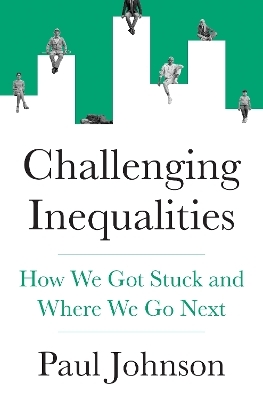
Challenging Inequalities
How We Got Stuck and Where We Go Next
Seiten
2026
Princeton University Press (Verlag)
978-0-691-28355-5 (ISBN)
Princeton University Press (Verlag)
978-0-691-28355-5 (ISBN)
- Noch nicht erschienen (ca. April 2026)
- Versandkostenfrei
- Auch auf Rechnung
- Artikel merken
A comprehensive look at inequalities and why they matter
There is a widespread sense throughout the developed world that progress toward a better society has stalled. Many countries, including the UK, have experienced persistent economic stagnation accompanied by declining trust in institutions. Governments are struggling to respond not only to traditional economic problems but also to newer challenges posed by climate change, migration and technological change. Challenging Inequalities connects these conditions to inequality—inequality not just of income and wealth but of health, political participation and opportunity. It not only offers a detailed analysis of the different forms of inequalities but also an in-depth consideration of why inequalities matter, how they have changed and what can, or should, be done about them.
The book explains the enduring effects of early life experiences and education and examines the trends in employment and earnings over recent decades. It argues that economic stagnation since the financial crises of 2008–2009 has exposed inequalities originating in the 1980s. Not only have incomes stagnated, but so has progress towards reducing health inequalities and dealing with inequalities across gender, ethnicity, geography, age and educational level. The combination of earnings inequality and economic stagnation has led to the growing importance of wealth, the increasing concentration of economic power in an older generation and a decline in social mobility. Economic inequalities have also resulted directly in dangerous differences between regions and in political power across groups.
The need to address inequality has never been more urgent. Challenging Inequalities offers a road map for how we have arrived at such a perilous spot—and how we can change course to achieve better outcomes for all.
There is a widespread sense throughout the developed world that progress toward a better society has stalled. Many countries, including the UK, have experienced persistent economic stagnation accompanied by declining trust in institutions. Governments are struggling to respond not only to traditional economic problems but also to newer challenges posed by climate change, migration and technological change. Challenging Inequalities connects these conditions to inequality—inequality not just of income and wealth but of health, political participation and opportunity. It not only offers a detailed analysis of the different forms of inequalities but also an in-depth consideration of why inequalities matter, how they have changed and what can, or should, be done about them.
The book explains the enduring effects of early life experiences and education and examines the trends in employment and earnings over recent decades. It argues that economic stagnation since the financial crises of 2008–2009 has exposed inequalities originating in the 1980s. Not only have incomes stagnated, but so has progress towards reducing health inequalities and dealing with inequalities across gender, ethnicity, geography, age and educational level. The combination of earnings inequality and economic stagnation has led to the growing importance of wealth, the increasing concentration of economic power in an older generation and a decline in social mobility. Economic inequalities have also resulted directly in dangerous differences between regions and in political power across groups.
The need to address inequality has never been more urgent. Challenging Inequalities offers a road map for how we have arrived at such a perilous spot—and how we can change course to achieve better outcomes for all.
Paul Johnson is provost of the Queen’s College, University of Oxford, and former director of the Institute for Fiscal Studies (IFS). He is the author of the Sunday Times bestseller Follow the Money.
| Erscheint lt. Verlag | 28.4.2026 |
|---|---|
| Zusatzinfo | 21 b/w illus. |
| Verlagsort | New Jersey |
| Sprache | englisch |
| Maße | 156 x 235 mm |
| Themenwelt | Geschichte ► Teilgebiete der Geschichte ► Wirtschaftsgeschichte |
| Sozialwissenschaften ► Politik / Verwaltung ► Staat / Verwaltung | |
| Sozialwissenschaften ► Soziologie ► Makrosoziologie | |
| Wirtschaft ► Betriebswirtschaft / Management ► Unternehmensführung / Management | |
| Wirtschaft ► Volkswirtschaftslehre ► Wirtschaftspolitik | |
| ISBN-10 | 0-691-28355-9 / 0691283559 |
| ISBN-13 | 978-0-691-28355-5 / 9780691283555 |
| Zustand | Neuware |
| Informationen gemäß Produktsicherheitsverordnung (GPSR) | |
| Haben Sie eine Frage zum Produkt? |
Mehr entdecken
aus dem Bereich



aus dem Bereich
wie Tech-Konzerne und Großmächte die Welt unter sich aufteilen
Buch | Hardcover (2025)
C.H.Beck (Verlag)
CHF 39,20
Aufstieg und Fall der Deutschland AG
Buch | Hardcover (2025)
Suhrkamp (Verlag)
CHF 41,95


