


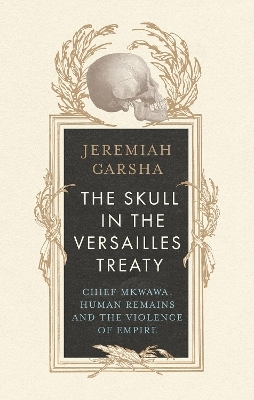
The Skull in the Versailles Treaty
Chief Mkwawa, Human Remains and the Violence of Empire
Seiten
2026
C Hurst & Co Publishers Ltd (Verlag)
978-1-80526-568-9 (ISBN)
C Hurst & Co Publishers Ltd (Verlag)
978-1-80526-568-9 (ISBN)
- Noch nicht erschienen (ca. August 2026)
- Versandkostenfrei
- Auch auf Rechnung
- Artikel merken
How the looted skull of Tanzanian Chief Mkwawa became a tool to justify colonial power and silence anticolonial resistance.
In 1891, Tanzanian Chief Mkwawa began an epic war of resistance against German colonialism. After defeating in battle the largest European force in Africa, he became the single greatest threat to Imperial Germany. When his rebellion eventually collapsed in 1898, his severed head was taken as a bounty. But his story was far from over.
In this fascinating book, Jeremiah Garsha traces Mkwawa’s life, death and afterlife through the strange history of his skull. Collected as a colonial administrator’s personal trophy, it became a German museum specimen, disappearing into the vast collections of body parts taken from across the empire. After Germany lost World War One, Mkwawa’s skull was claimed by the British, becoming the only named human remains in the 1919 Versailles Treaty. But it was never found.
During the decolonisation struggles of the 1950s, Britain resurrected Mkwawa’s story, bringing an anonymous skull from Germany to Tanzania to bolster its own fading empire. Today, that skull remains on display in a Tanzanian museum, a totem of anticolonial resistance. Weaving a broad tapestry of colonial violence and indigenous resistance, ‘scientific’ racism and stolen culture, Garsha’s history reveals how such ‘exhibits’ are intimately tied to legacies of empire.
In 1891, Tanzanian Chief Mkwawa began an epic war of resistance against German colonialism. After defeating in battle the largest European force in Africa, he became the single greatest threat to Imperial Germany. When his rebellion eventually collapsed in 1898, his severed head was taken as a bounty. But his story was far from over.
In this fascinating book, Jeremiah Garsha traces Mkwawa’s life, death and afterlife through the strange history of his skull. Collected as a colonial administrator’s personal trophy, it became a German museum specimen, disappearing into the vast collections of body parts taken from across the empire. After Germany lost World War One, Mkwawa’s skull was claimed by the British, becoming the only named human remains in the 1919 Versailles Treaty. But it was never found.
During the decolonisation struggles of the 1950s, Britain resurrected Mkwawa’s story, bringing an anonymous skull from Germany to Tanzania to bolster its own fading empire. Today, that skull remains on display in a Tanzanian museum, a totem of anticolonial resistance. Weaving a broad tapestry of colonial violence and indigenous resistance, ‘scientific’ racism and stolen culture, Garsha’s history reveals how such ‘exhibits’ are intimately tied to legacies of empire.
Jeremiah Garsha is Assistant Professor of Modern Global History at University College Dublin, where he researches and teaches the entangled global histories of colonial violence. He is a leading expert on the colonial collection, display and return of human remains. He holds a PhD from the University of Cambridge.
| Erscheint lt. Verlag | 20.8.2026 |
|---|---|
| Zusatzinfo | 16 Illustrations, black and white |
| Verlagsort | London |
| Sprache | englisch |
| Maße | 138 x 216 mm |
| Themenwelt | Geschichte ► Teilgebiete der Geschichte ► Wirtschaftsgeschichte |
| ISBN-10 | 1-80526-568-7 / 1805265687 |
| ISBN-13 | 978-1-80526-568-9 / 9781805265689 |
| Zustand | Neuware |
| Informationen gemäß Produktsicherheitsverordnung (GPSR) | |
| Haben Sie eine Frage zum Produkt? |
Mehr entdecken
aus dem Bereich



aus dem Bereich
wie Tech-Konzerne und Großmächte die Welt unter sich aufteilen
Buch | Hardcover (2025)
C.H.Beck (Verlag)
CHF 39,20
Aufstieg und Fall der Deutschland AG
Buch | Hardcover (2025)
Suhrkamp (Verlag)
CHF 41,95


