


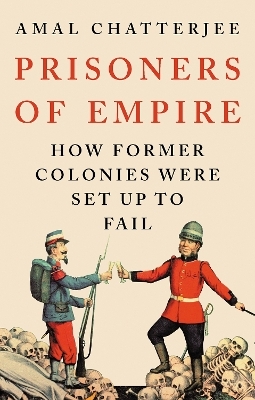
Prisoners of Empire
How Former Colonies Were Set Up to Fail
Seiten
2026
C Hurst & Co Publishers Ltd (Verlag)
978-1-80526-573-3 (ISBN)
C Hurst & Co Publishers Ltd (Verlag)
978-1-80526-573-3 (ISBN)
- Noch nicht erschienen (ca. September 2026)
- Portofrei ab CHF 40
- Auch auf Rechnung
- Artikel merken
A compelling social and political balance-sheet of empire, revealing how former colonies worldwide are still shackled by the legacies of colonial oppression.
Why do some former colonies fail, staggering from crisis to crisis, while others recover? Why did so many succumb to dictatorship, corruption, civil war and instability after independence?
Amal Chatterjee argues that these 'failures' are underpinned by persistent, robust colonial structures which preserve and reproduce the oppressive, exploitative systems of the past. From land ownership to mining, transport networks to education provision, morality to law, many post-colonial institutions function almost exactly as they did under foreign rule, with power still concentrated in the hands of elites, and inequalities baked in. Drawing on a wide range of contemporary and historical material, including memoirs, economic data and administrative documents, Chatterjee explains how empire not only made its colonies into places of extraction and exploitation, but keeps them there today. Offering a truly global account--from the British Empire to the Belgian, from Mexico to Mozambique, from the Sahel to Sri Lanka--he shows how extractive capitalism and colonialism are intertwined, and how human rights and development are hostage to the imperatives of profit-making.
The world built by empire can still be challenged and changed--but to design a new, equitable future for all, we must first understand the legacies of the past.
Why do some former colonies fail, staggering from crisis to crisis, while others recover? Why did so many succumb to dictatorship, corruption, civil war and instability after independence?
Amal Chatterjee argues that these 'failures' are underpinned by persistent, robust colonial structures which preserve and reproduce the oppressive, exploitative systems of the past. From land ownership to mining, transport networks to education provision, morality to law, many post-colonial institutions function almost exactly as they did under foreign rule, with power still concentrated in the hands of elites, and inequalities baked in. Drawing on a wide range of contemporary and historical material, including memoirs, economic data and administrative documents, Chatterjee explains how empire not only made its colonies into places of extraction and exploitation, but keeps them there today. Offering a truly global account--from the British Empire to the Belgian, from Mexico to Mozambique, from the Sahel to Sri Lanka--he shows how extractive capitalism and colonialism are intertwined, and how human rights and development are hostage to the imperatives of profit-making.
The world built by empire can still be challenged and changed--but to design a new, equitable future for all, we must first understand the legacies of the past.
Amal Chatterjee is a fellow of the Royal Historical Society and teaches Creative Writing at the University of Oxford. His work includes plays; a Crossword Book Award-nominated novel; and a historical study, Representations of India. His writing has also appeared in Prospect, the Huffington Post, The Independent and others.
| Erscheint lt. Verlag | 17.9.2026 |
|---|---|
| Verlagsort | London |
| Sprache | englisch |
| Maße | 138 x 216 mm |
| Themenwelt | Geschichte ► Teilgebiete der Geschichte ► Wirtschaftsgeschichte |
| ISBN-10 | 1-80526-573-3 / 1805265733 |
| ISBN-13 | 978-1-80526-573-3 / 9781805265733 |
| Zustand | Neuware |
| Informationen gemäß Produktsicherheitsverordnung (GPSR) | |
| Haben Sie eine Frage zum Produkt? |
Mehr entdecken
aus dem Bereich

aus dem Bereich
wie Tech-Konzerne und Großmächte die Welt unter sich aufteilen
Buch | Hardcover (2025)
C.H.Beck (Verlag)
CHF 39,20


