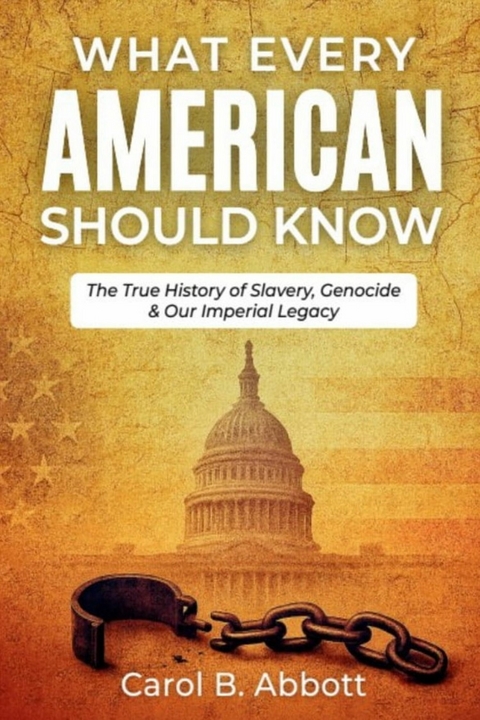
What Every American Should Know (eBook)
382 Seiten
Seahorse Pub (Verlag)
978-0-00-105743-2 (ISBN)
The Shocking Truth about America's Rise to Power They Don't Want You to Know
Everything you learned about American history was a lie.
From the first European settlements to the modern military-industrial complex, 'The Myth of American Exceptionalism' exposes the brutal reality behind America's rise to global dominance. This isn't the sanitized version taught in schools-this is the documented history of systematic genocide, slavery, corporate warfare, and imperial conquest that built the world's most powerful empire.
Discover the Hidden History:
How Columbus's diary reveals premeditated genocide from day one
The economic calculations behind Cherokee removal and Indigenous elimination
Why the Civil War was really about corporate interests, not moral principles
How Wall Street was literally built on slave trading and human trafficking
The true story of Reconstruction's betrayal and the rise of convict leasing
How the military-industrial complex engineered permanent warfare for profit
The CIA operations that overthrew democracies to protect corporate investments
Drawing from declassified documents, corporate archives, and suppressed testimonies, historian Carol B. Abbott presents overwhelming evidence that American 'exceptionalism' is history's greatest propaganda campaign. Each chapter demolishes cherished myths with documented facts that connect past atrocities to present-day inequalities.
This isn't anti-American-it's pro-truth. Understanding how systematic oppression actually works is essential for creating genuine democracy and justice.
'A masterwork of historical excavation that reveals the economic interests and corporate power behind America's most celebrated moments.' - Critical readers who demand truth over comfortable lies
Warning: This book will permanently change how you see American history, current events, and the true nature of power. Once you see the patterns, you can't unsee them.
The myth ends here. The reckoning begins now.
Introduction
The Myth of American Exceptionalism
October 12, 1492, Guanahaní Island
The morning sun rises over crystalline waters as dozens of canoes emerge from the mangrove-lined shores of Guanahaní Island. The Taíno people paddle toward three strange vessels that appeared on their horizon like floating islands, their white sails billowing against an endless blue sky. Chief Anacaona's people approach with the hospitality that has defined their culture for centuries—bearing gifts of cotton thread, parrots with brilliant plumage, and small golden ornaments that catch the Caribbean light.
On the deck of the Santa María, Christopher Columbus watches these "Indians"—as he has already decided to call them—with calculating eyes. His weathered hands grip a leather-bound journal where he will soon record thoughts that would horrify modern readers but reveal the unvarnished truth of this "first contact." The Taíno call out greetings in Arawakan, their voices carrying across the water with genuine curiosity and welcome. They have no way of knowing they are witnessing the beginning of the largest genocide in human history.
Columbus observes their naked bodies, unmarked by weapons or scars, and immediately recognizes opportunity. "They ought to make good and intelligent servants," he writes in his diary that very day, "for they repeat very quickly whatever we say to them." The Taíno offer gifts freely, expecting nothing in return—a practice that speaks to sophisticated social structures built around reciprocity and community wealth. Columbus sees only weakness to exploit.
The Admiral of the Ocean Sea notices the small gold ornaments adorning some of the islanders and presses them for information about its source. Through gestures and broken communication, they point south and east, speaking of places with names like Cubanacan and Cibao. Columbus's pulse quickens. Gold means wealth, and wealth means power in the European world he represents. But first, he must secure a labor force to extract it.
"I could conquer the whole of them with fifty men, and govern them as I pleased," Columbus confides to his journal. The Taíno continue bringing fresh water, food, and shelter materials to the foreign visitors, unaware that their generosity is being interpreted as submission. Their chief, likely Anacaona's predecessor, offers the traditional welcome ceremony—a ritual of peace and mutual recognition between sovereign peoples. Columbus accepts these gestures while simultaneously planning their enslavement.
The contrast could not be starker. On one side, Indigenous people operating from worldviews centered on collective responsibility, ecological balance, and spiritual connection to land that has sustained them for millennia. On the other, Europeans driven by individual accumulation, resource extraction, and territorial conquest—values that will soon reshape the entire Western Hemisphere through systematic violence.
As the day progresses, Columbus's men trade cheap European trinkets—glass beads worth mere pennies in Seville markets—for gold, cotton, and tropical delicacies worth many times more. The Taíno participate eagerly, seeing this as gift exchange between potential allies. Columbus sees confirmed proof of their naivety, writing that they "gave away everything they had" for items "worth nothing." This fundamental misunderstanding of economic systems—Indigenous reciprocity versus European accumulation—would fuel centuries of exploitation.
The sun sets on October 12, 1492, painting the Caribbean sky in brilliant oranges and purples. Taíno families gather on shore, sharing stories of the strange visitors and their floating houses. Children play in tidal pools while elders discuss what these newcomers might want and how their communities should respond. Their conversations flow in languages that connect them to ancestors, lands, and spiritual traditions stretching back countless generations.
Aboard the Santa María, Columbus completes his journal entry for the day: "They should be good servants and of good intelligence, since I see that they very quickly repeat whatever is said to them, and I believe that they would easily be made Christians, for they appear to have no religion." This single sentence encapsulates the violence to come—forced labor, cultural destruction, and religious conversion imposed through systematic brutality.
But Columbus's diary reveals something even more disturbing: the premeditation of genocide. This is not accidental cultural clash or inevitable historical progression. This is calculated exploitation planned from the moment of contact. "With fifty men we could subjugate them all and make them do whatever we want," he continues, already envisioning the encomienda system that would reduce entire populations to bondage.
The Taíno sleep peacefully that night, unaware that European diseases are already beginning to circulate through their communities. They cannot imagine that within thirty years, their population will decline from approximately one million to fewer than sixty thousand. They have no framework for understanding the approaching hurricane of violence, enslavement, and ecological destruction that will transform their paradise into a colonial extraction zone.
This scene, reconstructed from Columbus's own words and Spanish chroniclers' accounts, exposes the foundational lie of American exceptionalism. There was no "discovery" on October 12, 1492—only invasion. There was no "civilization" brought to "savage" lands—only the imposition of brutally exploitative systems. There was no providential destiny—only calculated genocide executed for economic gain.
Yet American schoolchildren still learn about "Columbus Day" as a celebration of exploration and discovery. They recite poems about "sailing the ocean blue" without learning about the immediate plans for enslavement documented in the explorer's private writings. This sanitized mythology serves a specific purpose: concealing the violent foundations of American wealth and power behind romantic narratives of manifest destiny and civilizing missions.
Deconstructing Five Centuries of Systematic Oppression
The scene at Guanahaní Island represents far more than historical tragedy—it reveals the operational blueprint for American empire. Columbus's diary entries from October 1492 contain all four pillars of systematic oppression that would define the next 533 years of American development: the immediate planning for Indigenous genocide, the instantaneous commodification of human beings, the rapacious pursuit of resource extraction, and the deployment of overwhelming violence to achieve economic objectives.
American exceptionalism—the belief that the United States represents a unique force for freedom, democracy, and human progress—constitutes the most successful propaganda campaign in modern history. This mythology obscures a documented pattern of systematic oppression that connects Columbus's invasion plans to contemporary American foreign policy, from the encomienda system to modern debt imperialism, from Cherokee removal to Palestinian displacement, from plantation slavery to mass incarceration.
The four interconnected pillars that structure this analysis emerged directly from primary source evidence spanning five centuries of American expansion. These are not theoretical frameworks imposed on historical data, but documented patterns of behavior that repeat across different contexts, time periods, and geographic locations with remarkable consistency.
Pillar One: Indigenous Genocide encompasses the systematic destruction of Native American societies through military conquest, biological warfare, forced cultural assimilation, and territorial theft. This process began with Columbus's immediate plans for enslavement and continues today through ongoing disputes over sacred lands, water rights, and tribal sovereignty. The pattern is consistent: identify Indigenous resources, manufacture legal justifications for appropriation, deploy overwhelming violence against resistance, and erase Indigenous presence from historical memory.
Conservative estimates suggest that 90% of the Indigenous population of the Americas died between 1492 and 1700, representing the largest demographic catastrophe in recorded human history. Yet this genocide remains largely absent from mainstream American historical narratives, replaced by myths of "empty wilderness" and "manifest destiny" that position European colonization as natural and inevitable rather than systematically violent.
The economic dimensions of Indigenous genocide cannot be separated from its cultural and spiritual impacts. European colonizers did not simply want Indigenous land—they required the complete elimination of Indigenous worldviews that understood land as sacred rather than commodity, that organized society around collective responsibility rather than individual accumulation, and that measured wealth through community well-being rather than resource extraction.
Pillar Two: Racialized Slavery provided the economic foundation for American development through the systematic commodification of African human beings. This system extended far beyond Southern plantations to encompass Northern manufacturing, Western expansion, and international trade networks that connected American cotton to British textiles to global markets. Slavery was not a regional aberration or historical accident—it was the engine of American capitalism.
The racialization of slavery—the deliberate construction of "whiteness" and "blackness" as legal categories determining human worth—served specific economic functions. By legally defining enslaved Africans as property rather than people,...
| Erscheint lt. Verlag | 18.9.2025 |
|---|---|
| Sprache | englisch |
| Themenwelt | Geisteswissenschaften ► Geschichte ► Regional- / Ländergeschichte |
| ISBN-10 | 0-00-105743-X / 000105743X |
| ISBN-13 | 978-0-00-105743-2 / 9780001057432 |
| Informationen gemäß Produktsicherheitsverordnung (GPSR) | |
| Haben Sie eine Frage zum Produkt? |
 EPUB (Adobe DRM)
Größe: 1,4 MB
Kopierschutz: Adobe-DRM
Adobe-DRM ist ein Kopierschutz, der das eBook vor Mißbrauch schützen soll. Dabei wird das eBook bereits beim Download auf Ihre persönliche Adobe-ID autorisiert. Lesen können Sie das eBook dann nur auf den Geräten, welche ebenfalls auf Ihre Adobe-ID registriert sind.
Details zum Adobe-DRM
Dateiformat: EPUB (Electronic Publication)
EPUB ist ein offener Standard für eBooks und eignet sich besonders zur Darstellung von Belletristik und Sachbüchern. Der Fließtext wird dynamisch an die Display- und Schriftgröße angepasst. Auch für mobile Lesegeräte ist EPUB daher gut geeignet.
Systemvoraussetzungen:
PC/Mac: Mit einem PC oder Mac können Sie dieses eBook lesen. Sie benötigen eine
eReader: Dieses eBook kann mit (fast) allen eBook-Readern gelesen werden. Mit dem amazon-Kindle ist es aber nicht kompatibel.
Smartphone/Tablet: Egal ob Apple oder Android, dieses eBook können Sie lesen. Sie benötigen eine
Geräteliste und zusätzliche Hinweise
Buying eBooks from abroad
For tax law reasons we can sell eBooks just within Germany and Switzerland. Regrettably we cannot fulfill eBook-orders from other countries.
aus dem Bereich