Roman Mythology for Beginners (eBook)
318 Seiten
Seahorse Pub (Verlag)
978-0-00-104314-5 (ISBN)
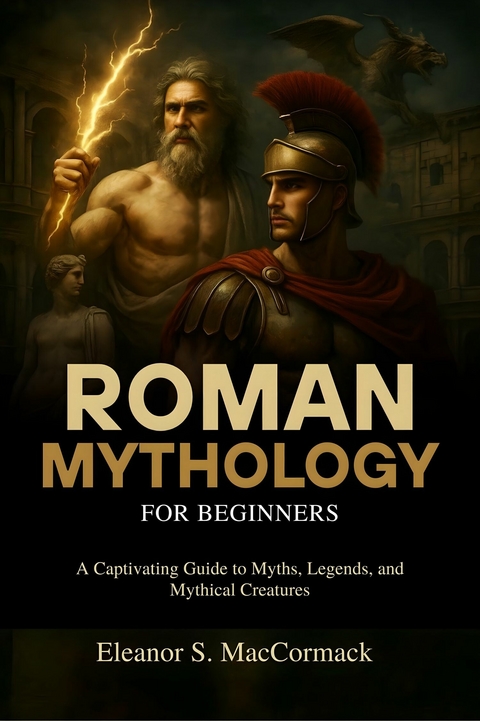
Unlock the fascinating world of ancient Rome's legendary stories and divine beings with this comprehensive introduction to Roman mythology. Perfect for newcomers and curious readers, this captivating guide explores the rich tapestry of myths that shaped Roman civilization for over a thousand years.
Discover the powerful gods and goddesses who ruled Mount Olympus, from mighty Jupiter, king of the heavens, to wise Minerva, goddess of wisdom and warfare. Learn about Venus, the enchanting goddess of love, and Mars, the fierce god of war who gave his name to the month of March.
Journey through epic tales of heroism and adventure as you explore legendary figures like Romulus and Remus, the twin brothers who founded Rome itself. Encounter mythical creatures that populate Roman folklore, from the wise phoenix to the fearsome Minotaur, each story revealing deeper truths about Roman values and beliefs.
This accessible guide breaks down complex mythological concepts into engaging, easy-to-understand chapters. Explore famous legends including the Aeneid, the story of Cupid and Psyche, and the tragic tale of Orpheus and Eurydice. Each chapter features clear explanations of mythological context, character relationships, and cultural significance.
Perfect for students, history enthusiasts, or anyone curious about ancient cultures, this beginner-friendly resource includes family trees of the gods, pronunciation guides, and connections between Roman and Greek mythology. Understand how these ancient stories continue to influence modern literature, art, and culture today.
Whether you're preparing for a course, researching for creative projects, or simply love a good story, this engaging introduction makes Roman mythology accessible and entertaining.
Start your journey into the ancient world today and discover why these timeless tales continue to captivate readers across generations.
Chapter 2
Origins: Roman Creation Myths
The sacred grove outside Caere fell silent as the last embers of the sacrificial fire cast dancing shadows across the weathered face of Vel Tarchies, eldest among the Etruscan haruspices. The acrid smoke of burned offerings—sheep's liver, sacred grains, and precious frankincense—hung heavy in the cool evening air, while six young Roman acolytes sat cross-legged on the mossy ground, their eyes wide with anticipation. These sons of patrician families had traveled north from Rome to learn the ancient mysteries that their ancestors had never possessed, knowledge that predated their city's foundation by centuries.
Tarchies adjusted his purple-bordered toga and touched the bronze liver model that hung from his belt—a miniature representation of the cosmic order inscribed with divine names and celestial regions. His voice, when he finally spoke, carried the weight of seventy years spent interpreting divine communications and studying the fundamental structures of existence. The night air carried the scent of wild thyme and sacred laurel, while somewhere in the darkness an owl called—a favorable omen from Minerva that sanctioned the sharing of sacred knowledge.
"Before your Rome rose from the seven hills, before even the Greeks sang of their Titans and Olympians, the Etruscan people understood the sacred geometry of creation," he began, his words barely above a whisper yet carrying clearly in the stillness. "What I share with you now has been passed down through twenty generations of my family, preserved in our sacred books and confirmed through countless observations of cosmic signs."
The old haruspex reached into a worn leather satchel and withdrew a bronze mirror polished to mirror brightness, its surface etched with intricate patterns of spirals, divine figures, and celestial symbols. As he held it toward the firelight, the reflected flames seemed to dance within the metal's depths, creating an illusion of infinite space contained within a palm-sized disc. The bronze felt warm against his palms, as if the cosmic forces depicted on its surface retained some vestige of their original divine heat.
"The Romans seek practical wisdom, and wisdom you shall have," Tarchies continued, his aged fingers tracing the spiral patterns that seemed to pulse with inner light. "But know that the origins of all things—the earth beneath your feet, the sky above your heads, the divine forces that govern your daily lives—these origins are not simple tales for children but profound mysteries that shape the very fabric of reality. Each morning when you perform your household rituals, each time you observe omens before important decisions, you participate in cosmic patterns established at the very beginning of existence."
The youngest acolyte, barely sixteen and son of a prominent Roman consul, leaned forward eagerly. His breath formed small clouds in the cooling air as he spoke. "Master Tarchies, our Roman priests speak of many gods, but they tell us little of how the world began. Did the gods create everything, or did they themselves emerge from something greater? Our teachers mention Greek stories of Chaos and Titans, but they say these are foreign tales unsuited to Roman understanding."
The haruspex smiled, his eyes crinkling with ancient amusement that spoke of countless similar questions from generations of eager students. "Ah, young Gaius, you ask the question that has occupied the wisest minds since time immemorial. The answer, like all profound truths, is both simpler and more complex than you might expect." He set the bronze mirror carefully on the ground between them, its surface still reflecting the dying firelight like a window into another realm.
"Let me tell you of the cosmic egg that contained all possibilities, the primordial waters that preceded all land, and the emergence of divine order from the void that existed before existence itself. But first, you must understand that creation is not a distant event completed long ago—it is an ongoing process that continues each dawn, each spring, each moment when divine forces shape the world according to cosmic law."
Roman Cosmogony
Roman creation mythology presents a fascinating puzzle to modern scholars because it deliberately avoided the systematic, narrative-driven approach that characterized Greek cosmogonic traditions. Unlike the Greeks, who developed comprehensive stories about Chaos, Gaia, and the successive generations of divine beings, Romans maintained a more fragmented, practical approach to cosmic origins that reflected their fundamental religious orientation toward function rather than speculation. This apparent lack of systematic cosmogonic narrative initially confused early Christian writers and Renaissance scholars who expected ancient religions to provide clear, authoritative explanations for the origins of existence.
However, this seeming deficiency actually reveals sophisticated Roman thinking about the nature of divine power and the appropriate relationship between human understanding and cosmic mysteries. Romans considered detailed speculation about primordial events less important than maintaining proper relationships with the divine forces that currently governed their world. They approached cosmic origins with the same practical mindset that characterized their approach to law, politics, and engineering—focusing on what worked rather than what satisfied intellectual curiosity or provided dramatic entertainment.
Roman cosmogonic concepts emphasized emergence rather than creation ex nihilo, suggesting that the world developed through gradual manifestation of divine forces rather than sudden creation by a supreme deity. This emergent view reflected Roman observations of natural processes—seeds growing into plants, seasons cycling through predictable patterns, rivers flowing from sources to seas—that demonstrated how complex systems developed from simpler beginnings through natural processes guided by divine intelligence. Romans saw cosmic creation as following the same patterns they observed in agriculture, where patient cultivation and proper timing produced abundant harvests from seemingly barren soil.
The concept of numen, fundamental to Roman religious thinking, provided the theoretical foundation for their cosmogonic beliefs. Romans understood numen as divine power or presence that could inhabit natural features, abstract concepts, or specific locations without requiring anthropomorphic personalities or detailed mythological narratives. This understanding suggested that cosmic creation involved the gradual concentration and organization of primordial numen into the various divine forces that governed different aspects of existence. Unlike Greek concepts of divine personality emerging through cosmic conflict, Roman numen represented stable divine power that manifested through orderly processes.
Natural forces served as primordial entities in Roman cosmogonic thinking, with elements like earth, water, fire, and air representing fundamental divine powers that preceded and enabled the formation of more complex divine personalities. Terra (Earth) existed as a primordial divine force before developing into the more personalized goddess Tellus, while Aqua (Water) manifested divine power before becoming associated with specific deities like Neptune or the various river gods. This progression from elemental forces to personalized deities reflected Roman understanding of how divine power manifested through increasingly complex and specialized forms.
The mythology surrounding Saturn's golden age provided Romans with their most developed cosmogonic narrative, describing a primordial period when divine rule established perfect harmony between cosmic order and human society. According to this tradition, Saturn's reign represented the original cosmic order before Jupiter's more complex divine hierarchy introduced the tensions and conflicts that characterized contemporary existence. This golden age mythology served practical purposes by providing a model for ideal human society while explaining the origins of current social and political structures.
Roman understanding of cosmic cycles reflected their agricultural background and practical orientation toward natural processes. Unlike linear creation narratives that described single acts of divine creation, Roman cosmogonic thinking emphasized recurring patterns of emergence, development, maturation, and renewal that mirrored the seasonal cycles governing agricultural life. This cyclical understanding suggested that cosmic creation was an ongoing process rather than a completed historical event, with divine forces continuously creating and recreating the world through natural processes.
The Roman focus on calendrical and agricultural applications of cosmogonic concepts demonstrated their practical approach to cosmic origins. Roman religious calendar organized the year around festivals and observances that commemorated different aspects of cosmic creation and renewal, with spring festivals celebrating the annual recreation of natural fertility and autumn ceremonies acknowledging the completion of cosmic cycles. This integration of cosmogonic concepts with practical religious observance made abstract ideas about cosmic origins relevant to daily life and seasonal activities.
Archaeological evidence from early Roman sites reveals cosmogonic symbols and ritual practices that suggest sophisticated understanding of cosmic order and divine organization. Circular temple foundations, astronomical alignments, and ritual deposits containing cosmic symbols demonstrate that early Romans possessed systematic knowledge about celestial movements and cosmic structures that informed their...
| Erscheint lt. Verlag | 1.9.2025 |
|---|---|
| Sprache | englisch |
| Themenwelt | Geisteswissenschaften ► Geschichte ► Regional- / Ländergeschichte |
| ISBN-10 | 0-00-104314-5 / 0001043145 |
| ISBN-13 | 978-0-00-104314-5 / 9780001043145 |
| Informationen gemäß Produktsicherheitsverordnung (GPSR) | |
| Haben Sie eine Frage zum Produkt? |
 EPUB (Adobe DRM)
Größe: 2,1 MB
Kopierschutz: Adobe-DRM
Adobe-DRM ist ein Kopierschutz, der das eBook vor Mißbrauch schützen soll. Dabei wird das eBook bereits beim Download auf Ihre persönliche Adobe-ID autorisiert. Lesen können Sie das eBook dann nur auf den Geräten, welche ebenfalls auf Ihre Adobe-ID registriert sind.
Details zum Adobe-DRM
Dateiformat: EPUB (Electronic Publication)
EPUB ist ein offener Standard für eBooks und eignet sich besonders zur Darstellung von Belletristik und Sachbüchern. Der Fließtext wird dynamisch an die Display- und Schriftgröße angepasst. Auch für mobile Lesegeräte ist EPUB daher gut geeignet.
Systemvoraussetzungen:
PC/Mac: Mit einem PC oder Mac können Sie dieses eBook lesen. Sie benötigen eine
eReader: Dieses eBook kann mit (fast) allen eBook-Readern gelesen werden. Mit dem amazon-Kindle ist es aber nicht kompatibel.
Smartphone/Tablet: Egal ob Apple oder Android, dieses eBook können Sie lesen. Sie benötigen eine
Geräteliste und zusätzliche Hinweise
Buying eBooks from abroad
For tax law reasons we can sell eBooks just within Germany and Switzerland. Regrettably we cannot fulfill eBook-orders from other countries.
aus dem Bereich