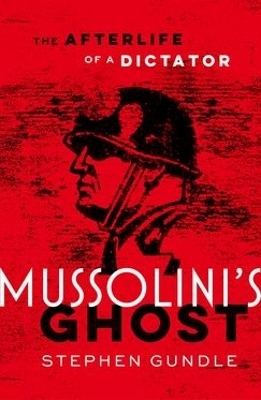
Mussolini's Ghost The Afterlife of a Dictator
Oxford University Press (Verlag)
9780198805908 (ISBN)
- Noch nicht erschienen (ca. November 2026)
- Versandkostenfrei
- Auch auf Rechnung
- Artikel merken
Mussolini died over 80 years ago, but his ghost haunts the streets, culture, and politics of Italy.The Italian Fascist dictator Mussolini was killed in 1945, his body was exhibited upside down in Milan before an angry crowd. The repudiation by the people of the dictator who had led them to disaster was complete. But his story did not end there. The Duce continued to live on thanks to a legacy that was multi-faceted and complex.
He was kept in view due to the activism of his widow and the work of the mass media. He symbolised persistent if often unmentionable ideas about masculinity, national identity, and political leadership. He was
embedded in the physical environment. He haunted the postwar republic in death just as he dominated the political landscape in life.In Mussolini's Ghost Stephen Gundle explores the many aspects of Mussolini's strange afterlife, be it through the fate of his statues and the places that Mussolini was most associated with, his depiction in film and television, his impact on political life, his treatment in public history and his place in popular culture. Gundle
argues that the root causes of Il Duce's disturbing persistence lie in the way Italians negotiated the transition from war to peace and from Fascism to democracy. Instead of acknowledging the enthusiastic backing
many had given to a criminal dictatorship, many Italians behaved as though Fascism had never really existed. The dictator was instead re-cast as a flawed but well-meaning family man. Thanks to this and other strange reconfigurations, the grip Mussolini established over the popular mind was never properly dismantled. Gundle uses psychoanalysis and collective psychology to explore a bold new interpretation of the causes of Mussolini's posthumous persistence, and compares his and Italy's fate to
that of Germany.
Stephen Gundle is Professor of Film and Television Studies at the University of Warwick. He is the author of several works of political and cultural history, including Between Hollywood and Moscow: The Italian Communists and the Challenge of Mass Culture, 1943-91 (2000), Bellissima: Feminine Beauty and the Idea of Italy (2007), Glamour: A History (2009), and co-author of Mass Culture and Italian Society from Fascism to the Cold War (2007).
Introduction
PART I: DECLINE AND FALL
1: The people and the dictator
2: Mussolini's dismissal
3: Divided nation
4: Death and damnation
PART II: 'OUR' MUSSOLINI
5: Getting over dictatorship
6: Family and nation
7: Anxieties of masculinity
8: Imaginary trials
PART III: MATERIAL LEGACIES
9: The fate of Duce statues
10: Mussolini's places
11: Fascist art and kitsch
12: Political ghost signs
PART IV: HISTORY AND MEMORY
13: Biography as monument
14: Performing the Duce
15: Pop culture and cultural memory
16: The shadow of M
Conclusion
| Erscheinungsdatum | 30.08.2025 |
|---|---|
| Verlagsort | Oxford |
| Sprache | englisch |
| Gewicht | 1 g |
| Themenwelt | Geschichte ► Allgemeine Geschichte ► Zeitgeschichte |
| Geisteswissenschaften ► Geschichte ► Regional- / Ländergeschichte | |
| ISBN-13 | 9780198805908 / 9780198805908 |
| Zustand | Neuware |
| Informationen gemäß Produktsicherheitsverordnung (GPSR) | |
| Haben Sie eine Frage zum Produkt? |
aus dem Bereich