


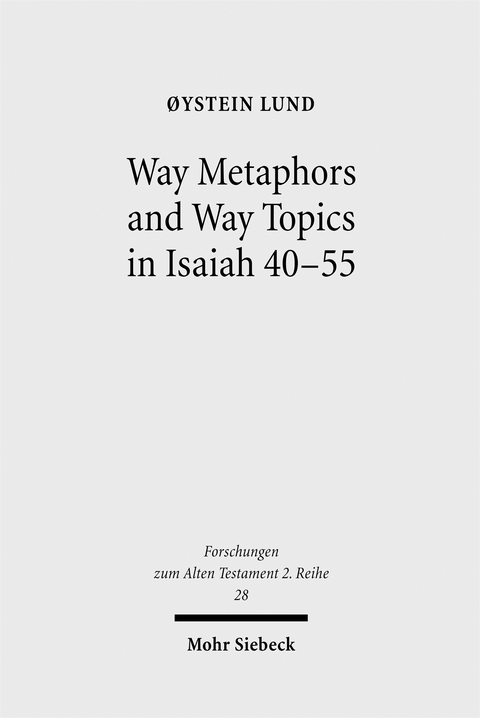
Way Metaphors and Way Topics in Isaiah 40-55
2008
Mohr Siebeck (Hersteller)
9783161511264 (ISBN)
Mohr Siebeck (Hersteller)
9783161511264 (ISBN)
Øystein Lund stellt einen neuen Ansatz zur Interpretation der Textstellen in Jesaja 40-55 vor, die sich mit den Themen Weg und Transformation der Wüste befassen. Er zeigt, daß die meisten dieser Textstellen zusammenhängen und metaphorisch gelesen die Weg-Situation des Volkes Israel erläutern.
Øystein Lund stellt einen neuen Ansatz zur Interpretation der Textstellen in Jesaja 40-55 vor, die sich mit den Themen Weg und Transformation der Wüste befassen. Bisher wurden diese Textstellen meist wörtlich ausgelegt. Seit einiger Zeit wird aber zunehmend eine metaphorische Lesart der 'Exodus'-Passagen vorgenommen. Dieser These schließt sich der Autor an und führt sie weiter, indem er die entsprechenden Stellen systematisiert und die metaphorische Lesart somit vertieft. Er zeigt, daß die meisten Textstellen, die sich in Jesaja 40-55 mit dem Thema 'Weg' befassen, zusammenhängen und so gelesen die Weg-Situation des Volkes Israel erläutern. Øystein Lund gives a new approach to texts in Isaiah 40-55 that deal with ways and desert transformation. Earlier exegesis has mainly read these texts in a literal way. In recent years, exegetes have pointed out that the so-called 'exodus texts' should rather be interpreted metaphorically. The author supports this, and accordingly seeks to continue this discourse by systematizing, intensifying, and deepening the argumentation for a metaphorical reading. He argues that most of the way-texts in Isaiah 40-55 are interrelated, and gradually contribute to explore questions regarding the way-situation of the people. The way-theme appears in the prologue, and in 40:27 a problem approach is established when the people is addressed: "How can you say, O Jacob, and speak, O Israel, 'My way is hidden from the LORD, and my right passes by my God'"? Several subsequent way-texts are related to this text, and together these draw a coherent picture in which the problematic way-situation of the people in the past and present is transformed. JHWH establishes new ways in which he leads his people through their difficult landscape. Øystein Lund argues that such a coherent reading of the way-texts gives good meaning, which is consistent with the over all message of Isaiah 40-55.
Øystein Lund stellt einen neuen Ansatz zur Interpretation der Textstellen in Jesaja 40-55 vor, die sich mit den Themen Weg und Transformation der Wüste befassen. Bisher wurden diese Textstellen meist wörtlich ausgelegt. Seit einiger Zeit wird aber zunehmend eine metaphorische Lesart der 'Exodus'-Passagen vorgenommen. Dieser These schließt sich der Autor an und führt sie weiter, indem er die entsprechenden Stellen systematisiert und die metaphorische Lesart somit vertieft. Er zeigt, daß die meisten Textstellen, die sich in Jesaja 40-55 mit dem Thema 'Weg' befassen, zusammenhängen und so gelesen die Weg-Situation des Volkes Israel erläutern. Øystein Lund gives a new approach to texts in Isaiah 40-55 that deal with ways and desert transformation. Earlier exegesis has mainly read these texts in a literal way. In recent years, exegetes have pointed out that the so-called 'exodus texts' should rather be interpreted metaphorically. The author supports this, and accordingly seeks to continue this discourse by systematizing, intensifying, and deepening the argumentation for a metaphorical reading. He argues that most of the way-texts in Isaiah 40-55 are interrelated, and gradually contribute to explore questions regarding the way-situation of the people. The way-theme appears in the prologue, and in 40:27 a problem approach is established when the people is addressed: "How can you say, O Jacob, and speak, O Israel, 'My way is hidden from the LORD, and my right passes by my God'"? Several subsequent way-texts are related to this text, and together these draw a coherent picture in which the problematic way-situation of the people in the past and present is transformed. JHWH establishes new ways in which he leads his people through their difficult landscape. Øystein Lund argues that such a coherent reading of the way-texts gives good meaning, which is consistent with the over all message of Isaiah 40-55.
Born 1967; studied Theology at MF Norwegian School of Theology; 2004 Dr. theol.; Director of Research and Studies at MF Norwegian School of Theology.
| Erscheint lt. Verlag | 11.1.2008 |
|---|---|
| Reihe/Serie | Forschungen zum Alten Testament 2. Reihe |
| Verlagsort | Tübingen |
| Sprache | englisch |
| Themenwelt | Religion / Theologie ► Christentum ► Bibelausgaben / Bibelkommentare |
| Geisteswissenschaften ► Religion / Theologie ► Judentum | |
| Schlagworte | Exegesis • Isaiah • metaphors |
| ISBN-13 | 9783161511264 / 9783161511264 |
| Zustand | Neuware |
| Informationen gemäß Produktsicherheitsverordnung (GPSR) | |
| Haben Sie eine Frage zum Produkt? |
Mehr entdecken
aus dem Bereich
aus dem Bereich
Die Begründung von Lebensformen angesichts gesellschaftlicher …
Online Resource (2025)
Mohr Siebeck (Hersteller)
CHF 39,95


