


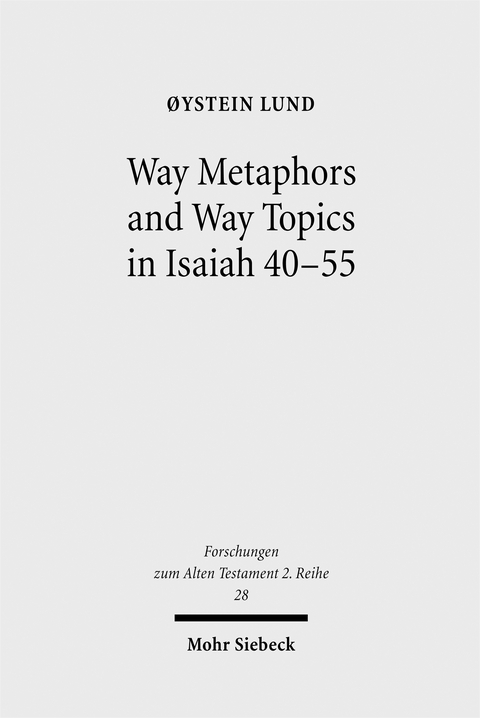
Way Metaphors and Way Topics in Isaiah 40-55
Seiten
Øystein Lund stellt einen neuen Ansatz zur Interpretation der Textstellen in Jesaja 40-55 vor, die sich mit den Themen Weg und Transformation der Wüste befassen. Er zeigt, daß die meisten dieser Textstellen zusammenhängen und metaphorisch gelesen die Weg-Situation des Volkes Israel erläutern.
Øystein Lund gives a new approach to texts in Isaiah 40-55 that deal with ways and desert transformation. Earlier exegesis has mainly read these texts in a literal way. In recent years, exegetes have pointed out that the so-called 'exodus texts' should rather be interpreted metaphorically. The author supports this, and accordingly seeks to continue this discourse by systematizing, intensifying, and deepening the argumentation for a metaphorical reading. He argues that most of the way-texts in Isaiah 40-55 are interrelated, and gradually contribute to explore questions regarding the way-situation of the people. The way-theme appears in the prologue, and in 40:27 a problem approach is established when the people is addressed: "How can you say, O Jacob, and speak, O Israel, 'My way is hidden from the LORD, and my right passes by my God'"? Several subsequent way-texts are related to this text, and together these draw a coherent picture in which the problematic way-situation of the people in the past and present is transformed. JHWH establishes new ways in which he leads his people through their difficult landscape. Øystein Lund argues that such a coherent reading of the way-texts gives good meaning, which is consistent with the over all message of Isaiah 40-55.
Øystein Lund gives a new approach to texts in Isaiah 40-55 that deal with ways and desert transformation. Earlier exegesis has mainly read these texts in a literal way. In recent years, exegetes have pointed out that the so-called 'exodus texts' should rather be interpreted metaphorically. The author supports this, and accordingly seeks to continue this discourse by systematizing, intensifying, and deepening the argumentation for a metaphorical reading. He argues that most of the way-texts in Isaiah 40-55 are interrelated, and gradually contribute to explore questions regarding the way-situation of the people. The way-theme appears in the prologue, and in 40:27 a problem approach is established when the people is addressed: "How can you say, O Jacob, and speak, O Israel, 'My way is hidden from the LORD, and my right passes by my God'"? Several subsequent way-texts are related to this text, and together these draw a coherent picture in which the problematic way-situation of the people in the past and present is transformed. JHWH establishes new ways in which he leads his people through their difficult landscape. Øystein Lund argues that such a coherent reading of the way-texts gives good meaning, which is consistent with the over all message of Isaiah 40-55.
Born 1967; studied Theology at MF Norwegian School of Theology; 2004 Dr. theol.; Director of Research and Studies at MF Norwegian School of Theology.
| Erscheint lt. Verlag | 11.1.2008 |
|---|---|
| Reihe/Serie | Forschungen zum Alten Testament 2. Reihe |
| Verlagsort | Tübingen |
| Sprache | englisch |
| Maße | 155 x 232 mm |
| Gewicht | 525 g |
| Themenwelt | Religion / Theologie ► Christentum ► Bibelausgaben / Bibelkommentare |
| Geisteswissenschaften ► Religion / Theologie ► Judentum | |
| Schlagworte | 40-55 • ALTEN • Altes Testament • HC/Religion/Theologie/Judentum • im • Jesaja • Jesaja 40-55 • Jesaja (Prophet) • Metapher • Metaphern • Metaphern im Alten Testament • Metapher / Sprachbild • metaphors • Testament • Weg (Motiv in der Bibel) |
| ISBN-13 | 9783161490873 / 9783161490873 |
| Zustand | Neuware |
| Informationen gemäß Produktsicherheitsverordnung (GPSR) | |
| Haben Sie eine Frage zum Produkt? |
Mehr entdecken
aus dem Bereich

aus dem Bereich
Buch | Softcover (2021)
De Gruyter (Verlag)
CHF 44,90


