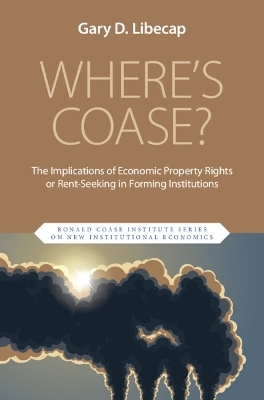
Where's Coase?
Cambridge University Press (Verlag)
978-1-009-40809-7 (ISBN)
- Noch nicht erschienen (ca. März 2026)
- Versandkostenfrei
- Auch auf Rechnung
- Artikel merken
Ronald Coase's Nobel work outlined gains by reducing transaction costs and promoting property rights and markets to confront externalities. Countering market failure assertions and calls for centralized government intervention, Coase retorted that decentralized market negotiations could be welfare-improving by promoting collaborative, efficient problem solving, and releasing resources to the general economy. Despite this, his approach is not central to any US environmental law implemented after 1970. Federal government mandates dominate. Where's Coase? explains why. The private objectives of political agents lead to policies that are likely to be too costly and inequitable, despite provision of public goods. Citizens face high collective action costs and lack information to distinguish between public goods and private agent benefits. Examining three major environmental laws: the Clean Air Act, the Magnuson Stevens Fishery Act, and the Endangered Species Act, the book explores policy development and assesses the resulting costs relative to Coase's framework.
Gary Libecap is Distinguished Professor in the Bren School of Environmental Science and Management and Economics Department at the University of California, Santa Barbara, and Research Associate at the National Bureau of Economic Research. Libecap was Pitt Professor in Economics at the University of Cambridge, 2010–2011 and Erskine Professor at the University of Canterbury (NZ), 2019. He has long worked on the development and impact of property rights institutions, particularly for natural resources: oil and gas, timber, rangeland, minerals, water, and fisheries. He has authored or coauthored 14 books and over 100 peer reviewed articles and chapters. He was awarded the Elinor Ostrom Lifetime Achievement Award in 2022.
1. The implications of economic property rights or rent-seeking in forming institutions; 2. Economic property rights and markets or rent-seeking: arguments in the institutional economics literature; 3. Economic property rights: adoption worldwide and in US environmental and natural resource policy; 4. Rent-seeking in the provision of a public good: The Clean Air Act; 5. Rent-seeking, economic property rights, and Coasean trade: US fisheries regulation; 6. Rent-seeking in protecting at-risk species: The Endangered Species Act; 7. What have we learned from the absence of Coase? Implications for the formation of institutions.
| Erscheint lt. Verlag | 31.3.2026 |
|---|---|
| Reihe/Serie | Ronald Coase Institute Series on New Institutional Economics |
| Zusatzinfo | Worked examples or Exercises |
| Verlagsort | Cambridge |
| Sprache | englisch |
| Gewicht | 500 g |
| Themenwelt | Geschichte ► Teilgebiete der Geschichte ► Wirtschaftsgeschichte |
| Wirtschaft ► Volkswirtschaftslehre ► Makroökonomie | |
| Wirtschaft ► Volkswirtschaftslehre ► Wirtschaftspolitik | |
| ISBN-10 | 1-009-40809-7 / 1009408097 |
| ISBN-13 | 978-1-009-40809-7 / 9781009408097 |
| Zustand | Neuware |
| Informationen gemäß Produktsicherheitsverordnung (GPSR) | |
| Haben Sie eine Frage zum Produkt? |
aus dem Bereich