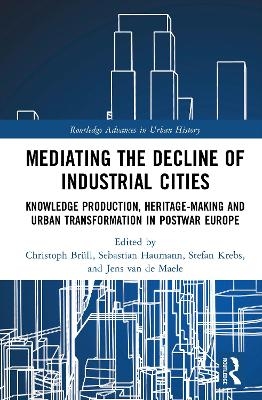
Mediating the Decline of Industrial Cities
Routledge (Verlag)
978-1-032-86728-1 (ISBN)
This volume reflects the latest historiographical discussion about the decline, transformation, heritagisation, and re-invention of industrial cities in Europe during the late 20th century.
It argues that the notion of “mediation” as it has been used in the history of technology helps to shed new light on the processes of understanding changes of industrial cities before, during, and after the economic crisis of the 1970s and 1980s. The contributors investigate how different actor groups, such as scientists, union members, journalists, politicians, artists, and historians, mediated the understanding of decline, the anticipated future, and the heritage of industrial cities. The authors look at a wide range of European cities during different phases of decline and transformation.
The book is aimed at scholars of urban history and industrial history, as well as contemporary European history, the history of technology, and deindustrialisation studies. The contributions also resonate with discussion in neighbouring fields such as urban studies, media studies, cultural studies, sociology, and digital history.
Christoph Brüll is Assistant Professor for Contemporary History at Luxembourg Centre for Contemporary and Digital History (C2DH). His research interests include the history of cross-border cooperation in Western Europe. He is the co-editor of Föderalisierung, Strukturwandel, Erwartungshorizonte [Federalisation, Structural Change, Expectations] (2023). Sebastian Haumann is Professor for Economic, Social, and Environmental History at Paris Lodron University Salzburg. His research interests include the history of raw materials and new methods in the field of Citizen Science. He is the co-editor of Concepts of Urban-Environmental History (2020). Stefan Krebs is Assistant Professor for Contemporary History at Luxembourg Centre for Contemporary and Digital History (C2DH). His research interests include the industrial history of Luxembourg and the history of repair and maintenance. He is the co-editor of The Persistence of Technology (2021) and Deindustrialisierung: Zum sozio-ökonomischen Wandel westeuropäischer Industriegesellschaften seit den 1970er Jahren [Deindustrialization: The Socio-economic Transformation of Western European Industrial Societies Since the 1970s] (forthcoming). Jens van de Maele is a postdoctoral member of the research group Modernity and Society (1800-2000) at KU Leuven. His research interests include architectural history and urban environmental history. He is the author of Architectures of Bureaucracy: The Politics of Government Office Buildings in Interwar Belgium (2025) and editor of Behind Office Doors: Use and Users in the History of Office Buildings (2026).
Introduction: Mediating the Transformation and Decline of Industrial Cities Part 1: Mediating the Understanding of Industrial Decline 1. “It’ll all be over with this place in two years”: Deindustrialisation and the Future of Work and Place on Late-1960s Tyneside 2. Mediating Knowledge in a European (Semi-)Periphery: Youth, Labour and Urban Research in Romania in the 1960s and 1970s 3. Being Unemployed: Deindustrialisation as an Issue in the Periodicals Published by Initiatives for the Unemployed in the Ruhr during the 1980s 4. Photography Mediating Change: The Role of Images During the Decline of Luxembourg’s Industrial South 5. Interpreting, Mediating and Coping with Deindustrialisation: Churches as Urban Actors in Manchester from the Late 1960s to the 1980s Part 2: Mediating Urban Transformations 6. “We Swallow the Dirt”: Popular and Governmental Perceptions of Metallurgical Air Pollution in Luxembourg During the Trente Glorieuses 7. How the Working Class in the Longwy Region Dealt with the Restructuring of the Steel Industry 8. Memory, Heritage and the Post-Steel City: Mediating the Transformation of Sheffield Since 1990 9. The Classic Slum?: Heritage Discourses, Ideologies of Transition and the Remaking of Post-Industrial Salford (1985–2021) Part 3: Mediating Industrial-Heritage 10. Working-Class Memories and Legacies of Deindustrialisation through Cultural Creation in Asturias, Spain 11. The Origins of Memory Construction through Film in the Context of Deindustrialisation in French Lorraine 12. Digital unter Tage – (Data) Mining Life Stories and Social Culture in the Ruhr Area
| Erscheinungsdatum | 03.12.2025 |
|---|---|
| Reihe/Serie | Routledge Advances in Urban History |
| Zusatzinfo | 1 Tables, black and white; 19 Halftones, black and white; 19 Illustrations, black and white |
| Verlagsort | London |
| Sprache | englisch |
| Maße | 156 x 234 mm |
| Gewicht | 730 g |
| Themenwelt | Geschichte ► Allgemeine Geschichte ► Zeitgeschichte |
| Geisteswissenschaften ► Geschichte ► Regional- / Ländergeschichte | |
| Geschichte ► Teilgebiete der Geschichte ► Kulturgeschichte | |
| Geschichte ► Teilgebiete der Geschichte ► Wirtschaftsgeschichte | |
| ISBN-10 | 1-032-86728-0 / 1032867280 |
| ISBN-13 | 978-1-032-86728-1 / 9781032867281 |
| Zustand | Neuware |
| Informationen gemäß Produktsicherheitsverordnung (GPSR) | |
| Haben Sie eine Frage zum Produkt? |
aus dem Bereich