


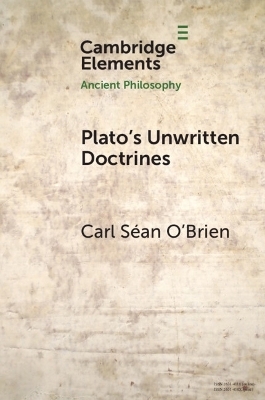
Plato's Unwritten Doctrines
Seiten
2025
Cambridge University Press (Verlag)
978-1-009-50620-5 (ISBN)
Cambridge University Press (Verlag)
978-1-009-50620-5 (ISBN)
This Element examines the arguments advanced by the Tübingen-Milan School in the claim that Plato had unwritten doctrines revealed in Aristotle and other testimonia. The unwritten doctrines are concerned with Plato's theory of principles, the one and the indefinite dyad, which account for unity and multiplicity respectively.
This Element examines the arguments advanced by the Tübingen-Milan School in support of the claim that Plato had Unwritten Doctrines (agrapha dogmata), revealed in Aristotle and other testimonia and indicated – but not explicitly treated – in some of his dialogues. The Unwritten Doctrines are primarily concerned with Plato's Theory of Principles of (the One and the Indefinite Dyad) which accounts for unity and multiplicity respectively. This Element considers two opposing approaches to reading Plato: that of sola scriptura (through the writings alone) or via the tradition. While it may appear counter-intuitive to privilege other sources over Plato's own works, his criticism of writing in the Phaedrus and the 'deliberate gaps', where he teases the reader with the possibility of a fuller response than that provided on the current occasion, firmly indicate the existence of doctrines not committed to his dialogues.
This Element examines the arguments advanced by the Tübingen-Milan School in support of the claim that Plato had Unwritten Doctrines (agrapha dogmata), revealed in Aristotle and other testimonia and indicated – but not explicitly treated – in some of his dialogues. The Unwritten Doctrines are primarily concerned with Plato's Theory of Principles of (the One and the Indefinite Dyad) which accounts for unity and multiplicity respectively. This Element considers two opposing approaches to reading Plato: that of sola scriptura (through the writings alone) or via the tradition. While it may appear counter-intuitive to privilege other sources over Plato's own works, his criticism of writing in the Phaedrus and the 'deliberate gaps', where he teases the reader with the possibility of a fuller response than that provided on the current occasion, firmly indicate the existence of doctrines not committed to his dialogues.
1. What are the unwritten doctrines?; 2. Plato's criticism of writing; 3. Plato's theory of principles and the testimonia; 4. Consequences of the Tübingen school approach for later Platonism; 5. Critics of the unwritten doctrines; 6. Conclusion; List of abbreviations; References.
| Erscheinungsdatum | 08.10.2025 |
|---|---|
| Reihe/Serie | Elements in Ancient Philosophy |
| Zusatzinfo | Worked examples or Exercises |
| Verlagsort | Cambridge |
| Sprache | englisch |
| Gewicht | 130 g |
| Themenwelt | Geisteswissenschaften ► Philosophie ► Metaphysik / Ontologie |
| Geisteswissenschaften ► Philosophie ► Philosophie Altertum / Antike | |
| Geisteswissenschaften ► Religion / Theologie | |
| ISBN-10 | 1-009-50620-X / 100950620X |
| ISBN-13 | 978-1-009-50620-5 / 9781009506205 |
| Zustand | Neuware |
| Informationen gemäß Produktsicherheitsverordnung (GPSR) | |
| Haben Sie eine Frage zum Produkt? |
Mehr entdecken
aus dem Bereich


aus dem Bereich
eine philosophische Reise
Buch | Softcover (2024)
Goldmann (Verlag)
CHF 21,90


